Kostyalik Diána, Vas Szilvia, Kátai Zita, Kitka Tamás, Gyertyán István, Bagdy Gyorgy, Tóthfalusi László
Department of Pharmacodynamics, Semmelweis University, Budapest, Hungary.
MTA-SE, Neuropsychopharmacology and Neurochemistry Research Group, Budapest, Hungary.
BMC Neurosci. 2014 Nov 19;15:120. doi: 10.1186/s12868-014-0120-8.
Shortened rapid eye movement (REM) sleep latency and increased REM sleep amount are presumed biological markers of depression. These sleep alterations are also observable in several animal models of depression as well as during the rebound sleep after selective REM sleep deprivation (RD). Furthermore, REM sleep fragmentation is typically associated with stress procedures and anxiety. The selective serotonin reuptake inhibitor (SSRI) antidepressants reduce REM sleep time and increase REM latency after acute dosing in normal condition and even during REM rebound following RD. However, their therapeutic outcome evolves only after weeks of treatment, and the effects of chronic treatment in REM-deprived animals have not been studied yet.
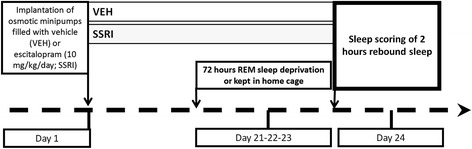
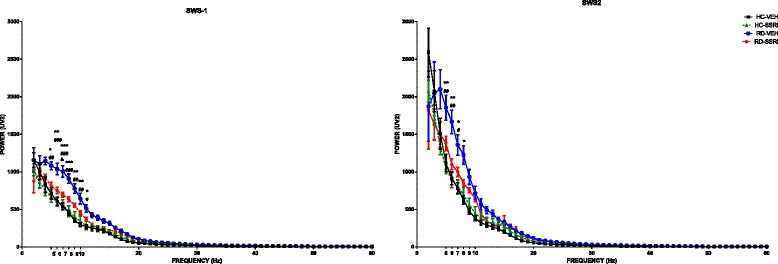
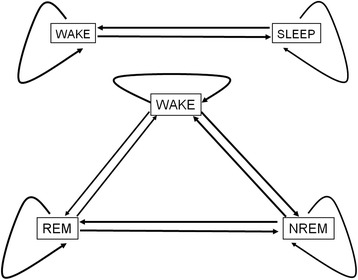
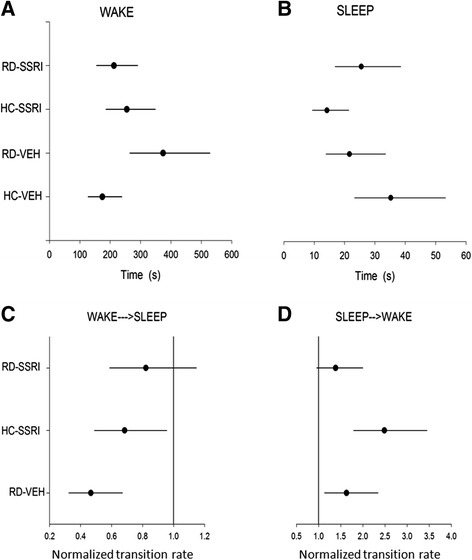
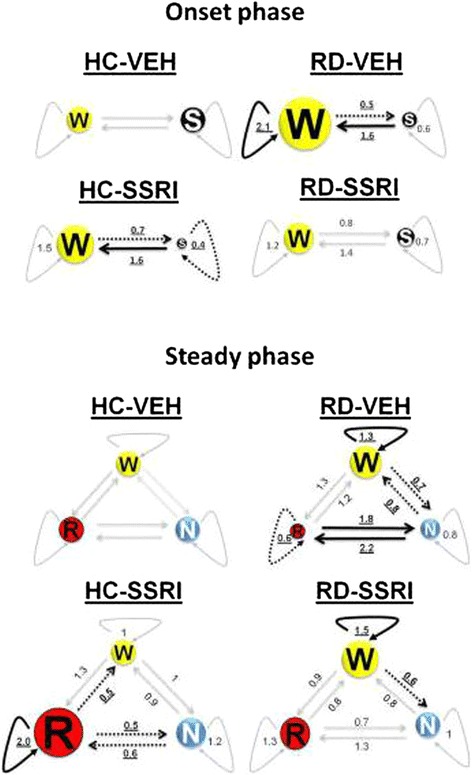
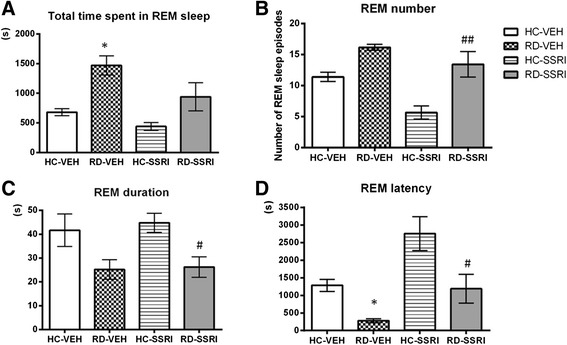
Chronic escitalopram- (10 mg/kg/day, osmotic minipump for 24 days) or vehicle-treated rats were subjected to a 3-day-long RD on day 21 using the flower pot procedure or kept in home cage. On day 24, fronto-parietal electroencephalogram, electromyogram and motility were recorded in the first 2 h of the passive phase. The observed sleep patterns were characterized applying standard sleep metrics, by modelling the transitions between sleep phases using Markov chains and by spectral analysis. Based on Markov chain analysis, chronic escitalopram treatment attenuated the REM sleep fragmentation [accelerated transition rates between REM and non-REM (NREM) stages, decreased REM sleep residence time between two transitions] during the rebound sleep. Additionally, the antidepressant avoided the frequent awakenings during the first 30 min of recovery period. The spectral analysis showed that the SSRI prevented the RD-caused elevation in theta (5-9 Hz) power during slow-wave sleep. Conversely, based on the aggregate sleep metrics, escitalopram had only moderate effects and it did not significantly attenuate the REM rebound after RD.
In conclusion, chronic SSRI treatment is capable of reducing several effects on sleep which might be the consequence of the sub-chronic stress caused by the flower pot method. These data might support the antidepressant activity of SSRIs, and may allude that investigating the rebound period following the flower pot protocol could be useful to detect antidepressant drug response. Markov analysis is a suitable method to study the sleep pattern.
快速眼动(REM)睡眠潜伏期缩短和REM睡眠量增加被认为是抑郁症的生物学标志。这些睡眠改变在几种抑郁症动物模型以及选择性REM睡眠剥夺(RD)后的反弹睡眠期间也可观察到。此外,REM睡眠片段化通常与应激程序和焦虑有关。选择性5-羟色胺再摄取抑制剂(SSRI)类抗抑郁药在正常情况下急性给药后甚至在RD后的REM反弹期间都会减少REM睡眠时间并增加REM潜伏期。然而,它们的治疗效果仅在数周治疗后才会显现,并且尚未研究过在REM剥夺动物中进行慢性治疗的效果。
慢性艾司西酞普兰(10毫克/千克/天,使用渗透微型泵给药24天)或赋形剂处理的大鼠在第21天使用花盆法进行为期3天的RD,或置于饲养笼中。在第24天,在被动期的前2小时记录额顶叶脑电图、肌电图和活动情况。通过应用标准睡眠指标、使用马尔可夫链对睡眠阶段之间的转换进行建模以及频谱分析来表征观察到的睡眠模式。基于马尔可夫链分析,慢性艾司西酞普兰治疗减轻了反弹睡眠期间的REM睡眠片段化[加速了REM和非快速眼动(NREM)阶段之间的转换速率,减少了两次转换之间的REM睡眠停留时间]。此外,抗抑郁药避免了恢复期前30分钟内的频繁觉醒。频谱分析表明,SSRI可防止RD导致的慢波睡眠期间θ波(5-9赫兹)功率升高。相反,基于总体睡眠指标,艾司西酞普兰只有中等效果,并且并未显著减轻RD后的REM反弹。
总之,慢性SSRI治疗能够减少对睡眠的多种影响,这些影响可能是花盆法引起的亚慢性应激的结果。这些数据可能支持SSRI的抗抑郁活性,并且可能暗示研究花盆方案后的反弹期对于检测抗抑郁药物反应可能是有用的。马尔可夫分析是研究睡眠模式的一种合适方法。