Serrano-Ferrer Juan, Walther Guillaume, Crendal Edward, Vinet Agnès, Dutheil Frédéric, Naughton Geraldine, Lesourd Bruno, Chapier Robert, Courteix Daniel, Obert Philippe
Cardiovasc Diabetol. 2014 Aug 3;13:116. doi: 10.1186/s12933-014-0116-9.
Growing evidence demonstrates subtle left ventricular myocardial dysfunction in patients with metabolic syndrome (MetS), with central obesity, glucose intolerance and inflammation emerging as important contributors. Whether these results can be translated to the right ventricle (RV) is not yet fully elucidated. Furthermore, although lifestyle intervention favorably impacts MetS components and inflammatory biomarkers, its effect on RV myocardial function remains unknown today.
Thirty-nine MetS adults free of diabetes were enrolled in a three month lifestyle intervention program including diet and physical exercise, and compared with forty healthy controls. Blood biochemistry, echocardiography including tissue Doppler imaging (TDI), and vector velocity imaging of the RV free wall to assess global longitudinal strain (GLS) and strain rates (SR) were obtained at baseline and after the intervention.
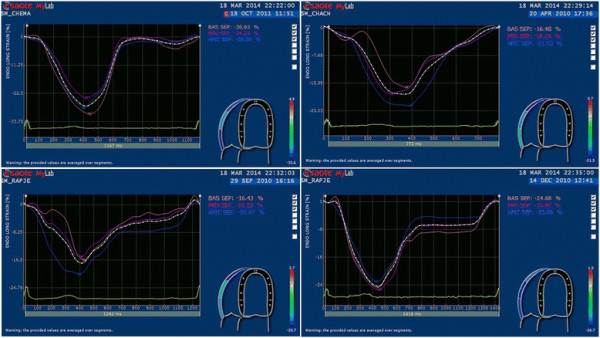
Compared with controls, MetS patients presented similar right atrial and RV morphology but reduced systolic (P = 0.04) and early diastolic (P = 0.02) velocities of the tricuspid annulus. They showed attenuated RV GLS (-21.4 ± 4.5 vs -25.7 ± 4.9%, P < 0.001) as well as early diastolic (P = 0.003) and systolic (P < 0.001) SR. Multiple regression analyses revealed log PAI-1 active, (P < 0.001), log adiponectin, (P = 0.01), LV mass indexed (P = 0.004) and central fat (P = 0.03) as independent predictors of RV GLS (R2 = 0.46, P < 0.001). Biological markers of MetS and inflammation as well as RV GLS (-21.8 ± 3.8 vs -24.3 ± 3.0%, P = 0.009) and systolic (P = 0.003) and early diastolic (P = 0.01) SR, but not TDI indexes, significantly improved after diet and exercise training, and vector velocity imaging data in MetS following the lifestyle intervention no longer differed from controls.
MetS is associated with subtle impairments in both RV free wall diastolic and systolic myocardial function which could be partly related to central-obesity induced changes in pro- and anti-inflammatory cytokines and left ventricular remodeling. The favorable impact of healthy dieting and physical activity on RV free wall mechanics indicates that cellular and sub-cellular alterations responsible for the RV myocardial abnormalities are probably not permanent and modifiable throughout adequate interventional strategies.
American National Institutes of Health database NCT00917917.
越来越多的证据表明,代谢综合征(MetS)患者存在轻微的左心室心肌功能障碍,中心性肥胖、葡萄糖不耐受和炎症是重要的促成因素。这些结果是否能推广到右心室(RV)尚未完全阐明。此外,尽管生活方式干预对代谢综合征的组成部分和炎症生物标志物有积极影响,但其对右心室心肌功能的影响目前仍不清楚。
39名无糖尿病的代谢综合征成年人参加了为期三个月的生活方式干预计划,包括饮食和体育锻炼,并与40名健康对照者进行比较。在基线和干预后获取血液生化指标、超声心动图(包括组织多普勒成像(TDI))以及右心室游离壁的向量速度成像,以评估整体纵向应变(GLS)和应变率(SR)。
与对照组相比,代谢综合征患者的右心房和右心室形态相似,但三尖瓣环的收缩期(P = 0.04)和舒张早期(P = 0.02)速度降低。他们的右心室GLS减弱(-21.4±4.5% 对 -25.7±4.9%,P < 0.001),舒张早期(P = 0.003)和收缩期(P < 0.001)SR也降低。多元回归分析显示,log PAI-1活性(P < 0.001)、log脂联素(P = 0.01)、左心室质量指数(P = 0.004)和中心脂肪(P = 0.03)是右心室GLS的独立预测因素(R2 = 0.46,P < 0.001)。代谢综合征和炎症的生物标志物以及右心室GLS(-21.8±3.8% 对 -24.3±3.0%,P = 0.009)、收缩期(P = 0.003)和舒张早期(P = 0.01)SR在饮食和运动训练后显著改善,但TDI指标未改善,生活方式干预后的代谢综合征患者的向量速度成像数据与对照组不再有差异。
代谢综合征与右心室游离壁舒张期和收缩期心肌功能的轻微损害有关,这可能部分与中心性肥胖引起的促炎和抗炎细胞因子变化以及左心室重构有关。健康饮食和体育活动对右心室游离壁力学的有利影响表明,导致右心室心肌异常的细胞和亚细胞改变可能不是永久性的,并且可以通过适当的干预策略进行改善。
美国国立卫生研究院数据库NCT00917917