Salloum Alison, Scheeringa Michael S, Cohen Judith A, Storch Eric A
University of South Florida, Tampa.
Tulane University.
Cogn Behav Pract. 2014 Feb 1;21(1):97-108. doi: 10.1016/j.cbpra.2013.07.004.
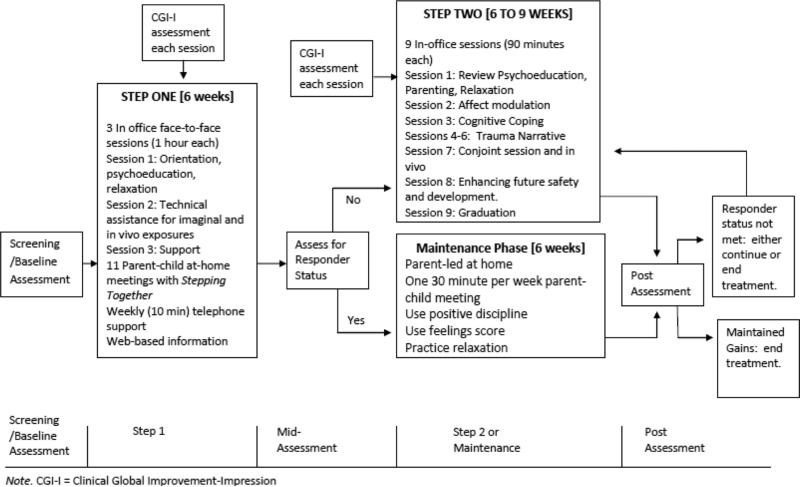
Young children who are exposed to traumatic events are at risk for developing posttraumatic stress disorder (PTSD). While effective psychosocial treatments for childhood PTSD exist, novel interventions that are more accessible, efficient, and cost-effective are needed to improve access to evidence-based treatment. Stepped care models currently being developed for mental health conditions are based on a service delivery model designed to address barriers to treatment. This treatment development article describes how trauma-focused cognitive-behavioral therapy (TF-CBT), a well-established evidence-based practice, was developed into a stepped care model for young children exposed to trauma. Considerations for developing the stepped care model for young children exposed to trauma, such as the type and number of steps, training of providers, entry point, inclusion of parents, treatment components, noncompliance, and a self-correcting monitoring system, are discussed. This model of stepped care for young children exposed to trauma, called Stepped Care TF-CBT, may serve as a model for developing and testing stepped care approaches to treating other types of childhood psychiatric disorders. Future research needed on Stepped Care TF-CBT is discussed.
遭受创伤性事件的幼儿有患创伤后应激障碍(PTSD)的风险。虽然存在针对儿童PTSD的有效心理社会治疗方法,但仍需要更易获得、高效且具成本效益的新型干预措施,以改善基于证据的治疗的可及性。目前正在为心理健康状况开发的分级护理模式基于一种旨在解决治疗障碍的服务提供模式。这篇治疗发展文章描述了创伤聚焦认知行为疗法(TF-CBT),一种成熟的循证实践,是如何发展成为针对遭受创伤的幼儿的分级护理模式的。文中讨论了为遭受创伤的幼儿开发分级护理模式时的考量因素,如步骤的类型和数量、提供者培训、切入点、家长的纳入、治疗组成部分、不依从情况以及自我纠正监测系统。这种针对遭受创伤的幼儿的分级护理模式,即分级护理TF-CBT,可作为开发和测试治疗其他类型儿童精神障碍的分级护理方法的模式。文中还讨论了未来对分级护理TF-CBT所需进行的研究。