Salloum Alison, Swaidan Victoria R, Torres Angela Claudio, Murphy Tanya K, Storch Eric A
School of Social Work, Department of Pediatrics, University of South Florida, 13301 Bruce B. Downs Blvd., MHC1400, Tampa, FL 33612-3870, USA.
Crisis Center of Tampa Bay, One Crisis Center Plaza, Tampa, FL 33613, USA.
J Child Fam Stud. 2016 Jan;25(1):262-274. doi: 10.1007/s10826-015-0207-6. Epub 2015 Jun 16.
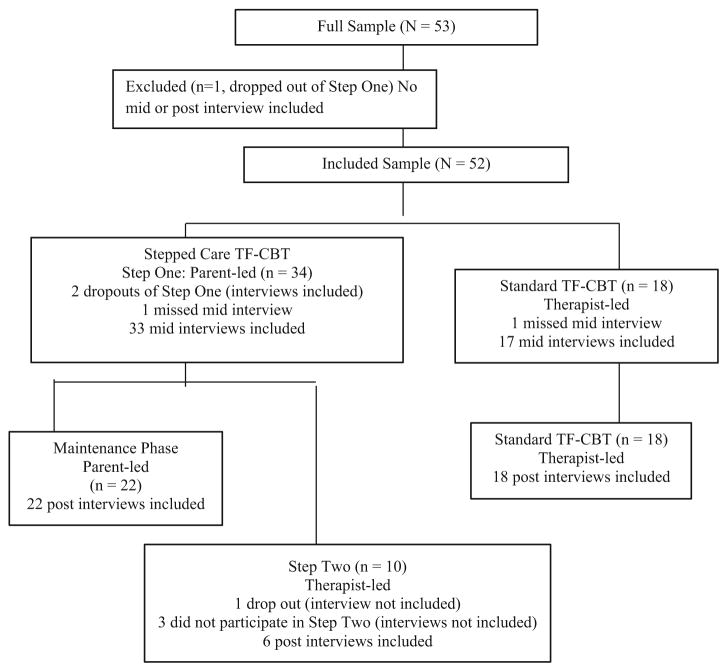
Delivery systems other than in-office therapist-led treatments are needed to address treatment barriers such as accessibility, efficiency, costs, and parents wanting an active role in helping their child. To address these barriers, stepped care trauma focused-cognitive behavioral therapy (SC-TF-CBT) was developed as a parent-led, therapist-assisted therapy that occurs primarily at-home so that fewer in-office sessions are required. The current study examines caregivers' perceptions of parent-led (SC-TF-CBT) and therapist-led (TF-CBT) treatment. Participants consisted of 52 parents/care-givers (25-68 years) of young trauma-exposed children (3-7 years) who were randomly assigned to SC-TF-CBT (n = 34) or to TF-CBT (n = 18). Data were collected at mid-and post-treatment via interviews inquiring about what participants liked, disliked, found most helpful, and found least helpful about the treatment. Results indicated that parents/caregivers favored relaxation skills, affect modulation and expression skills, the trauma narrative, and parenting skills across both conditions. The majority of parents/caregivers in SC-TF-CBT favored the at-home parent-child meetings and the workbook that guides the parent-led treatment, and there were suggestions for improving the workbook. Reported disliked and least helpful aspects of treatments were minimal across conditions, but themes that emerged that will need further exploration included the content and structure, and implementation difficulties for both conditions. Collectively, these results highlight the positive impact that a parent-led, therapist-assisted treatment could have in terms of providing caregivers with more tools to help their child after trauma and reduce barriers to treatment.
除了由办公室治疗师主导的治疗之外,还需要其他的治疗系统来解决诸如可及性、效率、成本以及父母希望积极参与帮助孩子等治疗障碍。为了解决这些障碍,逐步护理创伤聚焦认知行为疗法(SC-TF-CBT)被开发出来,这是一种由父母主导、治疗师辅助的疗法,主要在家中进行,这样就需要较少的办公室治疗疗程。当前的研究考察了照顾者对父母主导(SC-TF-CBT)和治疗师主导(TF-CBT)治疗的看法。参与者包括52名年轻创伤暴露儿童(3至7岁)的父母/照顾者(25至68岁),他们被随机分配到SC-TF-CBT组(n = 34)或TF-CBT组(n = 18)。在治疗中期和后期通过访谈收集数据,询问参与者对治疗的喜欢之处、不喜欢之处、最有帮助之处和最没有帮助之处。结果表明,父母/照顾者在两种治疗方式中都喜欢放松技巧、情感调节和表达技巧、创伤叙述以及育儿技巧。SC-TF-CBT组的大多数父母/照顾者喜欢在家中进行的亲子会议以及指导父母主导治疗的工作手册,并且有人提出了改进工作手册的建议。在两种治疗方式中,报告的不喜欢和最没有帮助的方面都很少,但出现的需要进一步探索的主题包括内容和结构,以及两种治疗方式的实施困难。总体而言,这些结果凸显了一种由父母主导、治疗师辅助的治疗方式在为照顾者提供更多帮助孩子应对创伤的工具以及减少治疗障碍方面可能产生的积极影响。