
具有自发攀爬纤维放电的小脑双半球神经网络模型在机器人控制过程中产生不对称运动学习。
A bi-hemispheric neuronal network model of the cerebellum with spontaneous climbing fiber firing produces asymmetrical motor learning during robot control.
作者信息
Pinzon-Morales Ruben-Dario, Hirata Yutaka
机构信息
Neural Cybernetics Laboratory, Department of Computer Science, Chubu University Kasugai, Japan.
Neural Cybernetics Laboratory, Department of Computer Science, Chubu University Kasugai, Japan ; Department of Robotic Science and Technology, Chubu University Kasugai, Japan.
出版信息
Front Neural Circuits. 2014 Nov 5;8:131. doi: 10.3389/fncir.2014.00131. eCollection 2014.
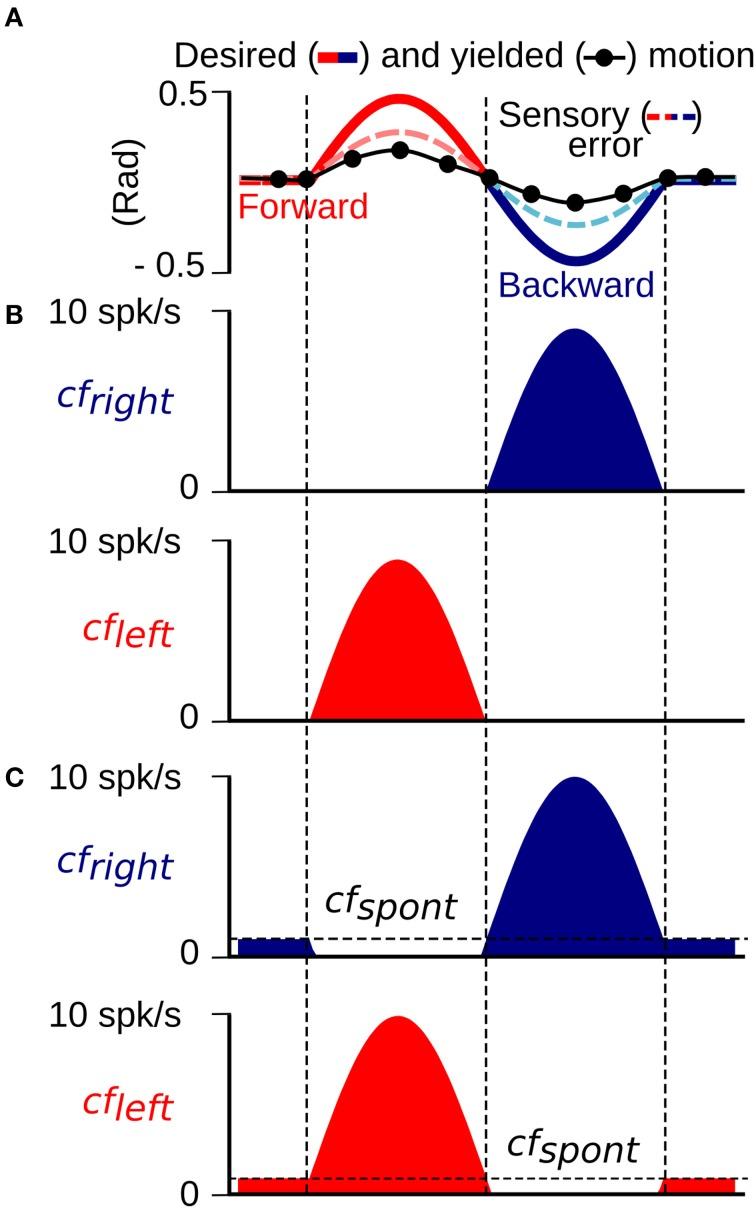
To acquire and maintain precise movement controls over a lifespan, changes in the physical and physiological characteristics of muscles must be compensated for adaptively. The cerebellum plays a crucial role in such adaptation. Changes in muscle characteristics are not always symmetrical. For example, it is unlikely that muscles that bend and straighten a joint will change to the same degree. Thus, different (i.e., asymmetrical) adaptation is required for bending and straightening motions. To date, little is known about the role of the cerebellum in asymmetrical adaptation. Here, we investigate the cerebellar mechanisms required for asymmetrical adaptation using a bi-hemispheric cerebellar neuronal network model (biCNN). The bi-hemispheric structure is inspired by the observation that lesioning one hemisphere reduces motor performance asymmetrically. The biCNN model was constructed to run in real-time and used to control an unstable two-wheeled balancing robot. The load of the robot and its environment were modified to create asymmetrical perturbations. Plasticity at parallel fiber-Purkinje cell synapses in the biCNN model was driven by error signal in the climbing fiber (cf) input. This cf input was configured to increase and decrease its firing rate from its spontaneous firing rate (approximately 1 Hz) with sensory errors in the preferred and non-preferred direction of each hemisphere, as demonstrated in the monkey cerebellum. Our results showed that asymmetrical conditions were successfully handled by the biCNN model, in contrast to a single hemisphere model or a classical non-adaptive proportional and derivative controller. Further, the spontaneous activity of the cf, while relatively small, was critical for balancing the contribution of each cerebellar hemisphere to the overall motor command sent to the robot. Eliminating the spontaneous activity compromised the asymmetrical learning capabilities of the biCNN model. Thus, we conclude that a bi-hemispheric structure and adequate spontaneous activity of cf inputs are critical for cerebellar asymmetrical motor learning.
为了在整个生命周期中获得并维持精确的运动控制,必须对肌肉的物理和生理特性变化进行适应性补偿。小脑在这种适应性过程中起着关键作用。肌肉特性的变化并不总是对称的。例如,使关节弯曲和伸直的肌肉不太可能以相同程度发生变化。因此,弯曲和伸直运动需要不同的(即不对称的)适应性。迄今为止,关于小脑在不对称适应性中的作用知之甚少。在这里,我们使用双半球小脑神经网络模型(biCNN)研究不对称适应性所需的小脑机制。双半球结构的灵感来自于这样的观察结果:损伤一个半球会不对称地降低运动表现。构建biCNN模型以实时运行,并用于控制一个不稳定的两轮平衡机器人。改变机器人及其环境的负载以产生不对称扰动。biCNN模型中平行纤维 - 浦肯野细胞突触的可塑性由攀爬纤维(cf)输入中的误差信号驱动。如在猴子小脑中所证明的那样,该cf输入被配置为根据每个半球的偏好和非偏好方向上的感觉误差,从其自发放电率(约1赫兹)增加或降低其放电率。我们的结果表明,与单半球模型或经典的非自适应比例和微分控制器相比,biCNN模型成功地处理了不对称情况。此外,cf的自发活动虽然相对较小,但对于平衡每个小脑半球对发送给机器人的总体运动指令的贡献至关重要。消除自发活动会损害biCNN模型的不对称学习能力。因此,我们得出结论,双半球结构和cf输入的适当自发活动对于小脑不对称运动学习至关重要。




 Zotero 插件