Dowall Stuart D, Matthews David A, Garcia-Dorival Isabel, Taylor Irene, Kenny John, Hertz-Fowler Christiane, Hall Neil, Corbin-Lickfett Kara, Empig Cyril, Schlunegger Kyle, Barr John N, Carroll Miles W, Hewson Roger, Hiscox Julian A
Genome Biol. 2014;15(11):540. doi: 10.1186/PREACCEPT-1724277741482641.
Ebolaviruses causes a severe and often fatal hemorrhagic fever in humans, with some species such as Ebola virus having case fatality rates approaching 90%. Currently the worst Ebola virus outbreak since the disease was discovered is occurring in West Africa. Although thought to be a zoonotic infection, a concern is that with increasing numbers of humans being infected, Ebola virus variants could be selected which are better adapted for human-to-human transmission.
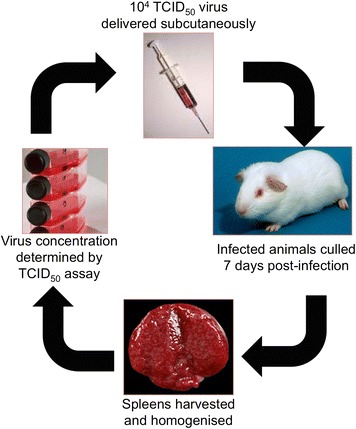
To investigate whether genetic changes in Ebola virus become established in response to adaptation in a different host, a guinea pig model of infection was used. In this experimental system, guinea pigs were infected with Ebola virus (EBOV), which initially did not cause disease. To simulate transmission to uninfected individuals, the virus was serially passaged five times in naive animals. As the virus was passaged, virulence increased and clinical effects were observed in the guinea pig. An RNAseq and consensus mapping approach was then used to evaluate potential nucleotide changes in the Ebola virus genome at each passage.
Upon passage in the guinea pig model, EBOV become more virulent, RNA editing and also coding changes in key proteins become established. The data suggest that the initial evolutionary trajectory of EBOV in a new host can lead to a gain in virulence. Given the circumstances of the sustained transmission of EBOV in the current outbreak in West Africa, increases in virulence may be associated with prolonged and uncontrolled epidemics of EBOV.
埃博拉病毒可导致人类严重且往往致命的出血热,一些种类如埃博拉病毒的病死率接近90%。目前,自该疾病被发现以来最严重的埃博拉病毒疫情正在西非发生。尽管被认为是一种人畜共患感染,但令人担忧的是,随着感染人类数量的增加,可能会选择出更适合人际传播的埃博拉病毒变种。
为了研究埃博拉病毒的基因变化是否会因在不同宿主中的适应性而确立,使用了豚鼠感染模型。在这个实验系统中,豚鼠感染了最初不会引发疾病的埃博拉病毒(EBOV)。为了模拟向未感染个体的传播,该病毒在未接触过该病毒的动物中连续传代五次。随着病毒的传代,毒力增强,在豚鼠身上观察到了临床症状。然后采用RNA测序和一致性图谱分析方法来评估每次传代时埃博拉病毒基因组中潜在的核苷酸变化。
在豚鼠模型中传代后,埃博拉病毒变得更具毒力,RNA编辑以及关键蛋白的编码变化得以确立。数据表明,埃博拉病毒在新宿主中的初始进化轨迹可能导致毒力增加。鉴于当前西非疫情中埃博拉病毒持续传播的情况,毒力增加可能与埃博拉病毒长期且不受控制的流行有关。