Division of epidemiology, Norwegian Institute of Public Health, P,O, Box 4404 Nydalen, NO-0403 Oslo, Norway.
BMC Public Health. 2014 Nov 24;14:1208. doi: 10.1186/1471-2458-14-1208.
Educational inequalities in total mortality in Norway have widened during 1960-2000. We wanted to investigate if inequalities have continued to increase in the post millennium decade, and which causes of deaths were the main drivers.
All deaths (total and cause specific) in the adult Norwegian population aged 45-74 years over five decades, until 2010 were included; in all 708,449 deaths and over 62 million person years. Two indices of inequalities were used to measure inequality and changes in inequalities over time, on the relative scale (Relative Index of Inequality, RII) and on the absolute scale (Slope Index of Inequality, SII).
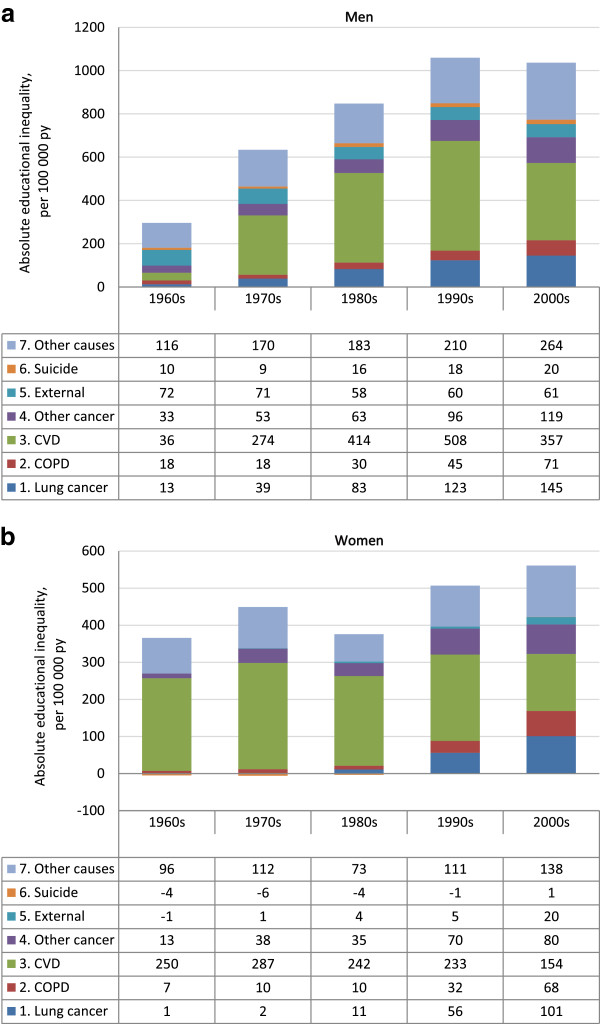
Relative inequalities in total mortality increased over the five decades in both genders. Among men absolute inequalities stabilized during 2000-2010, after steady, significant increases each decade back to the 1960s, while in women, absolute inequalities continued to increase significantly during the last decade. The stabilization in absolute inequalities among men in the last decade was mostly due to a fall in inequalities in cardiovascular disease (CVD) mortality and lung cancer and respiratory disease mortality. Still, in this last decade, the absolute inequalities in cause-specific mortality among men were mostly due to cardiovascular diseases (CVD) (34% of total mortality inequality), lung cancer and respiratory diseases (21%). Among women the absolute inequalities in mortality were mostly due to lung cancer and chronic lower respiratory tract diseases (30%) and CVD (27%).
In men, absolute inequalities in mortality have stopped increasing, seemingly due to reduction in inequalities in CVD mortality. Absolute inequality in mortality continues to widen among women, mostly due to death from lung cancer and chronic lung disease. Relative educational inequalities in mortality are still on the rise for Norwegian men and women.
1960 年至 2000 年间,挪威总死亡率的教育不平等现象有所扩大。我们想调查一下,在新千年的十年中,这种不平等是否继续加剧,以及哪些死因是主要驱动因素。
我们纳入了 50 年来所有年龄段在 45-74 岁的挪威成年人(总计 708449 例死亡和超过 6200 万的人年)的所有死亡(总死亡和死因特异性死亡)。使用两个不平等指数来衡量相对(相对不平等指数,RII)和绝对(不平等斜率指数,SII)尺度上的不平等及其随时间的变化:相对不平等指数(Relative Index of Inequality,RII)和不平等斜率指数(Slope Index of Inequality,SII)。
在两性中,总死亡率的相对不平等在这 50 年中不断增加。在男性中,绝对不平等在 2000 年至 2010 年期间稳定下来,在此之前,从 20 世纪 60 年代开始,每十年都在稳步显著增加,而在女性中,过去十年中绝对不平等仍在显著增加。在过去的十年中,男性绝对不平等的稳定主要是由于心血管疾病(CVD)死亡率和肺癌及呼吸道疾病死亡率的下降。尽管如此,在过去的十年中,男性特定原因死亡率的绝对不平等主要归因于心血管疾病(CVD)(占总死亡率不平等的 34%)、肺癌和呼吸道疾病(21%)。在女性中,死亡率的绝对不平等主要归因于肺癌和慢性下呼吸道疾病(30%)和 CVD(27%)。
在男性中,死亡率的绝对不平等已停止增加,这似乎是由于 CVD 死亡率的不平等程度降低所致。女性的死亡率绝对不平等仍在扩大,主要是由于肺癌和慢性肺部疾病导致的死亡。挪威男性和女性的相对教育死亡率不平等仍在上升。