Blaggana Vikram, Gill Amarjit Singh, Blaggana Anshu
Department of Periodontology and Oral Implantology, Krishna Dental College, Ghaziabad, Uttar Pradesh, India.
Department of Periodontology, Genesis Institute of Dental Sciences and Research, Ferozepur, Punjab, India.
J Indian Soc Periodontol. 2014 Sep;18(5):601-7. doi: 10.4103/0972-124X.142454.
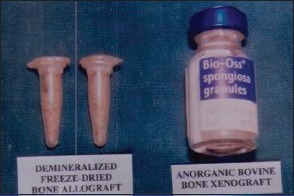
The ultimate goal of periodontal therapy entails regeneration of the periodontal tissues lost as a consequence of periodontitis. Predictable correction of vertical osseous defects has however posed as a constant therapeutic challenge. The aim of our present study is to evaluate the relative efficacy of demineralized freeze-dried bone allograft (DFDBA) vs anorganic bovine bone xenograft (ABBX) in the treatment of human infrabony periodontal defects.
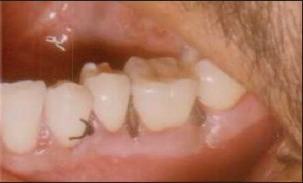
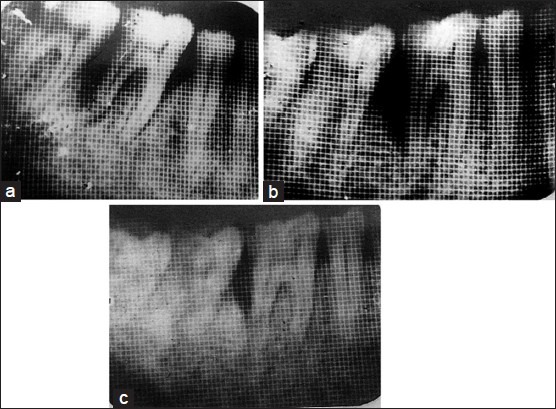
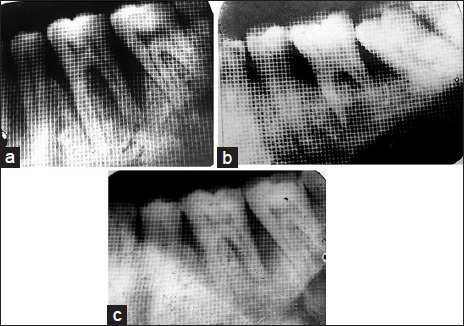
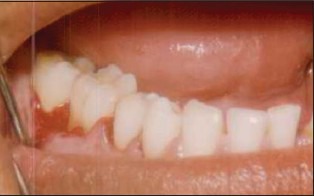
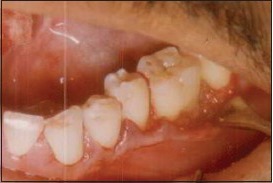
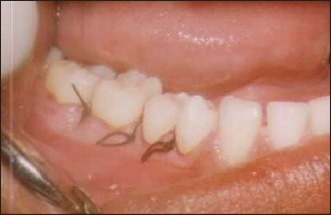
15 patients with 30 bilaterally symmetrical defect sites in either of the arches, in the age group of 25-50 years were selected as part of split-mouth study design. Defect-A (right side) was grafted with DFDBA while Defect-B (left side) was grafted with ABBX. Various clinical and radiographic parameters viz. probing depth(PD), clinical attachment level(CAL) and linear bone fill were recorded preoperatively, 12- & 24-weeks postoperatively.
Both defect-A & defect-B sites exhibited a highly significant reduction in probing depth, and gain in clinical attachment level and linear bone fill at 12-weeks & at the end of 24-weeks. Comparative evaluation between the study groups revealed a statistically non-significant reduction in probing depth (P<0.1) and mean gain in linear bone fill (P<0.1). However, there was a statistically significant gain in clinical attachment level (P<0.05) in Defect-A (CD=0.356) as compared to Defect-B (CD=0.346).
Within the limits of this study, both the materials viz. ABBX and DFDBA are beneficial for the treatment of periodontal infrabony defects. Both the materials were found to be equally effective in all respects except the gain in attachment level, which was found to be more with DFDBA. Long-term studies are suggested to evaluate further the relative efficacy of the two grafts.
牙周治疗的最终目标是使因牙周炎而丧失的牙周组织再生。然而,可预测地矫正垂直骨缺损一直是一项持续的治疗挑战。我们当前研究的目的是评估脱矿冻干骨同种异体移植物(DFDBA)与无机牛骨异种移植物(ABBX)在治疗人类骨下袋牙周缺损中的相对疗效。
选择15名年龄在25至50岁之间、牙弓两侧有30个双侧对称缺损部位的患者作为分口研究设计的一部分。缺损A(右侧)用DFDBA移植,缺损B(左侧)用ABBX移植。术前、术后12周和24周记录各种临床和影像学参数,即探诊深度(PD)、临床附着水平(CAL)和线性骨填充。
缺损A和缺损B部位在术后12周和24周结束时,探诊深度均显著降低,临床附着水平和线性骨填充均有增加。研究组之间的比较评估显示,探诊深度的降低(P<0.1)和线性骨填充的平均增加(P<0.1)在统计学上无显著差异。然而,与缺损B(CD = 0.346)相比,缺损A(CD = 0.356)的临床附着水平有统计学显著增加(P<0.05)。
在本研究的范围内,两种材料,即ABBX和DFDBA,均有益于治疗牙周骨下袋缺损。发现两种材料在所有方面均同样有效,除了附着水平的增加,发现DFDBA的附着水平增加更多。建议进行长期研究以进一步评估两种移植物的相对疗效。