Tamura Jun, Ishizuka Tomohito, Fukui Sho, Oyama Norihiko, Kawase Kodai, Miyoshi Kenjiro, Sano Tadashi, Pasloske Kirby, Yamashita Kazuto
Department of Small Animal Clinical Sciences, School of Veterinary Medicine, Rakuno Gakuen University, Ebetsu, Hokkaido 069-8501, Japan.
J Vet Med Sci. 2015 Mar;77(3):289-96. doi: 10.1292/jvms.14-0368. Epub 2014 Nov 27.
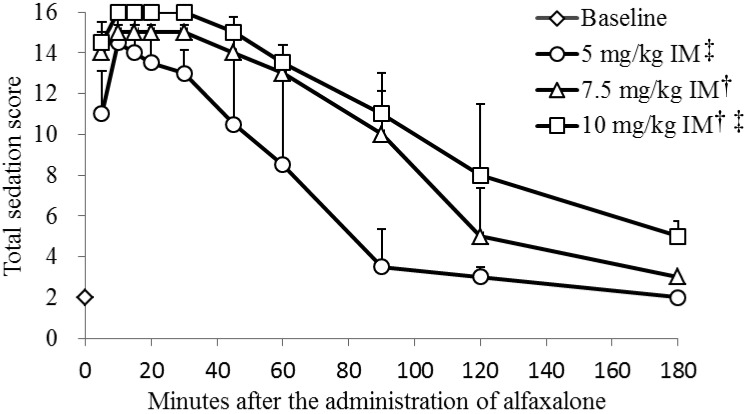
The pharmacological effects of the anesthetic alfaxalone were evaluated after intramuscular (IM) administration to 6 healthy beagle dogs. The dogs received three IM doses each of alfaxalone at increasing dose rates of 5 mg/kg (IM5), 7.5 mg/kg (IM7.5) and 10 mg/kg (IM10) every other day. Anesthetic effect was subjectively evaluated by using an ordinal scoring system to determine the degree of neuro-depression and the quality of anesthetic induction and recovery from anesthesia. Cardiorespiratory variables were measured using noninvasive methods. Alfaxalone administered IM produced dose-dependent neuro-depression and lateral recumbency (i.e., 36 ± 28 min, 87 ± 26 min and 115 ± 29 min after the IM5, IM7.5 and IM10 treatments, respectively). The endotracheal tube was tolerated in all dogs for 46 ± 20 and 58 ± 21 min after the IM7.5 and IM10 treatments, respectively. It was not possible to place endotracheal tubes in 5 of the 6 dogs after the IM5 treatment. Most cardiorespiratory variables remained within clinically acceptable ranges, but hypoxemia was observed by pulse oximetry for 5 to 10 min in 2 dogs receiving the IM10 treatment. Dose-dependent decreases in rectal temperature, respiratory rate and arterial blood pressure also occurred. The quality of recovery was considered satisfactory in all dogs receiving each treatment; all the dog exhibited transient muscular tremors and staggering gait. In conclusion, IM alfaxalone produced a dose-dependent anesthetic effect with relatively mild cardiorespiratory depression in dogs. However, hypoxemia may occur at higher IM doses of alfaxalone.
对6只健康的比格犬进行肌肉注射(IM)麻醉剂阿法沙龙后,评估其药理作用。这些犬每隔一天接受三次阿法沙龙的肌肉注射,剂量率逐渐增加,分别为5mg/kg(IM5)、7.5mg/kg(IM7.5)和10mg/kg(IM10)。通过使用序数评分系统主观评估麻醉效果,以确定神经抑制程度以及麻醉诱导和从麻醉中恢复的质量。使用非侵入性方法测量心肺变量。肌肉注射阿法沙龙产生剂量依赖性神经抑制和侧卧(即分别在IM5、IM7.5和IM10治疗后36±28分钟、87±26分钟和115±29分钟)。在IM7.5和IM10治疗后,所有犬分别耐受气管插管46±20分钟和58±21分钟。在IM5治疗后,6只犬中有5只无法插入气管插管。大多数心肺变量仍在临床可接受范围内,但在接受IM10治疗的2只犬中,通过脉搏血氧饱和度仪观察到低氧血症持续5至10分钟。直肠温度、呼吸频率和动脉血压也出现剂量依赖性下降。接受每种治疗的所有犬的恢复质量被认为是令人满意的;所有犬均表现出短暂的肌肉震颤和蹒跚步态。总之,肌肉注射阿法沙龙在犬中产生剂量依赖性麻醉效果,伴有相对较轻的心肺抑制。然而,在较高的肌肉注射剂量下可能会出现低氧血症。