Shibata Tomoyuki, Wilson James L, Watson Lindsey M, LeDuc Alyse, Meng Can, La Ane Ruslan, Manyullei Syamsuar, Maidin Alimin
Public Health Program, Northern Illinois University, DeKalb, IL 60115, USA.
Institute of the Study for Environment, Sustainability, and Energy, Northern Illinois University, DeKalb, IL 60115, USA.
Int J Environ Res Public Health. 2014 Nov 25;11(12):12190-203. doi: 10.3390/ijerph111212190.
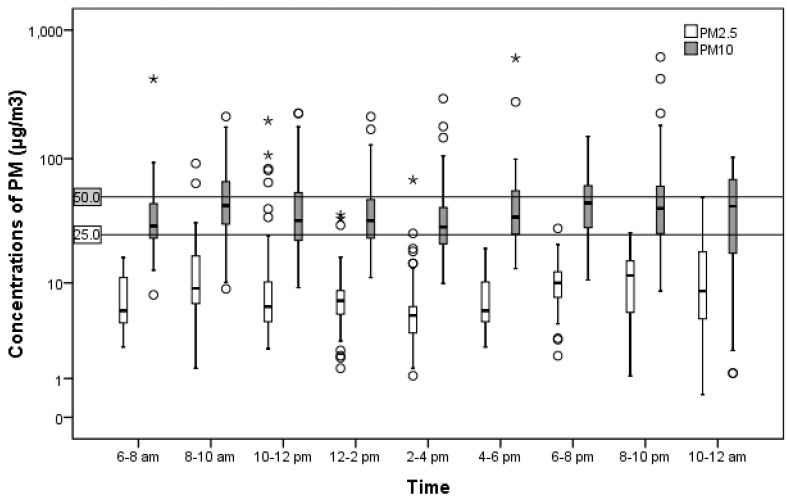
This pilot study evaluated the potential effect of household environmental factors such as income, maternal characteristics, and indoor air pollution on children's respiratory status in an Eastern Indonesian community. Household data were collected from cross-sectional (n = 461 participants) and preliminary childhood case-control surveys (pneumonia cases = 31 diagnosed within three months at a local health clinic; controls = 30). Particulate matter (PM2.5 and PM10) was measured in living rooms, kitchens, children's bedrooms, and outside areas in close proximity once during the case-control household interviews (55 homes) and once per hour from 6 a.m. to midnight in 11 homes. The household survey showed that children were 1.98 times (p = 0.02) more likely to have coughing symptoms indicating respiratory infection, if mothers were not the primary caregivers. More children exhibited coughing if they were not exclusively breastfed (OR = 2.18; p = 0.06) or there was a possibility that their mothers were exposed to environmental tobacco smoke during pregnancy (OR = 2.05; p = 0.08). This study suggests that household incomes and mother's education have an indirect effect on childhood pneumonia and respiratory illness. The concentrations of PM2.5 and PM10 ranged from 0.5 to 35.7 µg/m3 and 7.7 to 575.7 µg/m3, respectively, based on grab samples. PM was significantly different between the case and control groups (p < 0.01). The study also suggests that ambient air may dilute indoor pollution, but also introduces pollution into the home from the community environment. Effective intervention programs need to be developed that consider multiple direct and indirect risk factors to protect children.
这项试点研究评估了印度尼西亚东部一个社区的家庭环境因素(如收入、母亲特征和室内空气污染)对儿童呼吸状况的潜在影响。家庭数据来自横断面调查(n = 461名参与者)和初步的儿童病例对照调查(肺炎病例 = 31例,在当地一家健康诊所三个月内确诊;对照组 = 30例)。在病例对照家庭访谈期间(55户家庭),对客厅、厨房、儿童卧室和附近室外区域的颗粒物(PM2.5和PM10)进行了一次测量,在11户家庭中,从上午6点到午夜每小时测量一次。家庭调查显示,如果母亲不是主要照顾者,儿童出现表明呼吸道感染的咳嗽症状的可能性要高1.98倍(p = 0.02)。如果儿童不是纯母乳喂养(比值比 = 2.18;p = 0.06)或其母亲在怀孕期间有可能接触环境烟草烟雾(比值比 = 2.05;p = 0.08),则更多儿童会出现咳嗽。这项研究表明,家庭收入和母亲的教育程度对儿童肺炎和呼吸道疾病有间接影响。基于采集样本,PM2.5和PM10的浓度分别在0.5至35.7微克/立方米和7.7至575.7微克/立方米之间。病例组和对照组之间的颗粒物浓度有显著差异(p < 0.01)。该研究还表明,室外空气可能会稀释室内污染,但也会将社区环境中的污染引入家中。需要制定有效的干预计划,考虑多种直接和间接风险因素以保护儿童。