Fok Mark C, Wong Roger Y
BMC Med Educ. 2014 Nov 28;14:252. doi: 10.1186/s12909-014-0252-7.
Teaching quality improvement (QI) principles during residency is an important component of promoting patient safety and improving quality of care. The literature on QI curricula for internal medicine residents is limited. We sought to evaluate the impact of a competency based curriculum on QI among internal medicine residents.
This was a prospective, cohort study over four years (2007-2011) using pre-post curriculum comparison design in an internal medicine residency program in Canada. Overall 175 post-graduate year one internal medicine residents participated. A two-phase, competency based curriculum on QI was developed with didactic workshops and longitudinal, team-based QI projects. The main outcome measures included self-assessment, objective assessment using the Quality Improvement Knowledge Assessment Tool (QIKAT) scores to assess QI knowledge, and performance-based assessment via presentation of longitudinal QI projects.
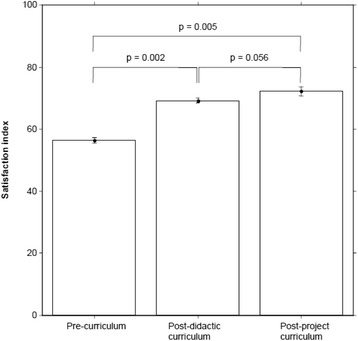
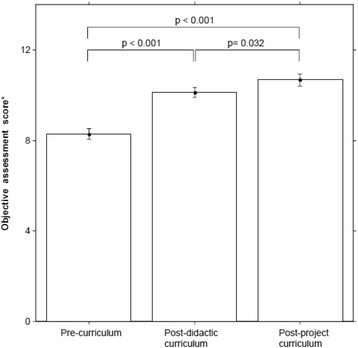
Overall 175 residents participated, with a response rate of 160/175 (91%) post-curriculum and 114/175 (65%) after conducting their longitudinal QI project. Residents' self-reported confidence in making changes to improve health increased and was sustained at twelve months post-curriculum. Self-assessment scores of QI skills improved significantly from pre-curriculum (53.4 to 69.2 percent post-curriculum [p-value 0.002]) and scores were sustained at twelve months after conducting their longitudinal QI projects (53.4 to 72.2 percent [p-value 0.005]). Objective scores using the QIKAT increased post-curriculum from 8.3 to 10.1 out of 15 (p-value for difference <0.001) and this change was sustained at twelve months post-project with average individual scores of 10.7 out of 15 (p-value for difference from pre-curriculum <0.001). Performance-based assessment occurred via presentation of all projects at the annual QI Project Podium Presentation Day.
The competency based curriculum on QI improved residents' QI knowledge and skills during residency training. Importantly, residents perceived that their QI knowledge improved after the curriculum and this also correlated to improved QIKAT scores. Experiential QI project work appeared to contribute to sustaining QI knowledge at twelve months.
住院医师培训期间的教学质量改进(QI)原则是促进患者安全和提高医疗质量的重要组成部分。关于内科住院医师QI课程的文献有限。我们旨在评估基于能力的课程对内科住院医师QI的影响。
这是一项在加拿大一个内科住院医师培训项目中进行的为期四年(2007 - 2011年)的前瞻性队列研究,采用课程前后比较设计。共有175名一年级内科住院医师参与。开发了一个基于能力的两阶段QI课程,包括理论讲习班和纵向的团队QI项目。主要结局指标包括自我评估、使用质量改进知识评估工具(QIKAT)分数进行的客观评估以评估QI知识,以及通过展示纵向QI项目进行的基于表现的评估。
共有175名住院医师参与,课程结束后的回复率为160/175(91%),完成纵向QI项目后的回复率为114/175(65%)。住院医师自我报告的进行改善健康的变革的信心增加,并在课程结束后十二个月保持。QI技能的自我评估分数从课程前的53.4%显著提高到课程后的69.2%(p值0.002),并且在完成纵向QI项目后的十二个月保持在72.2%(p值0.005)。使用QIKAT的客观分数在课程后从15分中的8.3分提高到10.1分(差异p值<0.001),并且在项目后十二个月保持这一变化,平均个人分数为15分中的10.7分(与课程前差异的p值<0.001)。基于表现의评估通过在年度QI项目讲台展示日展示所有项目进行。
基于能力的QI课程在住院医师培训期间提高了住院医师的QI知识和技能。重要的是,住院医师认为他们的QI知识在课程后有所提高,这也与QIKAT分数的提高相关。经验性的QI项目工作似乎有助于在十二个月时维持QI知识。