Wagner Bradley G, Behrend Matthew R, Klein Daniel J, Upfill-Brown Alexander M, Eckhoff Philip A, Hu Hao
Institute for Disease Modeling, Bellevue, Washington, United States of America.
PLoS One. 2014 Dec 1;9(12):e113538. doi: 10.1371/journal.pone.0113538. eCollection 2014.
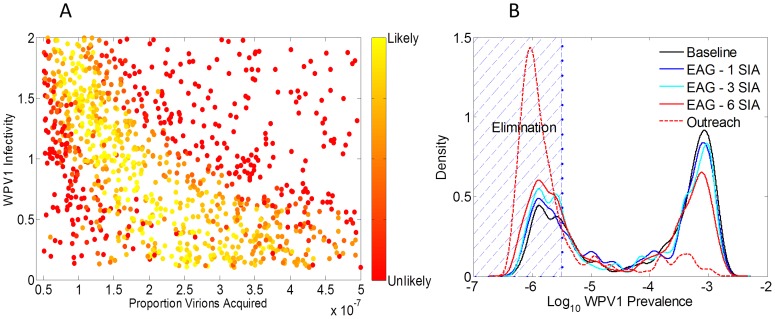
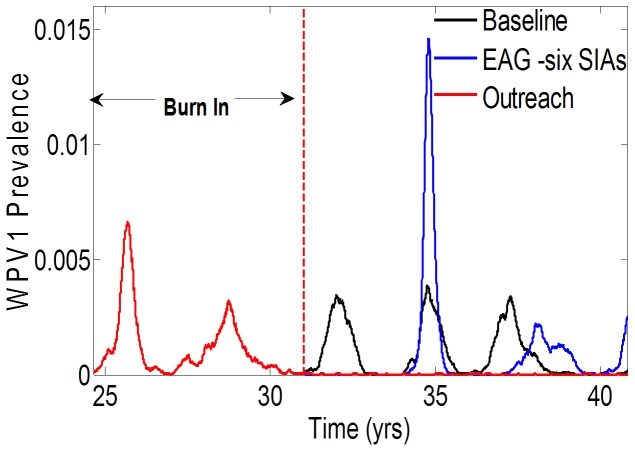
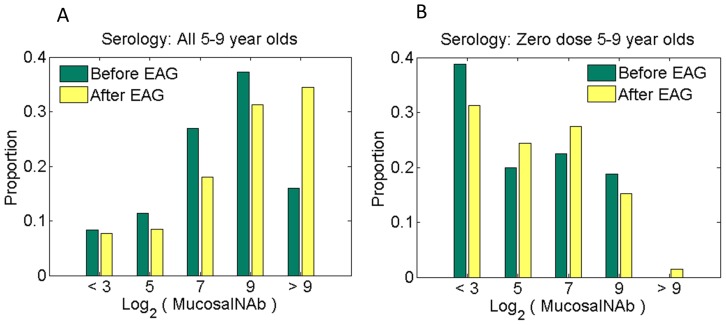
A priority of the Global Polio Eradication Initiative (GPEI) 2013-2018 strategic plan is to evaluate the potential impact on polio eradication resulting from expanding one or more Supplementary Immunization Activities (SIAs) to children beyond age five-years in polio endemic countries. It has been hypothesized that such expanded age group (EAG) campaigns could accelerate polio eradication by eliminating immunity gaps in older children that may have resulted from past periods of low vaccination coverage. Using an individual-based mathematical model, we quantified the impact of EAG campaigns in terms of probability of elimination, reduction in polio transmission and age stratified immunity levels. The model was specifically calibrated to seroprevalence data from a polio-endemic region: Zaria, Nigeria. We compared the impact of EAG campaigns, which depend only on age, to more targeted interventions which focus on reaching missed populations. We found that EAG campaigns would not significantly improve prospects for polio eradication; the probability of elimination increased by 8% (from 24% at baseline to 32%) when expanding three annual SIAs to 5-14 year old children and by 18% when expanding all six annual SIAs. In contrast, expanding only two of the annual SIAs to target hard-to-reach populations at modest vaccination coverage-representing less than one tenth of additional vaccinations required for the six SIA EAG scenario-increased the probability of elimination by 55%. Implementation of EAG campaigns in polio endemic regions would not improve prospects for eradication. In endemic areas, vaccination campaigns which do not target missed populations will not benefit polio eradication efforts.
全球消灭脊髓灰质炎行动(GPEI)2013 - 2018年战略计划的一项重点是评估在脊髓灰质炎流行国家将一项或多项补充免疫活动(SIA)扩展至五岁以上儿童对消灭脊髓灰质炎可能产生的影响。据推测,这种扩大年龄组(EAG)活动可通过消除大龄儿童中因过去疫苗接种覆盖率低而可能产生的免疫空白来加速消灭脊髓灰质炎。我们使用基于个体的数学模型,从消灭概率、脊髓灰质炎传播减少情况以及按年龄分层的免疫水平方面,对EAG活动的影响进行了量化。该模型专门根据脊髓灰质炎流行地区——尼日利亚扎里亚的血清学流行率数据进行了校准。我们将仅取决于年龄的EAG活动的影响与更具针对性的、侧重于覆盖未接种人群的干预措施的影响进行了比较。我们发现,EAG活动不会显著改善消灭脊髓灰质炎的前景;将三项年度SIA扩展至5 - 14岁儿童时,消灭概率提高了8%(从基线时的24%增至32%),将所有六项年度SIA扩展时,消灭概率提高了18%。相比之下,仅将两项年度SIA扩展至疫苗接种覆盖率较低的难以到达人群(占六项SIA EAG方案所需额外接种疫苗的不到十分之一),消灭概率提高了55%。在脊髓灰质炎流行地区开展EAG活动不会改善消灭工作的前景。在流行地区,不针对未接种人群的疫苗接种活动对消灭脊髓灰质炎的努力没有益处。