Willem Lander, Verelst Frederik, Bilcke Joke, Hens Niel, Beutels Philippe
Centre for Health Economics Research & Modeling Infectious Diseases, Vaccine and Infectious Disease Institute, University of Antwerp, Antwerp, Belgium.
Interuniversity Institute for Biostatistics and statistical Bioinformatics, UHasselt, Hasselt, Belgium.
BMC Infect Dis. 2017 Sep 11;17(1):612. doi: 10.1186/s12879-017-2699-8.
Individual-based models (IBMs) are useful to simulate events subject to stochasticity and/or heterogeneity, and have become well established to model the potential (re)emergence of pathogens (e.g., pandemic influenza, bioterrorism). Individual heterogeneity at the host and pathogen level is increasingly documented to influence transmission of endemic diseases and it is well understood that the final stages of elimination strategies for vaccine-preventable childhood diseases (e.g., polio, measles) are subject to stochasticity. Even so it appears IBMs for both these phenomena are not well established. We review a decade of IBM publications aiming to obtain insights in their advantages, pitfalls and rationale for use and to make recommendations facilitating knowledge transfer within and across disciplines.
We systematically identified publications in Web of Science and PubMed from 2006-2015 based on title/abstract/keywords screening (and full-text if necessary) to retrieve topics, modeling purposes and general specifications. We extracted detailed modeling features from papers on established vaccine-preventable childhood diseases based on full-text screening.
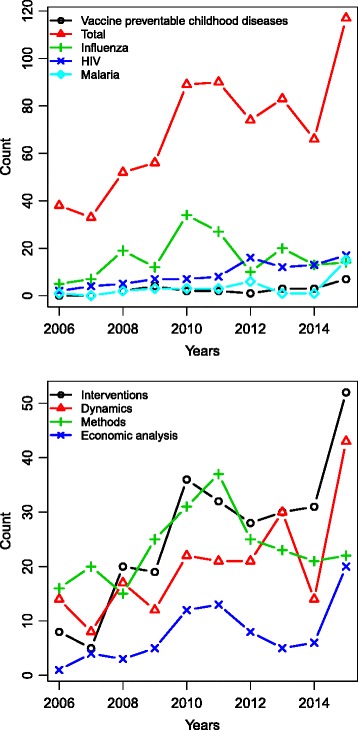
We identified 698 papers, which applied an IBM for infectious disease transmission, and listed these in a reference database, describing their general characteristics. The diversity of disease-topics and overall publication frequency have increased over time (38 to 115 annual publications from 2006 to 2015). The inclusion of intervention strategies (8 to 52) and economic consequences (1 to 20) are increasing, to the detriment of purely theoretical explorations. Unfortunately, terminology used to describe IBMs is inconsistent and ambiguous. We retrieved 24 studies on a vaccine-preventable childhood disease (covering 7 different diseases), with publication frequency increasing from the first such study published in 2008. IBMs have been useful to explore heterogeneous between- and within-host interactions, but combined applications are still sparse. The amount of missing information on model characteristics and study design is remarkable.
IBMs are suited to combine heterogeneous within- and between-host interactions, which offers many opportunities, especially to analyze targeted interventions for endemic infections. We advocate the exchange of (open-source) platforms and stress the need for consistent "branding". Using (existing) conventions and reporting protocols would stimulate cross-fertilization between research groups and fields, and ultimately policy making in decades to come.
基于个体的模型(IBMs)有助于模拟受随机性和/或异质性影响的事件,并且已广泛用于对病原体的潜在(再)出现进行建模(例如,大流行性流感、生物恐怖主义)。越来越多的文献表明,宿主和病原体层面的个体异质性会影响地方病的传播,而且人们也清楚地认识到,疫苗可预防的儿童疾病(如脊髓灰质炎、麻疹)消除策略的最后阶段存在随机性。即便如此,针对这两种现象的基于个体的模型似乎尚未得到充分确立。我们回顾了过去十年间关于基于个体的模型的出版物,旨在了解其优势、缺陷以及使用的基本原理,并提出一些建议,以促进不同学科内部和之间的知识转移。
我们基于标题/摘要/关键词筛选(必要时进行全文筛选),系统地检索了2006年至2015年期间Web of Science和PubMed上的出版物,以获取主题、建模目的和一般规范。我们通过全文筛选,从关于已确立的疫苗可预防儿童疾病的论文中提取了详细的建模特征。
我们识别出698篇应用基于个体的模型进行传染病传播建模的论文,并将其列入一个参考文献数据库,描述了它们的一般特征。随着时间的推移,疾病主题的多样性和总体发表频率有所增加(从2006年到2015年,每年的发表数量从38篇增至115篇)。干预策略(从8种增至52种)和经济后果(从1种增至20种)的纳入情况也在增加,这不利于纯粹的理论探索。不幸的是,用于描述基于个体的模型的术语不一致且含糊不清。我们检索到24项关于疫苗可预防儿童疾病的研究(涵盖7种不同疾病),自2008年发表第一篇此类研究以来,发表频率不断增加。基于个体的模型有助于探索宿主间和宿主内的异质性相互作用,但联合应用仍然很少。关于模型特征和研究设计的缺失信息数量惊人。
基于个体的模型适合结合宿主内和宿主间的异质性相互作用,这提供了很多机会,特别是用于分析针对地方感染的靶向干预措施。我们提倡(开源)平台的交流,并强调需要一致的“品牌”。采用(现有的)惯例和报告协议将促进研究团队和领域之间的交叉融合,并最终在未来几十年推动政策制定。