Karelina K, Liu Y, Alzate-Correa D, Wheaton K L, Hoyt K R, Arthur J S C, Obrietan K
Department of Neuroscience, The Ohio State University, Columbus, OH 43210, USA.
Division of Pharmacology, The Ohio State University, Columbus, OH 43210, USA.
Neuroscience. 2015 Jan 29;285:292-302. doi: 10.1016/j.neuroscience.2014.10.053. Epub 2014 Nov 14.
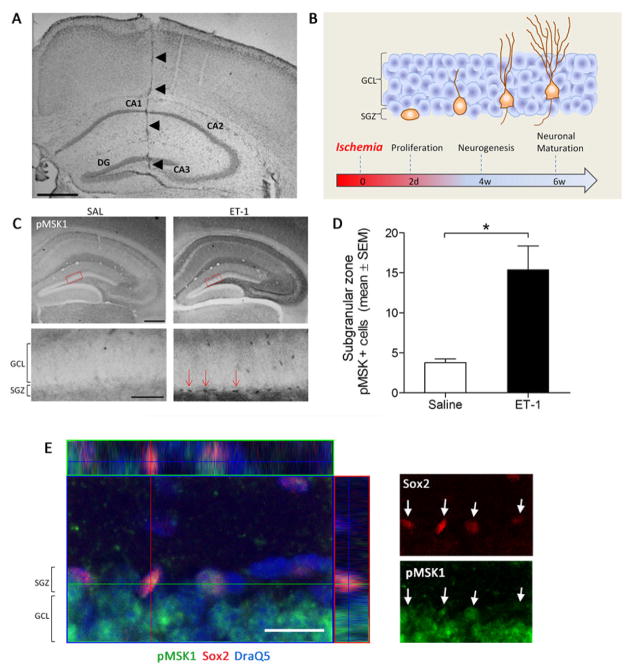
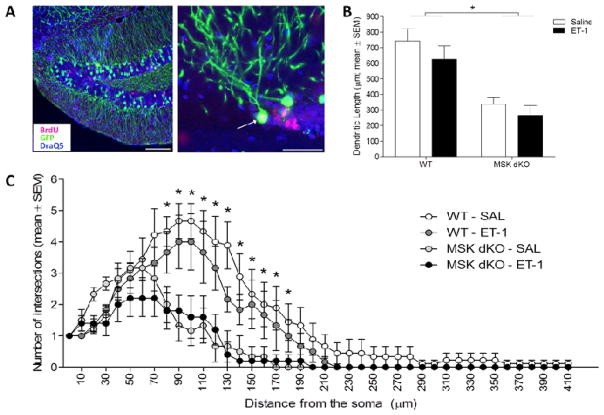
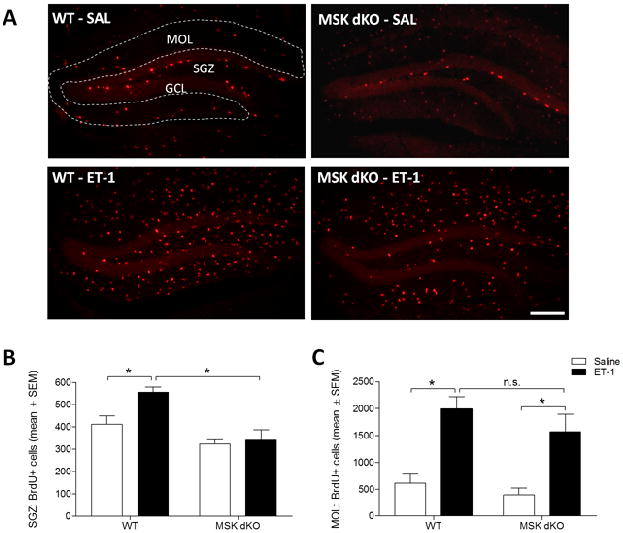
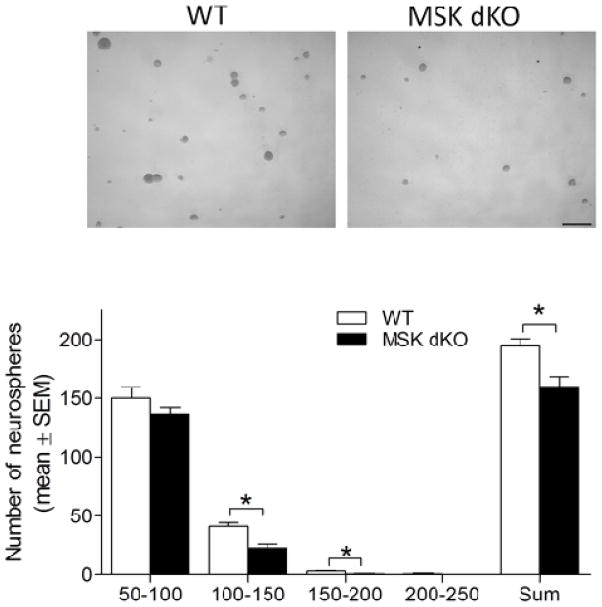
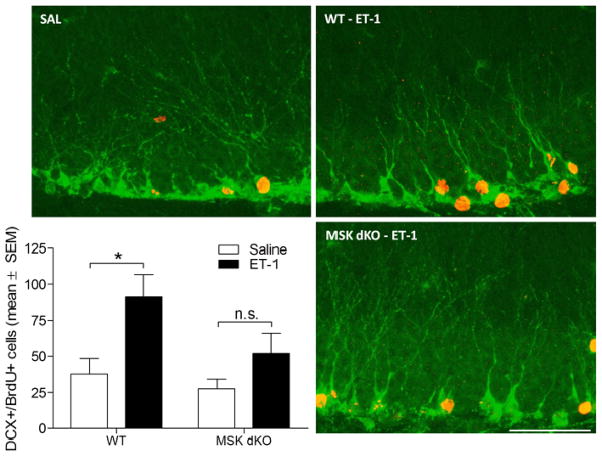
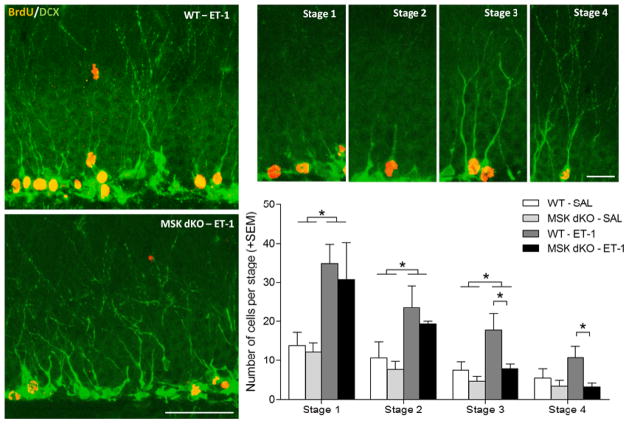
Pathophysiological conditions such as cerebral ischemia trigger the production of new neurons from the neurogenic niche within the subgranular zone (SGZ) of the dentate gyrus. The functional significance of ischemia-induced neurogenesis is believed to be the regeneration of lost cells, thus contributing to post-ischemia recovery. However, the cell signaling mechanisms by which this process is regulated are still under investigation. Here, we investigated the role of mitogen and stress-activated protein kinases (MSK1/2) in the regulation of progenitor cell proliferation and neurogenesis after cerebral ischemia. Using the endothelin-1 model of ischemia, wild-type (WT) and MSK1(-/-)/MSK2(-/-) (MSK dKO) mice were injected with BrdU and sacrificed 2 days, 4 weeks, or 6 weeks later for the analysis of progenitor cell proliferation, neurogenesis, and neuronal morphology, respectively. We report a decrease in SGZ progenitor cell proliferation in MSK dKO mice compared to WT mice. Moreover, MSK dKO mice exhibited reduced neurogenesis and a delayed maturation of ischemia-induced newborn neurons. Further, structural analysis of neuronal arborization revealed reduced branching complexity in MSK dKO compared to WT mice. Taken together, this dataset suggests that MSK1/2 plays a significant role in the regulation of ischemia-induced progenitor cell proliferation and neurogenesis. Ultimately, revealing the cell signaling mechanisms that promote neuronal recovery will lead to novel pharmacological approaches for the treatment of neurodegenerative diseases such as cerebral ischemia.
诸如脑缺血等病理生理状况会触发齿状回颗粒下区(SGZ)神经源性微环境产生新的神经元。缺血诱导神经发生的功能意义被认为是丢失细胞的再生,从而有助于缺血后恢复。然而,调节这一过程的细胞信号机制仍在研究中。在此,我们研究了丝裂原和应激激活蛋白激酶(MSK1/2)在脑缺血后祖细胞增殖和神经发生调节中的作用。利用内皮素-1缺血模型,给野生型(WT)和MSK1(-/-)/MSK2(-/-)(MSK双敲除)小鼠注射溴脱氧尿苷(BrdU),并分别在2天、4周或6周后处死,以分析祖细胞增殖、神经发生和神经元形态。我们报告,与WT小鼠相比,MSK双敲除小鼠的SGZ祖细胞增殖减少。此外,MSK双敲除小鼠表现出神经发生减少以及缺血诱导的新生神经元成熟延迟。此外,对神经元分支的结构分析显示,与WT小鼠相比,MSK双敲除小鼠的分支复杂性降低。综上所述,该数据集表明MSK1/2在调节缺血诱导的祖细胞增殖和神经发生中起重要作用。最终,揭示促进神经元恢复的细胞信号机制将为治疗诸如脑缺血等神经退行性疾病带来新的药理学方法。