Menzies Lara, Goddings Anne-Lise, Whitaker Kirstie J, Blakemore Sarah-Jayne, Viner Russell M
University College London Institute of Cognitive Neuroscience, Alexandra House, 17 Queen Square, London WC1N 3AR, UK; General Adolescent and Paediatric Unit, University College London Institute of Child Health, 30 Guilford Street, London WC1N 1EH, UK.
University College London Institute of Cognitive Neuroscience, Alexandra House, 17 Queen Square, London WC1N 3AR, UK; General Adolescent and Paediatric Unit, University College London Institute of Child Health, 30 Guilford Street, London WC1N 1EH, UK.
Dev Cogn Neurosci. 2015 Feb;11:116-28. doi: 10.1016/j.dcn.2014.10.002. Epub 2014 Oct 22.
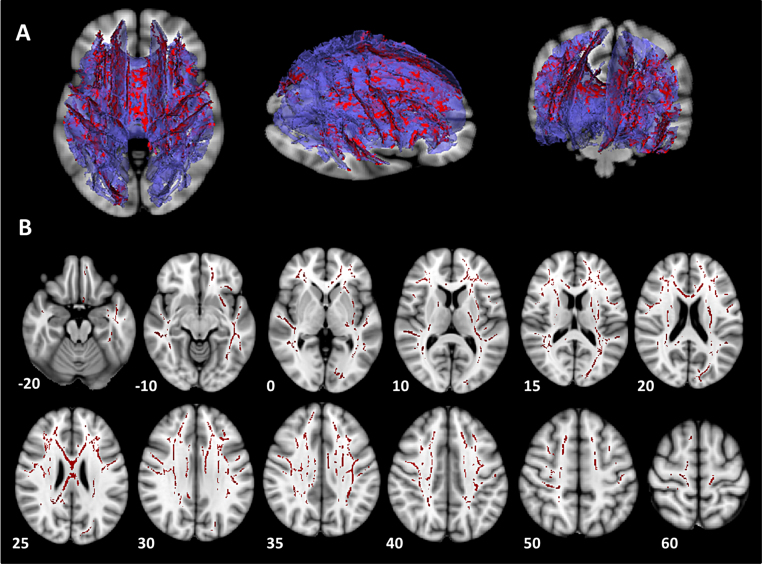
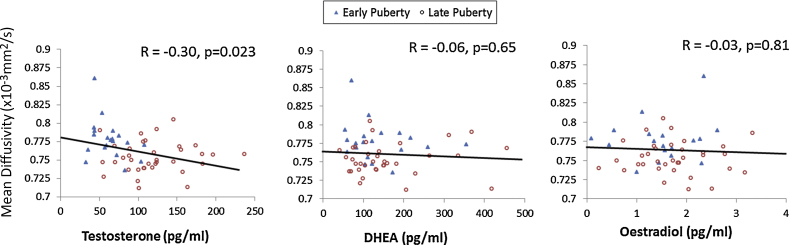
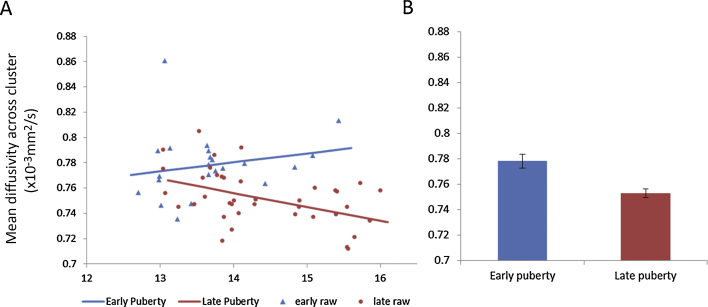
Neuroimaging studies demonstrate considerable changes in white matter volume and microstructure during adolescence. Most studies have focused on age-related effects, whilst puberty-related changes are not well understood. Using diffusion tensor imaging and tract-based spatial statistics, we investigated the effects of pubertal status on white matter mean diffusivity (MD) and fractional anisotropy (FA) in 61 males aged 12.7-16.0 years. Participants were grouped into early-mid puberty (≤Tanner Stage 3 in pubic hair and gonadal development; n=22) and late-post puberty (≥Tanner Stage 4 in pubic hair or gonadal development; n=39). Salivary levels of pubertal hormones (testosterone, DHEA and oestradiol) were also measured. Pubertal stage was significantly related to MD in diverse white matter regions. No relationship was observed between pubertal status and FA. Regression modelling of MD in the significant regions demonstrated that an interaction model incorporating puberty, age and puberty×age best explained our findings. In addition, testosterone was correlated with MD in these pubertally significant regions. No relationship was observed between oestradiol or DHEA and MD. In conclusion, pubertal status was significantly related to MD, but not FA, and this relationship cannot be explained by changes in chronological age alone.
神经影像学研究表明,青春期期间白质体积和微观结构会发生显著变化。大多数研究集中在与年龄相关的影响,而与青春期相关的变化尚未得到充分理解。我们使用扩散张量成像和基于体素的空间统计学方法,研究了青春期状态对61名年龄在12.7至16.0岁男性白质平均扩散率(MD)和分数各向异性(FA)的影响。参与者被分为青春期早期至中期(阴毛和性腺发育≤坦纳3期;n = 22)和青春期后期至青春期后(阴毛或性腺发育≥坦纳4期;n = 39)。还测量了唾液中青春期激素(睾酮、脱氢表雄酮和雌二醇)水平。青春期阶段与不同白质区域的MD显著相关。未观察到青春期状态与FA之间的关系。对显著区域的MD进行回归建模表明,包含青春期、年龄和青春期×年龄的交互模型最能解释我们的研究结果。此外,睾酮与这些青春期显著区域的MD相关。未观察到雌二醇或脱氢表雄酮与MD之间的关系。总之,青春期状态与MD显著相关,但与FA无关,而且这种关系不能仅由实际年龄的变化来解释。