Thyphronitis G, Tsokos G C, June C H, Levine A D, Finkelman F D
Department of Medicine, Uniformed Services University of the Health Sciences, Bethesda, MD 20814.
Proc Natl Acad Sci U S A. 1989 Jul;86(14):5580-4. doi: 10.1073/pnas.86.14.5580.
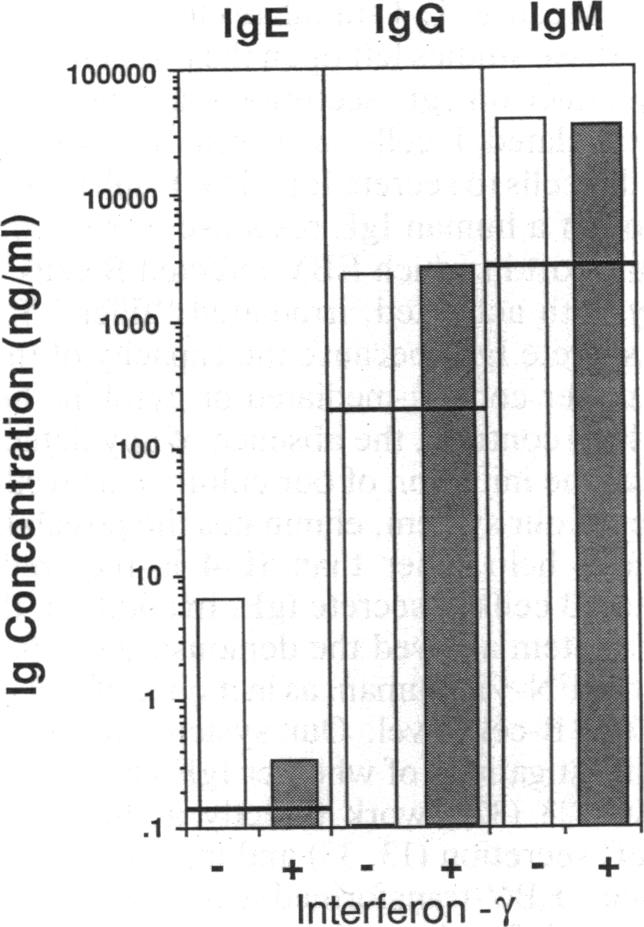
The cytokine interleukin 4 (IL-4) has been shown to induce lipopolysaccharide-activated murine B cells to differentiate into IgE-secreting cells and to stimulate IgE secretion by cultured human peripheral blood lymphoid cells. It is unclear, however, whether this effect of IL-4 on human peripheral blood lymphoid cells is a direct effect on the B cell because IL-4 can stimulate T cells and monocytes as well as B cells and does not induce purified human B cells to secrete immunoglobulin. To investigate this issue we studied the ability of IL-4 to induce IgE secretion by purified human B cells (93-96% CD20+, less than 1% CD3+) that were cultured with Epstein-Barr virus (EBV). Although B cells cultured with IL-4 alone did not secrete Ig and B cells cultured with EBV alone secreted IgM, IgG, and IgA but less than 150 pg of IgE per ml, the combination of EBV and IL-4 induced an IgE response that ranged from 11.4 to 40.3 ng/ml of culture supernatant after 26 days of culture. While IL-4 also enhanced IgM, IgG, and IgA secretion, as well as proliferation by EBV-infected B cells, these effects were less pronounced, occurred earlier during culture, and required a lower concentration of IL-4 than did the stimulation of IgE secretion. Furthermore, interferon gamma at 10 units per ml was found to inhibit IL-4/EBV-induced IgE secretion without inhibiting the other stimulatory effects of IL-4. We conclude that (i) IL-4 and interferon gamma can act directly on polyclonally activated human B cells to respectively stimulate and suppress IgE secretion and (ii) IL-4, in addition to its specific effect on IgE secretion, has a general stimulatory effect on the growth and differentiation of EBV-infected human B cells.
细胞因子白细胞介素4(IL-4)已被证明可诱导脂多糖激活的小鼠B细胞分化为分泌IgE的细胞,并刺激培养的人外周血淋巴细胞分泌IgE。然而,尚不清楚IL-4对人外周血淋巴细胞的这种作用是否是对B细胞的直接作用,因为IL-4不仅可以刺激B细胞,还可以刺激T细胞和单核细胞,并且不能诱导纯化的人B细胞分泌免疫球蛋白。为了研究这个问题,我们研究了IL-4诱导与爱泼斯坦-巴尔病毒(EBV)一起培养的纯化人B细胞(93-96% CD20+,小于1% CD3+)分泌IgE的能力。尽管单独用IL-4培养的B细胞不分泌Ig,单独用EBV培养的B细胞分泌IgM、IgG和IgA,但每毫升分泌的IgE少于150 pg,然而,EBV和IL-4的组合在培养26天后诱导了IgE反应,培养上清液中的IgE反应范围为11.4至40.3 ng/ml。虽然IL-4也增强了IgM、IgG和IgA的分泌以及EBV感染的B细胞的增殖,但这些作用不太明显,在培养过程中出现得更早,并且比刺激IgE分泌所需的IL-4浓度更低。此外,发现每毫升10单位的干扰素γ可抑制IL-4/EBV诱导的IgE分泌,而不抑制IL-4的其他刺激作用。我们得出结论:(i)IL-4和干扰素γ可直接作用于多克隆激活的人B细胞,分别刺激和抑制IgE分泌;(ii)IL-4除了对IgE分泌有特异性作用外,对EBV感染的人B细胞的生长和分化具有普遍的刺激作用。