• 文献检索
  • 文档翻译
  • 深度研究
  • 学术资讯
  • Suppr Zotero 插件Zotero 插件
  • 邀请有礼
  • 套餐&价格
  • 历史记录
应用&插件
Suppr Zotero 插件Zotero 插件浏览器插件Mac 客户端Windows 客户端微信小程序
定价
高级版会员购买积分包购买API积分包
服务
文献检索文档翻译深度研究API 文档MCP 服务
关于我们
关于 Suppr公司介绍联系我们用户协议隐私条款
关注我们

Suppr 超能文献

核心技术专利:CN118964589B侵权必究
粤ICP备2023148730 号-1Suppr @ 2026

文献检索

告别复杂PubMed语法,用中文像聊天一样搜索,搜遍4000万医学文献。AI智能推荐,让科研检索更轻松。

立即免费搜索

文件翻译

保留排版,准确专业,支持PDF/Word/PPT等文件格式,支持 12+语言互译。

免费翻译文档

深度研究

AI帮你快速写综述,25分钟生成高质量综述,智能提取关键信息,辅助科研写作。

立即免费体验

重症监护病房死亡率预测的超级 ICU 学习者算法(SICULA):一项基于人群的研究。

Mortality prediction in intensive care units with the Super ICU Learner Algorithm (SICULA): a population-based study.

机构信息

Division of Biostatistics, School of Public Health, University of California, Berkeley, CA, USA; Service de Biostatistique et Information Médicale, Unité INSERM 1153, Equipe ECSTRA, Hôpital Saint Louis, Paris, France; Service d'Anesthésie-Réanimation, Hôpital Européen Georges Pompidou, Paris, France.

Division of Biostatistics, School of Public Health, University of California, Berkeley, CA, USA.

出版信息

Lancet Respir Med. 2015 Jan;3(1):42-52. doi: 10.1016/S2213-2600(14)70239-5. Epub 2014 Nov 24.

DOI:10.1016/S2213-2600(14)70239-5
PMID:25466337
原文链接:https://pmc.ncbi.nlm.nih.gov/articles/PMC4321691/
Abstract

BACKGROUND

Improved mortality prediction for patients in intensive care units is a big challenge. Many severity scores have been proposed, but findings of validation studies have shown that they are not adequately calibrated. The Super ICU Learner Algorithm (SICULA), an ensemble machine learning technique that uses multiple learning algorithms to obtain better prediction performance, does at least as well as the best member of its library. We aimed to assess whether the Super Learner could provide a new mortality prediction algorithm for patients in intensive care units, and to assess its performance compared with other scoring systems.

METHODS

From January, 2001, to December, 2008, we used the Multiparameter Intelligent Monitoring in Intensive Care II (MIMIC-II) database (version 26) including all patients admitted to an intensive care unit at the Beth Israel Deaconess Medical Centre, Boston, MA, USA. We assessed the calibration, discrimination, and risk classification of predicted hospital mortality based on Super Learner compared with SAPS-II, APACHE-II, and SOFA. We calculated performance measures with cross-validation to avoid making biased assessments. Our proposed score was then externally validated on a dataset of 200 randomly selected patients admitted at the intensive care unit of Hôpital Européen Georges-Pompidou, Paris, France, between Sept 1, 2013, and June, 30, 2014. The primary outcome was hospital mortality. The explanatory variables were the same as those included in the SAPS II score.

FINDINGS

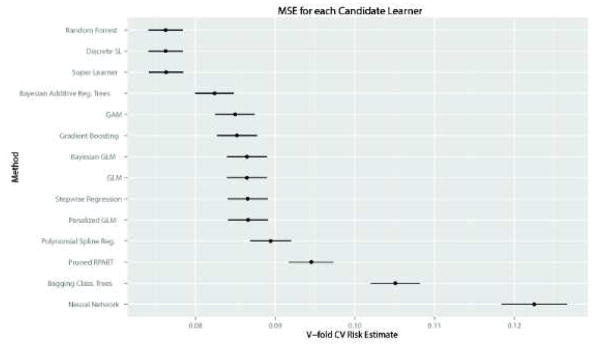
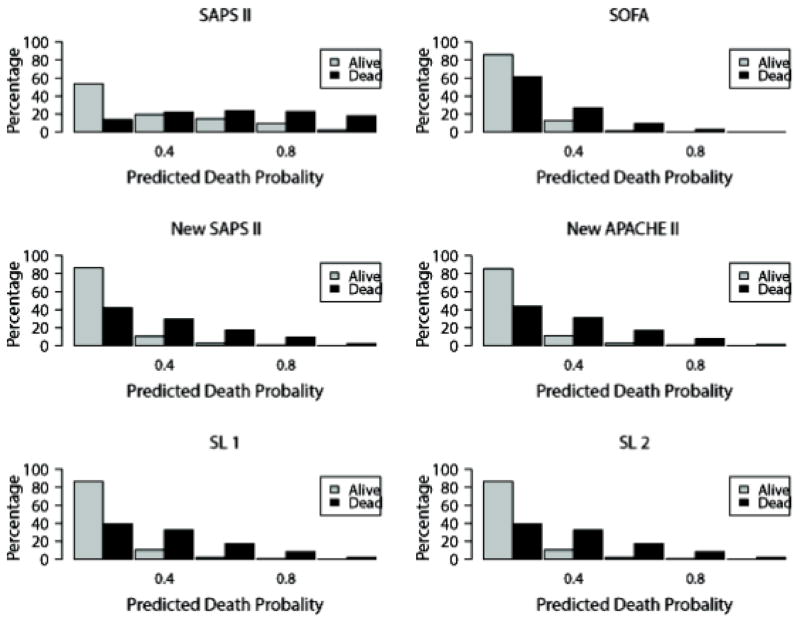
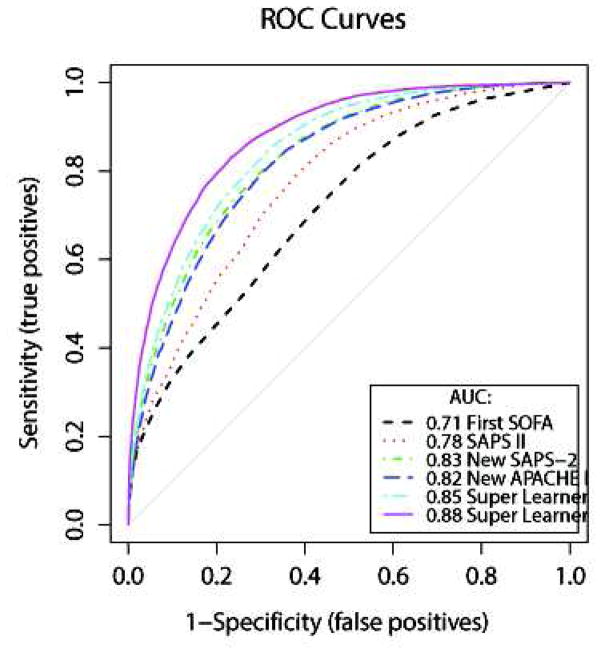
24,508 patients were included, with median SAPS-II of 38 (IQR 27-51) and median SOFA of 5 (IQR 2-8). 3002 of 24,508 (12%) patients died in the Beth Israel Deaconess Medical Centre. We produced two sets of predictions based on the Super Learner; the first based on the 17 variables as they appear in the SAPS-II score (SL1), and the second, on the original, untransformed variables (SL2). The two versions yielded average predicted probabilities of death of 0·12 (IQR 0·02-0·16) and 0·13 (0·01-0·19), whereas the corresponding value for SOFA was 0·12 (0·05-0·15) and for SAPS-II 0·30 (0·08-0·48). The cross-validated area under the receiver operating characteristic curve (AUROC) for SAPS-II was 0·78 (95% CI 0·77-0·78) and 0·71 (0·70-0·72) for SOFA. Super Learner had an AUROC of 0·85 (0·84-0·85) when the explanatory variables were categorised as in SAPS-II, and of 0·88 (0·87-0·89) when the same explanatory variables were included without any transformation. Additionally, Super Learner showed better calibration properties than previous score systems. On the external validation dataset, the AUROC was 0·94 (0·90-0·98) and calibration properties were good.

INTERPRETATION

Compared with conventional severity scores, Super Learner offers improved performance for predicting hospital mortality in patients in intensive care units. A user-friendly implementation is available online and should be useful for clinicians seeking to validate our score.

FUNDING

Fulbright Foundation, Assistance Publique-Hôpitaux de Paris, Doris Duke Clinical Scientist Development Award, and the NIH.

摘要

背景

提高重症监护病房患者的死亡率预测是一个巨大的挑战。已经提出了许多严重程度评分,但验证研究的结果表明,它们的校准效果并不理想。Super ICU Learner Algorithm(SICULA)是一种集成机器学习技术,它使用多种学习算法来获得更好的预测性能,其表现至少与库中最好的成员一样出色。我们旨在评估 Super Learner 是否可以为重症监护病房的患者提供新的死亡率预测算法,并评估其与其他评分系统的性能比较。

方法

从 2001 年 1 月到 2008 年 12 月,我们使用了 Beth Israel Deaconess Medical Centre 的 Multiparameter Intelligent Monitoring in Intensive Care II(MIMIC-II)数据库(版本 26),其中包括美国马萨诸塞州波士顿贝斯以色列女执事医疗中心重症监护病房的所有患者。我们评估了基于 Super Learner 的医院死亡率预测的校准、区分和风险分类,并与 SAPS-II、APACHE-II 和 SOFA 进行了比较。我们通过交叉验证计算了性能指标,以避免产生有偏差的评估。然后,我们在法国巴黎欧洲乔治·蓬皮杜医院重症监护病房的 200 名随机选择的患者数据集(2013 年 9 月 1 日至 2014 年 6 月 30 日)上对我们提出的评分进行了外部验证。主要结局是医院死亡率。解释变量与 SAPS II 评分中包含的变量相同。

结果

共纳入 24508 例患者,SAPS-II 中位数为 38(IQR 27-51),SOFA 中位数为 5(IQR 2-8)。24508 例患者中有 3002 例(12%)在贝斯以色列女执事医疗中心死亡。我们基于 Super Learner 生成了两组预测值;第一组基于 SAPS-II 中出现的 17 个变量(SL1),第二组基于原始、未经转换的变量(SL2)。这两种版本产生的死亡平均预测概率分别为 0.12(IQR 0.02-0.16)和 0.13(0.01-0.19),而 SOFA 的对应值为 0.12(0.05-0.15),SAPS-II 的对应值为 0.30(0.08-0.48)。SAPS-II 的交叉验证接受者操作特征曲线下面积(AUROC)为 0.78(95%CI 0.77-0.78),SOFA 为 0.71(0.70-0.72)。当解释变量分类为 SAPS-II 时,Super Learner 的 AUROC 为 0.85(0.84-0.85),当包含相同的解释变量而无需任何转换时,AUROC 为 0.88(0.87-0.89)。此外,Super Learner 显示出比以前的评分系统更好的校准特性。在外部验证数据集上,AUROC 为 0.94(0.90-0.98),校准特性良好。

解释

与传统的严重程度评分相比,Super Learner 为重症监护病房患者的医院死亡率预测提供了更好的性能。一个用户友好的实现可在线获得,应该对寻求验证我们评分的临床医生有用。

资助

富布赖特基金会、巴黎公立医院、Doris Duke 临床科学家发展奖和 NIH。
https://cdn.ncbi.nlm.nih.gov/pmc/blobs/fd1b/4321691/3aa46e4eb7bd/nihms653243f3.jpg
https://cdn.ncbi.nlm.nih.gov/pmc/blobs/fd1b/4321691/e2294d38d469/nihms653243f1.jpg
https://cdn.ncbi.nlm.nih.gov/pmc/blobs/fd1b/4321691/27b69a62a0b6/nihms653243f2.jpg
https://cdn.ncbi.nlm.nih.gov/pmc/blobs/fd1b/4321691/3aa46e4eb7bd/nihms653243f3.jpg
https://cdn.ncbi.nlm.nih.gov/pmc/blobs/fd1b/4321691/e2294d38d469/nihms653243f1.jpg
https://cdn.ncbi.nlm.nih.gov/pmc/blobs/fd1b/4321691/27b69a62a0b6/nihms653243f2.jpg
https://cdn.ncbi.nlm.nih.gov/pmc/blobs/fd1b/4321691/3aa46e4eb7bd/nihms653243f3.jpg

相似文献

1
Mortality prediction in intensive care units with the Super ICU Learner Algorithm (SICULA): a population-based study.重症监护病房死亡率预测的超级 ICU 学习者算法(SICULA):一项基于人群的研究。
Lancet Respir Med. 2015 Jan;3(1):42-52. doi: 10.1016/S2213-2600(14)70239-5. Epub 2014 Nov 24.
2
Early hospital mortality prediction of intensive care unit patients using an ensemble learning approach.基于集成学习方法的重症监护病房患者早期住院病死率预测。
Int J Med Inform. 2017 Dec;108:185-195. doi: 10.1016/j.ijmedinf.2017.10.002. Epub 2017 Oct 5.
3
Dynamic and explainable machine learning prediction of mortality in patients in the intensive care unit: a retrospective study of high-frequency data in electronic patient records.动态可解释机器学习预测 ICU 患者死亡率:电子患者记录中高频数据的回顾性研究。
Lancet Digit Health. 2020 Apr;2(4):e179-e191. doi: 10.1016/S2589-7500(20)30018-2. Epub 2020 Mar 12.
4
Validation of APACHE II and SAPS II scales at the intensive care unit along with assessment of SOFA scale at the admission as an isolated risk of death predictor.在重症监护病房对急性生理与慢性健康状况评分系统II(APACHE II)和简化急性生理学评分系统II(SAPS II)进行验证,并在入院时评估序贯器官衰竭评估(SOFA)量表作为独立的死亡风险预测指标。
Anaesthesiol Intensive Ther. 2019;51(2):107-111. doi: 10.5114/ait.2019.86275.
5
[Constructing a predictive model for the death risk of patients with septic shock based on supervised machine learning algorithms].基于监督机器学习算法构建脓毒症休克患者死亡风险预测模型
Zhonghua Wei Zhong Bing Ji Jiu Yi Xue. 2024 Apr;36(4):345-352. doi: 10.3760/cma.j.cn121430-20230930-00832.
6
Comparison of different intensive care scoring systems and Glasgow Aneurysm score for aortic aneurysm in predicting 28-day mortality: a retrospective cohort study from MIMIC-IV database.比较不同的重症监护评分系统和格拉斯哥动脉瘤评分对预测主动脉瘤 28 天死亡率的作用:来自 MIMIC-IV 数据库的回顾性队列研究。
BMC Cardiovasc Disord. 2024 Sep 27;24(1):513. doi: 10.1186/s12872-024-04184-4.
7
Customization of a Severity of Illness Score Using Local Electronic Medical Record Data.利用本地电子病历数据定制疾病严重程度评分
J Intensive Care Med. 2017 Jan;32(1):38-47. doi: 10.1177/0885066615585951. Epub 2015 May 12.
8
The Pros and Cons of the Prediction Game: The Never-ending Debate of Mortality in the Intensive Care Unit.预测游戏的利弊:重症监护室死亡率的永无止境的争论。
Int J Environ Res Public Health. 2019 Sep 13;16(18):3394. doi: 10.3390/ijerph16183394.
9
A comparison of severity of illness scoring systems for intensive care unit patients: results of a multicenter, multinational study. The European/North American Severity Study Group.重症监护病房患者疾病严重程度评分系统的比较:一项多中心、跨国研究的结果。欧洲/北美严重程度研究组。
Crit Care Med. 1995 Aug;23(8):1327-35. doi: 10.1097/00003246-199508000-00005.
10
Performance assessment of the SOFA, APACHE II scoring system, and SAPS II in intensive care unit organophosphate poisoned patients.在重症监护病房有机磷中毒患者中,SOFA、APACHE II 评分系统和 SAPS II 的性能评估。
J Korean Med Sci. 2013 Dec;28(12):1822-6. doi: 10.3346/jkms.2013.28.12.1822. Epub 2013 Nov 26.

引用本文的文献

1
Multiplex Targeted Proteomic Analysis of Cytokine Ratios for ICU Mortality in Severe COVID-19.用于重症新型冠状病毒肺炎患者重症监护病房死亡率的细胞因子比值多重靶向蛋白质组学分析
Proteomes. 2025 Aug 2;13(3):35. doi: 10.3390/proteomes13030035.
2
Interpretable prediction of hospital mortality in bleeding critically ill patients based on machine learning and SHAP.基于机器学习和SHAP对出血性危重症患者医院死亡率的可解释预测
BMC Med Inform Decis Mak. 2025 Jul 15;25(1):263. doi: 10.1186/s12911-025-03101-9.
3
Advances in Machine Learning for Mechanically Ventilated Patients.

本文引用的文献

1
Changes in hospital mortality for United States intensive care unit admissions from 1988 to 2012.1988年至2012年美国重症监护病房收治患者的医院死亡率变化。
Crit Care. 2013 Apr 27;17(2):R81. doi: 10.1186/cc12695.
2
Comparison between SAPS II and SAPS 3 in predicting hospital mortality in a cohort of 103 Italian ICUs. Is new always better?SAPS II 与 SAPS 3 在预测意大利 103 家 ICU 患者住院死亡率中的比较。新的总是更好吗?
Intensive Care Med. 2012 Aug;38(8):1280-8. doi: 10.1007/s00134-012-2578-0. Epub 2012 May 15.
3
A Comparison of Intensive Care Unit Mortality Prediction Models through the Use of Data Mining Techniques.
机械通气患者的机器学习进展
Int J Gen Med. 2025 Jun 21;18:3301-3311. doi: 10.2147/IJGM.S515170. eCollection 2025.
4
Machine Learning and Artificial Intelligence in Intensive Care Medicine: Critical Recalibrations from Rule-Based Systems to Frontier Models.重症监护医学中的机器学习与人工智能:从基于规则的系统到前沿模型的关键重新校准
J Clin Med. 2025 Jun 6;14(12):4026. doi: 10.3390/jcm14124026.
5
powerROC: An Interactive Web Tool for Sample Size Calculation in Assessing Models' Discriminative Abilities.powerROC:用于评估模型鉴别能力时样本量计算的交互式网络工具。
AMIA Jt Summits Transl Sci Proc. 2025 Jun 10;2025:196-204. eCollection 2025.
6
Estimating the Risk of Lower Extremity Complications in Adults Newly Diagnosed With Diabetic Polyneuropathy: Retrospective Cohort Study.新诊断为糖尿病性多发性神经病的成人下肢并发症风险评估:回顾性队列研究
JMIR Diabetes. 2025 May 29;10:e60141. doi: 10.2196/60141.
7
Development and Validation of a Dynamic Real-Time Risk Prediction Model for Intensive Care Units Patients Based on Longitudinal Irregular Data: Multicenter Retrospective Study.基于纵向不规则数据的重症监护病房患者动态实时风险预测模型的开发与验证:多中心回顾性研究
J Med Internet Res. 2025 Apr 23;27:e69293. doi: 10.2196/69293.
8
Physician documentation matters. Using natural language processing to predict mortality in sepsis.医生的记录很重要。利用自然语言处理预测脓毒症死亡率。
Intell Based Med. 2021;5. doi: 10.1016/j.ibmed.2021.100028. Epub 2021 Mar 10.
9
AI for the hemodynamic assessment of critically ill and surgical patients: focus on clinical applications.人工智能在危重症及外科手术患者血流动力学评估中的应用:聚焦临床应用
Ann Intensive Care. 2025 Feb 24;15(1):26. doi: 10.1186/s13613-025-01448-w.
10
External validation of AI-based scoring systems in the ICU: a systematic review and meta-analysis.重症监护病房中基于人工智能的评分系统的外部验证:一项系统评价和荟萃分析。
BMC Med Inform Decis Mak. 2025 Jan 6;25(1):5. doi: 10.1186/s12911-024-02830-7.
通过数据挖掘技术对重症监护病房死亡率预测模型的比较
Healthc Inform Res. 2011 Dec;17(4):232-43. doi: 10.4258/hir.2011.17.4.232. Epub 2011 Dec 31.
4
Open-access MIMIC-II database for intensive care research.用于重症监护研究的开放获取MIMIC-II数据库。
Annu Int Conf IEEE Eng Med Biol Soc. 2011;2011:8315-8. doi: 10.1109/IEMBS.2011.6092050.
5
Severe sepsis mortality prediction with relevance vector machines.基于相关向量机的严重脓毒症死亡率预测
Annu Int Conf IEEE Eng Med Biol Soc. 2011;2011:100-3. doi: 10.1109/IEMBS.2011.6089906.
6
Caution when using prognostic models: a prospective comparison of 3 recent prognostic models.使用预后模型时需谨慎:3 种近期预后模型的前瞻性比较。
J Crit Care. 2012 Aug;27(4):423.e1-7. doi: 10.1016/j.jcrc.2011.08.016. Epub 2011 Oct 26.
7
Multiparameter Intelligent Monitoring in Intensive Care II: a public-access intensive care unit database.多参数智能监护在重症监护中的应用 II:一个公共接入重症监护病房数据库。
Crit Care Med. 2011 May;39(5):952-60. doi: 10.1097/CCM.0b013e31820a92c6.
8
Using VLAD scores to have a look insight ICU performance: towards a modelling of the errors.使用 VLAD 分数深入了解 ICU 绩效:迈向错误建模。
J Eval Clin Pract. 2010 Oct;16(5):968-75. doi: 10.1111/j.1365-2753.2009.01240.x. Epub 2010 Aug 15.
9
An introduction to recursive partitioning: rationale, application, and characteristics of classification and regression trees, bagging, and random forests.递归分区介绍:分类和回归树、装袋和随机森林的原理、应用和特点。
Psychol Methods. 2009 Dec;14(4):323-48. doi: 10.1037/a0016973.
10
Critical care medicine in the United States 2000-2005: an analysis of bed numbers, occupancy rates, payer mix, and costs.美国 2000-2005 年的重症监护医学:对床位数、入住率、付费者构成比和费用的分析。
Crit Care Med. 2010 Jan;38(1):65-71. doi: 10.1097/CCM.0b013e3181b090d0.