Brouwers Bas, de Faudeur Geoffroy, Osipovich Anna B, Goyvaerts Lotte, Lemaire Katleen, Boesmans Leen, Cauwelier Elisa J G, Granvik Mikaela, Pruniau Vincent P E G, Van Lommel Leentje, Van Schoors Jolien, Stancill Jennifer S, Smolders Ilse, Goffin Vincent, Binart Nadine, in't Veld Peter, Declercq Jeroen, Magnuson Mark A, Creemers John W M, Schuit Frans, Schraenen Anica
Laboratory for Biochemical Neuroendocrinology, Department of Human Genetics, KU Leuven, Leuven 3000, Belgium.
Gene Expression Unit, Department of Cellular and Molecular Medicine, KU Leuven, Leuven 3000, Belgium.
Cell Metab. 2014 Dec 2;20(6):979-90. doi: 10.1016/j.cmet.2014.11.004.
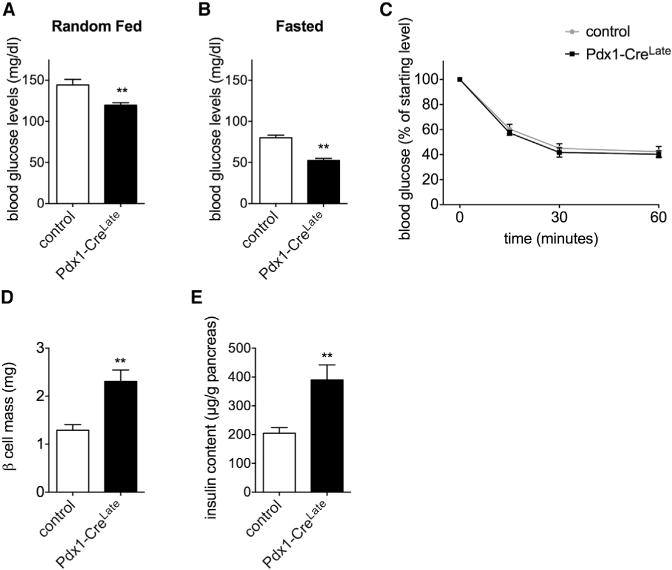
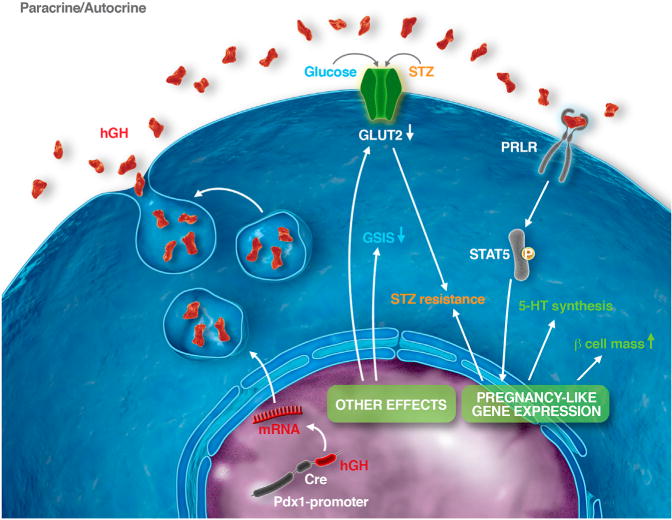
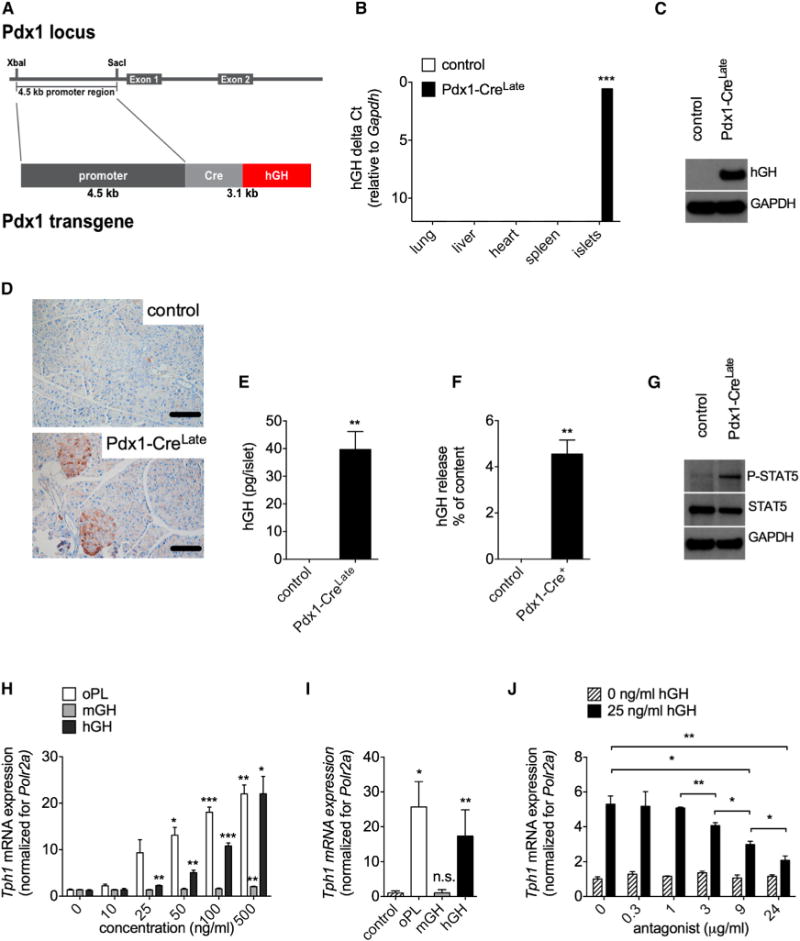
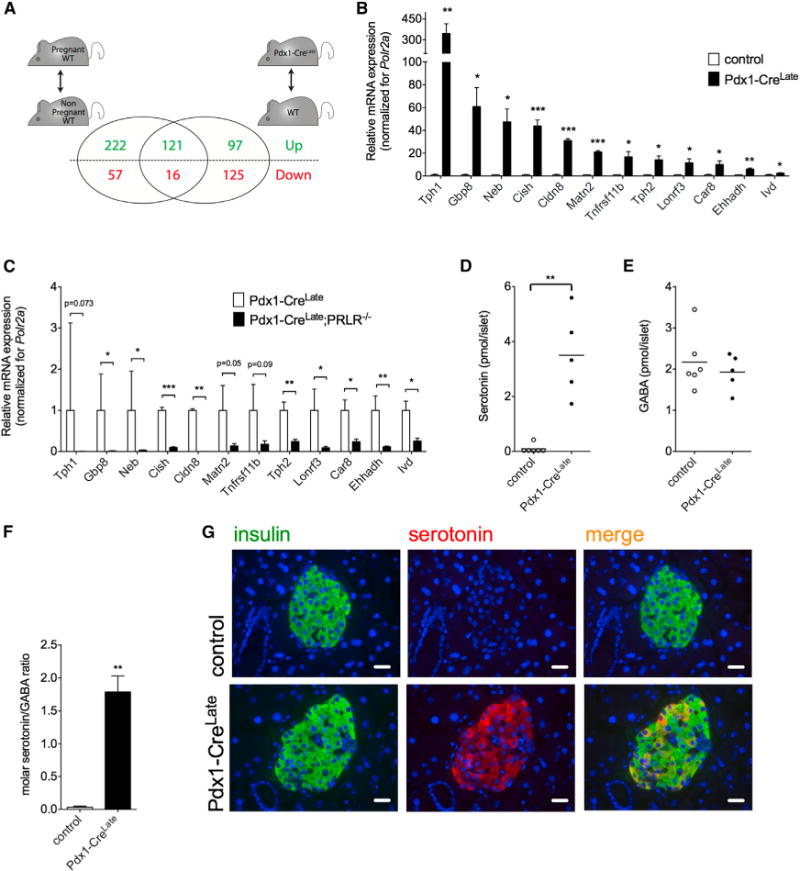
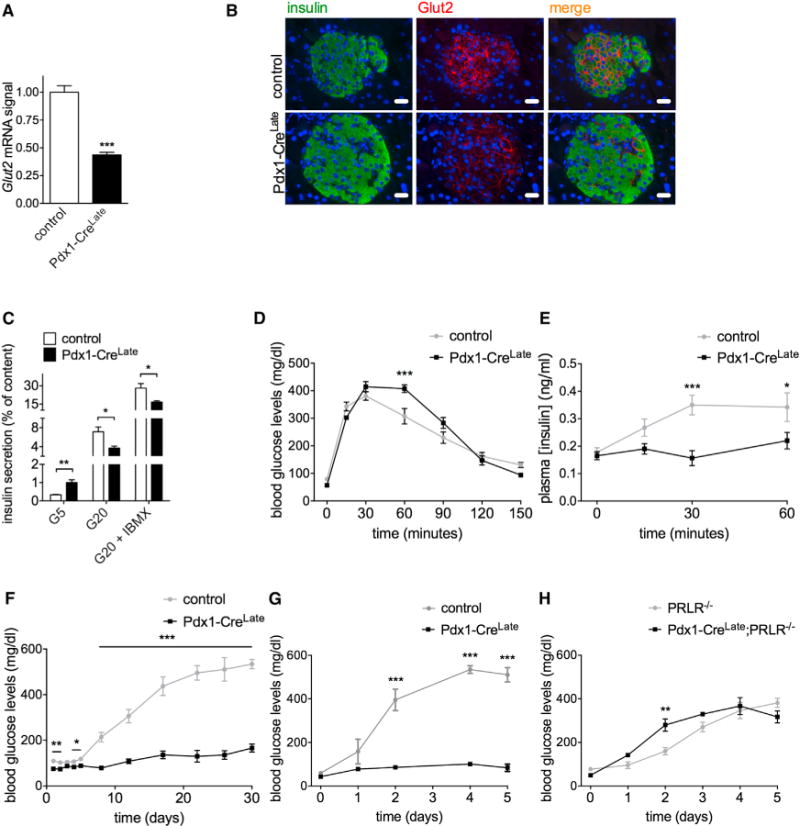
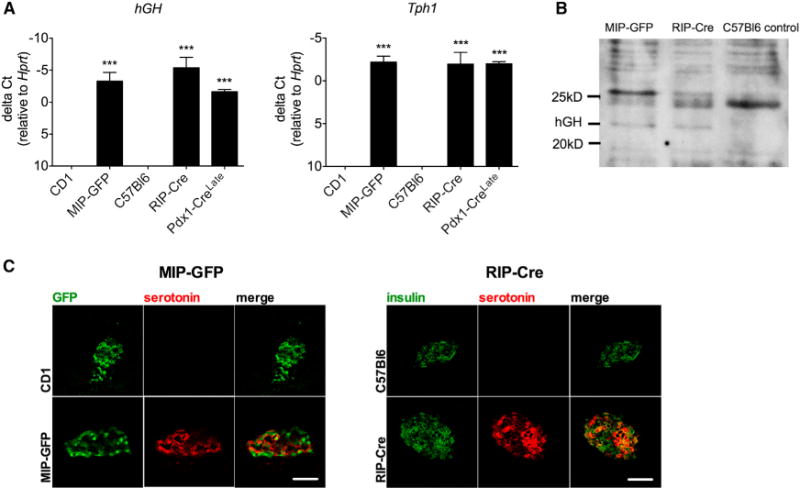
The human growth hormone (hGH) minigene is frequently used in the derivation of transgenic mouse lines to enhance transgene expression. Although this minigene is present in the transgenes as a secondcistron, and thus not thought to be expressed, we found that three commonly used lines, Pdx1-Cre(Late), RIP-Cre, and MIP-GFP, each expressed significant amounts of hGH in pancreatic islets. Locally secreted hGH binds to prolactin receptors on β cells, activates STAT5 signaling, and induces pregnancy-like changes in gene expression, thereby augmenting pancreatic β cell mass and insulin content. In addition, islets of Pdx1-Cre(Late) mice have lower GLUT2 expression and reduced glucose-induced insulin release and are protected against the β cell toxin streptozotocin. These findings may be important when interpreting results obtained when these and other hGH minigene-containing transgenic mice are used.
人类生长激素(hGH)微型基因常用于转基因小鼠品系的培育,以增强转基因表达。尽管这个微型基因作为第二个顺反子存在于转基因中,因此一般认为它不会表达,但我们发现三个常用品系,即Pdx1-Cre(晚期)、RIP-Cre和MIP-GFP,在胰岛中均表达了大量的hGH。局部分泌的hGH与β细胞上的催乳素受体结合,激活STAT5信号,并诱导基因表达发生类似妊娠的变化,从而增加胰腺β细胞数量和胰岛素含量。此外,Pdx1-Cre(晚期)小鼠的胰岛具有较低的GLUT2表达和葡萄糖诱导的胰岛素释放减少的现象,并且对β细胞毒素链脲佐菌素具有抗性。在解释使用这些以及其他含有hGH微型基因的转基因小鼠所获得的结果时,这些发现可能具有重要意义。