Madura Florian, Rizkallah Pierre J, Holland Christopher J, Fuller Anna, Bulek Anna, Godkin Andrew J, Schauenburg Andrea J, Cole David K, Sewell Andrew K
Division of Infection and Immunity, Cardiff University School of Medicine, Heath Park, Cardiff, UK.
Eur J Immunol. 2015 Feb;45(2):584-91. doi: 10.1002/eji.201445114. Epub 2014 Dec 28.
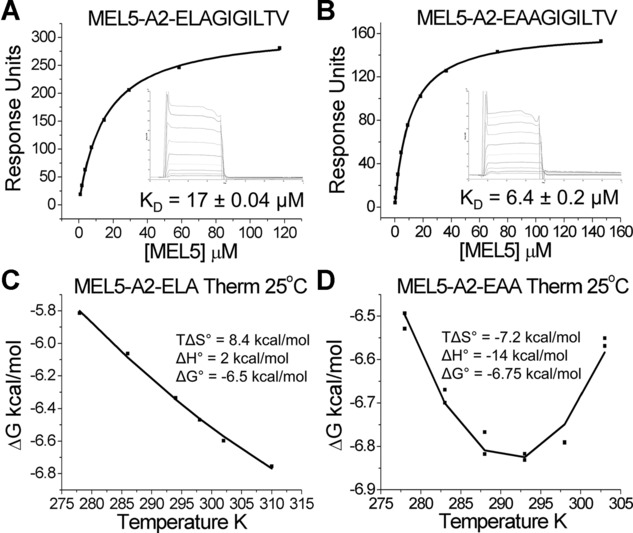
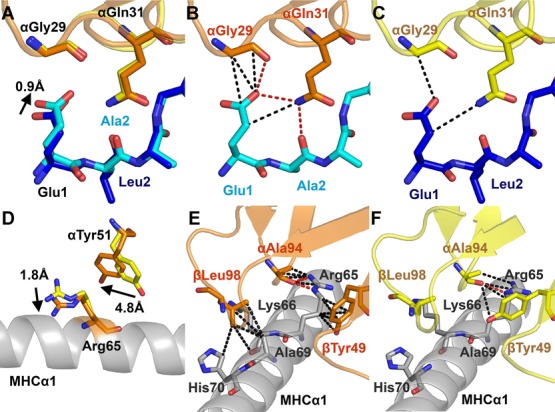
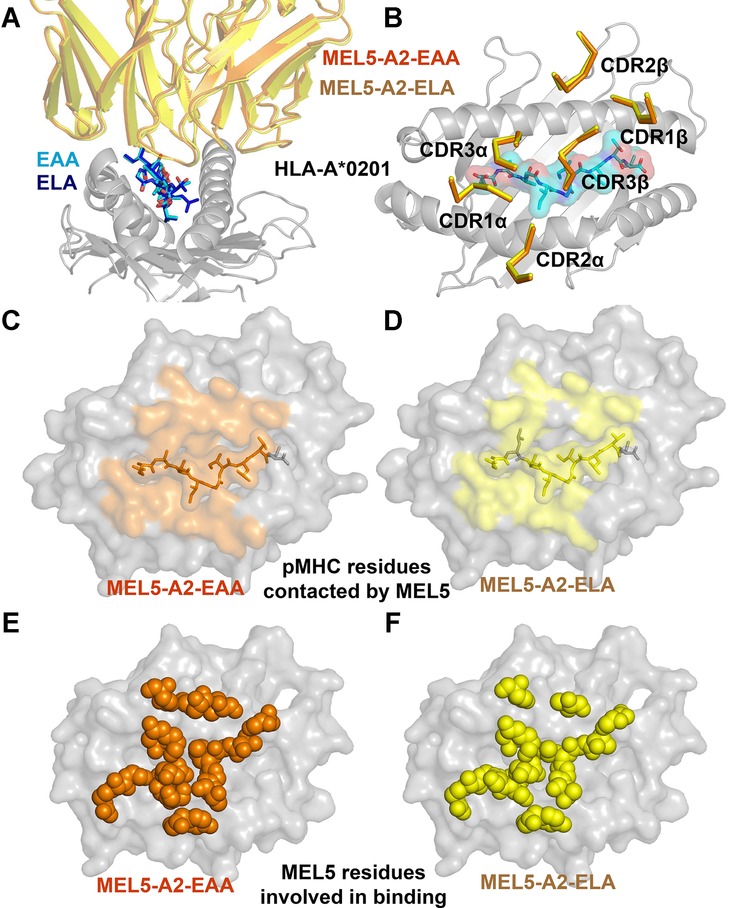
MHC anchor residue-modified "heteroclitic" peptides have been used in many cancer vaccine trials and often induce greater immune responses than the wild-type peptide. The best-studied system to date is the decamer MART-1/Melan-A26-35 peptide, EAAGIGILTV, where the natural alanine at position 2 has been modified to leucine to improve human leukocyte antigen (HLA)-A0201 anchoring. The resulting ELAGIGILTV peptide has been used in many studies. We recently showed that T cells primed with the ELAGIGILTV peptide can fail to recognize the natural tumor-expressed peptide efficiently, thereby providing a potential molecular reason for why clinical trials of this peptide have been unsuccessful. Here, we solved the structure of a TCR in complex with HLA-A0201-EAAGIGILTV peptide and compared it with its heteroclitic counterpart , HLA-A*0201-ELAGIGILTV. The data demonstrate that a suboptimal anchor residue at position 2 enables the TCR to "pull" the peptide away from the MHC binding groove, facilitating extra contacts with both the peptide and MHC surface. These data explain how a TCR can distinguish between two epitopes that differ by only a single MHC anchor residue and demonstrate how weak MHC anchoring can enable an induced-fit interaction with the TCR. Our findings constitute a novel demonstration of the extreme sensitivity of the TCR to minor alterations in peptide conformation.
MHC锚定残基修饰的“异质性”肽已用于许多癌症疫苗试验,并且通常比野生型肽诱导更强的免疫反应。迄今为止研究得最透彻的系统是十肽MART-1/Melan-A26-35肽,即EAAGIGILTV,其中第2位的天然丙氨酸已被修饰为亮氨酸,以改善人类白细胞抗原(HLA)-A0201的锚定作用。由此产生的ELAGIGILTV肽已在许多研究中使用。我们最近发现,用ELAGIGILTV肽启动的T细胞可能无法有效识别天然肿瘤表达的肽,从而为该肽的临床试验为何不成功提供了一个潜在的分子原因。在这里,我们解析了与HLA-A0201-EAAGIGILTV肽复合物中的TCR结构,并将其与其异质性对应物HLA-A*0201-ELAGIGILTV进行了比较。数据表明,第2位的次优锚定残基使TCR能够将肽从MHC结合槽中“拉”出,促进与肽和MHC表面的额外接触。这些数据解释了TCR如何区分仅因单个MHC锚定残基不同的两个表位,并展示了弱MHC锚定如何能够与TCR发生诱导契合相互作用。我们的发现首次证明了TCR对肽构象微小变化的极端敏感性。