Lee Su Nam, Hwang You-Mi, Kim Gee-Hee, Kim Ji-Hoon, Yoo Ki-Dong, Kim Chul-Min, Moon Keon-Woong
Department of Internal Medicine, St Vincent's Hospital, The Catholic University of Korea, Suwon, South Korea.
Clin Interv Aging. 2014 Nov 24;9:2027-31. doi: 10.2147/CIA.S74088. eCollection 2014.
Complete atrioventricular block (CAVB) in acute inferior ST-segment elevation myocardial infarction (STEMI) is associated with poor clinical outcomes after noninvasive treatment. This study was designed to determine the effect of primary percutaneous coronary intervention (PCI) in patients with CAVB complicating acute inferior STEMI, at a single center.
We enrolled 138 consecutive patients diagnosed with STEMI involving the inferior wall; of these, 27 patients had CAVB. All patients received primary PCI. The clinical characteristics, procedural data, and clinical outcomes were compared in patients with versus without CAVB.
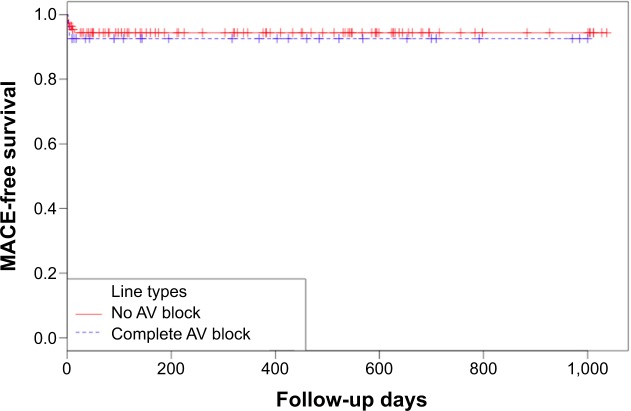
Baseline clinical characteristics were similar between patients with and without CAVB. Patients with CAVB were more likely to present with cardiogenic shock, and CAVB was caused primarily by right coronary artery occlusion. Door-to-balloon time was similar between those two groups. After primary PCI, CAVB was reversed in all patients. The peak creatinine phosphokinase level, left ventricular ejection fraction and in-hospital mortality rate were similar between the two groups. After a median follow up of 318 days, major adverse cardiac events did not differ between the groups (8.1% in patients without CAVB; 11.1% in patients with CAVB) (P=0.702).
We conclude that primary PCI can ameliorate CAVB-complicated acute inferior STEMI, with an acceptable rate of major adverse cardiac events, and suggest that primary PCI should be the preferred reperfusion therapy in patients with CAVB complicating acute inferior myocardial infarction.
急性下壁ST段抬高型心肌梗死(STEMI)合并完全性房室传导阻滞(CAVB)在接受非侵入性治疗后临床预后较差。本研究旨在确定在单中心对合并CAVB的急性下壁STEMI患者进行直接经皮冠状动脉介入治疗(PCI)的效果。
我们连续纳入了138例诊断为下壁STEMI的患者;其中27例患有CAVB。所有患者均接受了直接PCI。对合并与未合并CAVB的患者的临床特征、手术数据和临床结局进行了比较。
合并与未合并CAVB的患者基线临床特征相似。合并CAVB的患者更易出现心源性休克,且CAVB主要由右冠状动脉闭塞引起。两组患者的门球时间相似。直接PCI后,所有患者的CAVB均得到逆转。两组患者的肌酸磷酸激酶峰值水平、左心室射血分数和住院死亡率相似。中位随访318天后,两组间主要不良心脏事件无差异(未合并CAVB的患者为8.1%;合并CAVB的患者为11.1%)(P = 0.702)。
我们得出结论,直接PCI可改善合并CAVB的急性下壁STEMI,主要不良心脏事件发生率可接受,并建议直接PCI应成为合并CAVB的急性下壁心肌梗死患者的首选再灌注治疗方法。