Liu Weixi, Cohenford Menashi A, Frost Leslie, Seneviratne Champika, Dain Joel A
Department of Chemistry, University of Rhode Island, Kingston, RI, USA.
Department of Chemistry, University of Rhode Island, Kingston, RI, USA ; Department of Integrated Science and Technology, Marshall University, Huntington, WV, USA ; Department of Chemistry, Marshall University, Huntington, WV, USA.
Int J Nanomedicine. 2014 Nov 26;9:5461-9. doi: 10.2147/IJN.S70777. eCollection 2014.
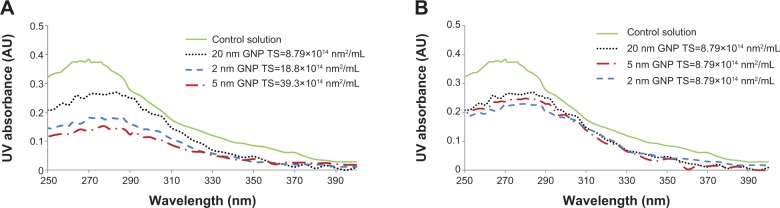
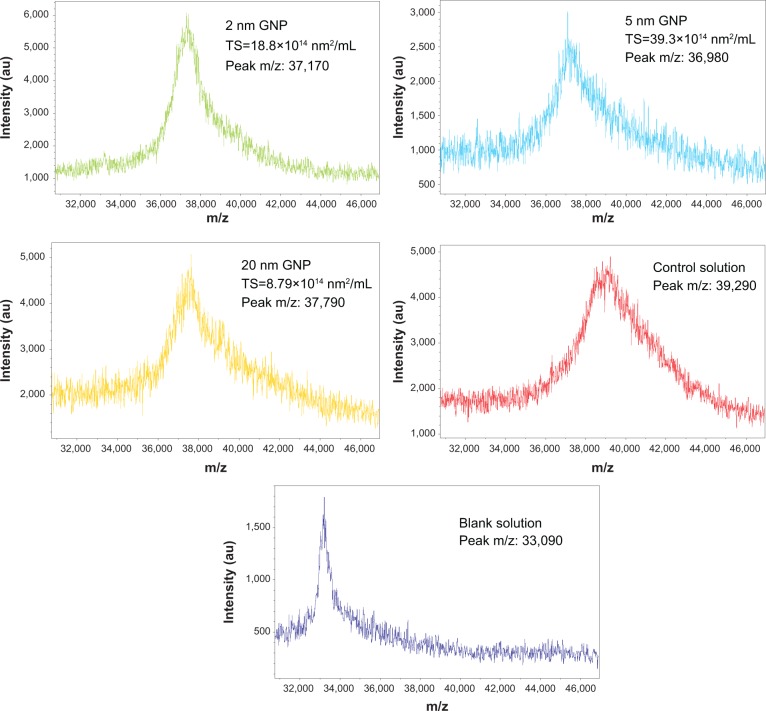
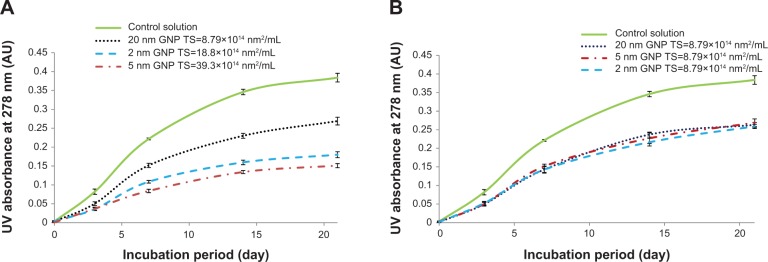
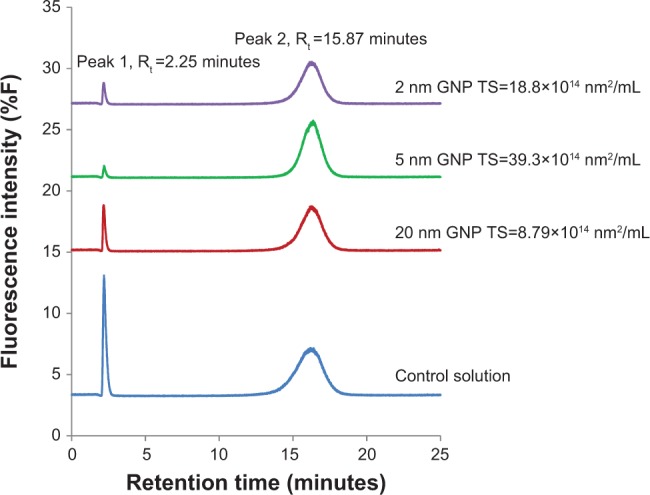
Formation of advanced glycation end products (AGEs) by nonenzymatic glycation of proteins is a major contributory factor to the pathophysiology of diabetic conditions including senile dementia and atherosclerosis. This study describes the inhibitory effect of gold nanoparticles (GNPs) on the D-ribose glycation of bovine serum albumin (BSA). A combination of analytical methods including ultraviolet-visible spectrometry, high performance liquid chromatography, circular dichroism, and matrix-assisted laser desorption/ionization time-of-flight (MALDI-TOF) mass spectrometry were used to determine the extent of BSA glycation in the presence of citrate reduced spherical GNPs of various sizes and concentrations. GNPs of particle diameters ranging from 2 nm to 20 nm inhibited BSA's AGE formation. The extent of inhibition correlated with the total surface area of the nanoparticles. GNPs of highest total surface area yielded the most inhibition whereas those with the lowest total surface area inhibited the formation of AGEs the least. Additionally, when GNPs' total surface areas were set the same, their antiglycation activities were similar. This inhibitory effect of GNPs on BSA's glycation by D-ribose suggests that colloidal particles may have a therapeutic application for the treatment of diabetes and conditions that promote hyperglycemia.
蛋白质的非酶糖基化形成晚期糖基化终产物(AGEs)是包括老年痴呆和动脉粥样硬化在内的糖尿病病理生理学的一个主要促成因素。本研究描述了金纳米颗粒(GNPs)对牛血清白蛋白(BSA)的D-核糖糖基化的抑制作用。使用包括紫外可见光谱法、高效液相色谱法、圆二色性和基质辅助激光解吸/电离飞行时间(MALDI-TOF)质谱法在内的多种分析方法,来确定在存在不同尺寸和浓度的柠檬酸盐还原球形GNPs的情况下BSA糖基化的程度。直径范围为2纳米至20纳米的GNPs抑制了BSA的AGE形成。抑制程度与纳米颗粒的总表面积相关。总表面积最高的GNPs产生的抑制作用最大,而总表面积最低的GNPs对AGEs形成的抑制作用最小。此外,当GNPs的总表面积设定相同时,它们抗糖基化的活性相似。GNPs对BSA被D-核糖糖基化的这种抑制作用表明,胶体颗粒可能在糖尿病及促进高血糖的病症治疗中具有治疗应用。