Centi Sonia, Tatini Francesca, Ratto Fulvio, Gnerucci Alessio, Mercatelli Raffaella, Romano Giovanni, Landini Ida, Nobili Stefania, Ravalli Andrea, Marrazza Giovanna, Mini Enrico, Fusi Franco, Pini Roberto
Dipartimento di Scienze Biomediche Sperimentali e Cliniche 'Mario Serio', Università degli Studi di Firenze, Viale Pieraccini 6, 50139, Firenze, Italy.
Istituto di Fisica Applicata 'Nello Carrara', Consiglio Nazionale delle Ricerche, Via Madonna del Piano 10, 50019, Sesto Fiorentino, Italy.
J Nanobiotechnology. 2014 Dec 5;12:55. doi: 10.1186/s12951-014-0055-3.
The interest for gold nanorods in biomedical optics is driven by their intense absorbance of near infrared light, their biocompatibility and their potential to reach tumors after systemic administration. Examples of applications include the photoacoustic imaging and the photothermal ablation of cancer. In spite of great current efforts, the selective delivery of gold nanorods to tumors through the bloodstream remains a formidable challenge. Their bio-conjugation with targeting units, and in particular with antibodies, is perceived as a hopeful solution, but the complexity of living organisms complicates the identification of possible obstacles along the way to tumors.
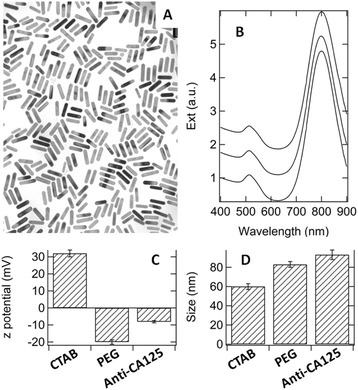
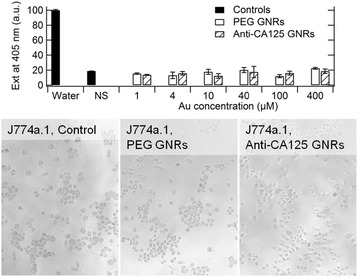
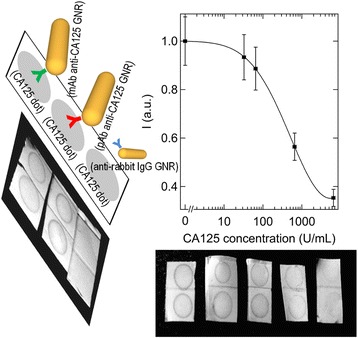
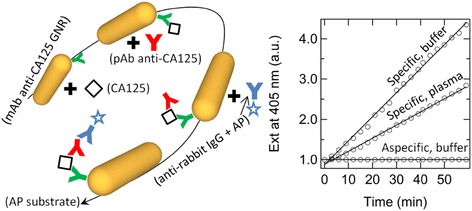
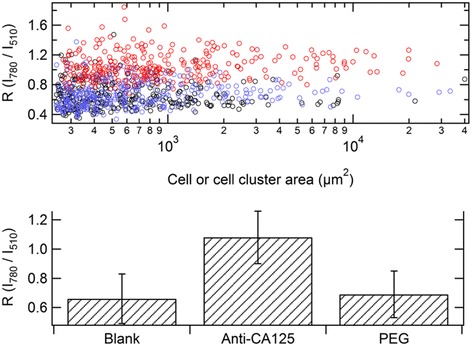
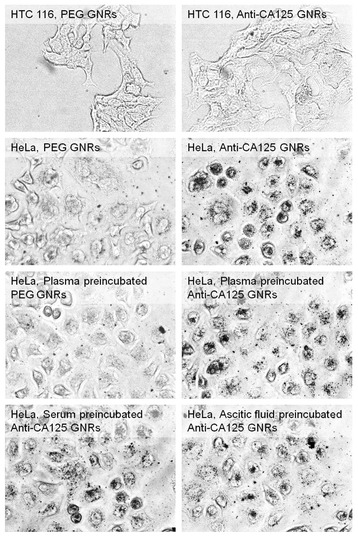
Here, we present a new model of gold nanorods conjugated with anti-cancer antigen 125 (CA125) antibodies, which exhibit high specificity for ovarian cancer cells. We implement a battery of tests in vitro, in order to simulate major nuisances and predict the feasibility of these particles for intravenous injections. We show that parameters like the competition of free CA125 in the bloodstream, which could saturate the probe before arriving at the tumors, the matrix effect and the interference with erythrocytes and phagocytes are uncritical.
Although some deterioration is detectable, anti-CA125-conjugated gold nanorods retain their functional features after interaction with blood tissue and so represent a powerful candidate to hit ovarian cancer cells.
金纳米棒在生物医学光学领域备受关注,这是由于它们对近红外光有强烈吸收、具有生物相容性以及在全身给药后有到达肿瘤部位的潜力。其应用实例包括光声成像和癌症的光热消融。尽管目前付出了巨大努力,但通过血液循环将金纳米棒选择性递送至肿瘤部位仍然是一项艰巨的挑战。它们与靶向单元,特别是与抗体的生物共轭被视为一种有希望的解决方案,但生物体的复杂性使得在通往肿瘤的过程中识别可能存在的障碍变得复杂。
在此,我们展示了一种与抗癌抗原125(CA125)抗体共轭的金纳米棒新模型,该模型对卵巢癌细胞具有高度特异性。我们在体外进行了一系列测试,以模拟主要干扰因素并预测这些颗粒进行静脉注射的可行性。我们表明,诸如血液中游离CA125的竞争(这可能在到达肿瘤之前使探针饱和)、基质效应以及与红细胞和吞噬细胞的相互干扰等参数并不关键。
尽管可检测到一些降解,但与抗CA125共轭的金纳米棒在与血液组织相互作用后仍保留其功能特性,因此是靶向卵巢癌细胞的有力候选物。