Harrison Stephanie L, Ding Jie, Tang Eugene Y H, Siervo Mario, Robinson Louise, Jagger Carol, Stephan Blossom C M
Institute of Health and Society, Newcastle University, Newcastle upon Tyne, Tyne and Wear, United Kingdom.
Laboratory of Epidemiology and Population Sciences, National Institute on Aging, NIH, Bethesda, Maryland, United States of America.
PLoS One. 2014 Dec 5;9(12):e114431. doi: 10.1371/journal.pone.0114431. eCollection 2014.
Cardiovascular disease and its risk factors have consistently been associated with poor cognitive function and incident dementia. Whether cardiovascular disease prediction models, developed to predict an individual's risk of future cardiovascular disease or stroke, are also informative for predicting risk of cognitive decline and dementia is not known.
The objective of this systematic review was to compare cohort studies examining the association between cardiovascular disease risk models and longitudinal changes in cognitive function or risk of incident cognitive impairment or dementia.
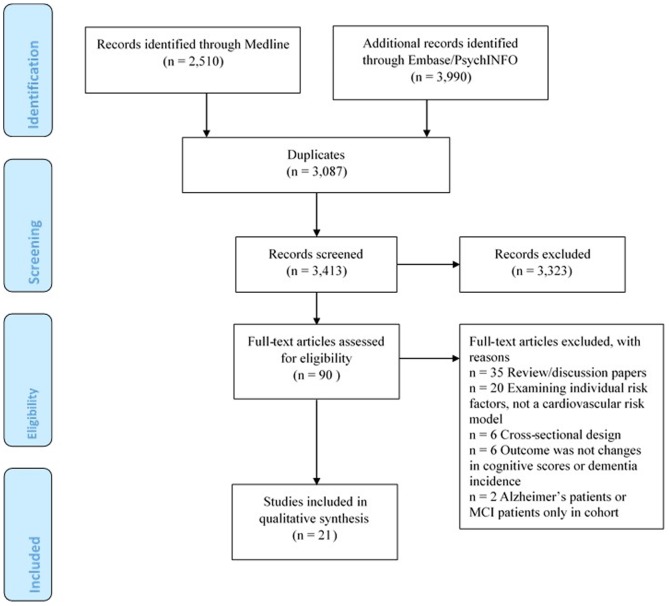
Medline, PsychINFO, and Embase were searched from inception to March 28, 2014. From 3,413 records initially screened, 21 were included.
The association between numerous different cardiovascular disease risk models and cognitive outcomes has been tested, including Framingham and non-Framingham risk models. Five studies examined dementia as an outcome; fourteen studies examined cognitive decline or incident cognitive impairment as an outcome; and two studies examined both dementia and cognitive changes as outcomes. In all studies, higher cardiovascular disease risk scores were associated with cognitive changes or risk of dementia. Only four studies reported model prognostic performance indices, such as Area Under the Curve (AUC), for predicting incident dementia or cognitive impairment and these studies all examined non-Framingham Risk models (AUC range: 0.74 to 0.78).
Cardiovascular risk prediction models are associated with cognitive changes over time and risk of dementia. Such models are easily obtainable in clinical and research settings and may be useful for identifying individuals at high risk of future cognitive decline and dementia.
心血管疾病及其危险因素一直与认知功能差和新发痴呆症相关。用于预测个体未来患心血管疾病或中风风险的心血管疾病预测模型,对于预测认知功能下降和痴呆症风险是否也具有参考价值尚不清楚。
本系统评价的目的是比较队列研究,这些研究考察了心血管疾病风险模型与认知功能的纵向变化或新发认知障碍或痴呆症风险之间的关联。
检索了从数据库建立至2014年3月28日的Medline、PsychINFO和Embase数据库。在最初筛选的3413条记录中,纳入了21条。
已经对众多不同的心血管疾病风险模型与认知结局之间的关联进行了测试,包括弗雷明汉风险模型和非弗雷明汉风险模型。五项研究将痴呆症作为结局进行考察;十四项研究将认知功能下降或新发认知障碍作为结局进行考察;两项研究同时将痴呆症和认知变化作为结局进行考察。在所有研究中,较高的心血管疾病风险评分与认知变化或痴呆症风险相关。只有四项研究报告了用于预测新发痴呆症或认知障碍的模型预后性能指标,如曲线下面积(AUC),并且这些研究均考察了非弗雷明汉风险模型(AUC范围:0.74至0.78)。
心血管疾病风险预测模型与认知功能随时间的变化以及痴呆症风险相关。此类模型在临床和研究环境中易于获得,可能有助于识别未来有认知功能下降和痴呆症高风险的个体。