Lai Z C, DeAngelo D J, DiLiberto M, Childs G
Department of Molecular Genetics, Albert Einstein Medical School, Bronx, New York 10461.
Mol Cell Biol. 1989 Jun;9(6):2315-21. doi: 10.1128/mcb.9.6.2315-2321.1989.
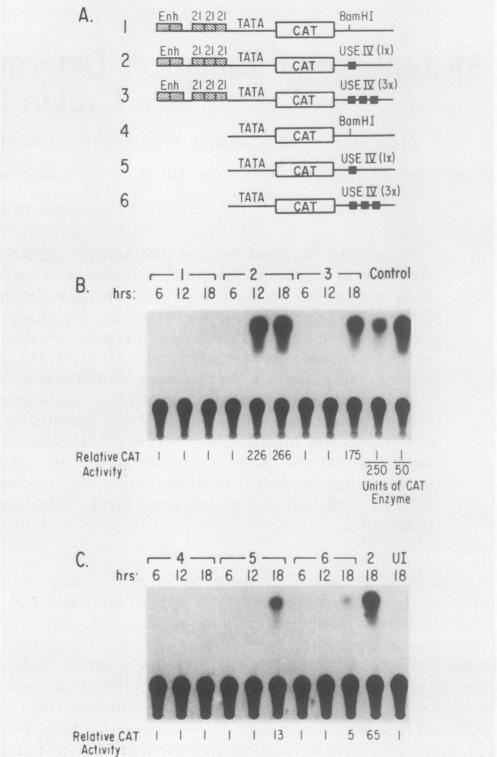
Normal development requires that individual genes be expressed in their correct temporal patterns, but the mechanisms regulating this process during early embryogenesis are poorly understood. We have studied the early and late sea urchin histone genes during embryogenesis to address the molecular mechanisms controlling temporal gene expression. By measuring the changes in expression of cloned H1-beta DNA constructs after microinjection into fertilized one-cell zygotes, we demonstrated that a highly conserved 30-base-pair segment of DNA between positions -288 and -317 (USE IV) is responsible for the transcriptional activation of this late histone gene at the late blastula stage. In this report, we demonstrate that an oligonucleotide corresponding to USE IV acts as an embryonic enhancer element capable of activating the simian virus 40 early promoter in a stage-specific manner. Using an in vivo competition assay and in vitro DNase I footprinting and mobility shift assays, we also identified a protein(s) that interacts with this enhancer. Results of the competition assay suggested that this factor acts to stimulate transcription of the H1-beta gene. The factor was found to be stored in mature eggs as well as in all embryonic stages examined. The mobility of the factor found in eggs, however, differed from that of the embryonic form, which suggested that posttranslational modification occurs after fertilization.
正常发育要求个体基因按其正确的时间模式表达,但在胚胎发育早期调控这一过程的机制却知之甚少。我们在胚胎发育过程中研究了海胆早期和晚期组蛋白基因,以探讨控制时间基因表达的分子机制。通过测量将克隆的H1-β DNA构建体显微注射到受精的单细胞受精卵后其表达的变化,我们证明了在位置-288和-317之间一段高度保守的30个碱基对的DNA片段(USE IV)负责该晚期组蛋白基因在囊胚晚期的转录激活。在本报告中,我们证明了与USE IV对应的寡核苷酸作为一种胚胎增强子元件,能够以阶段特异性方式激活猿猴病毒40早期启动子。使用体内竞争试验以及体外DNase I足迹试验和迁移率变动试验,我们还鉴定出一种与该增强子相互作用的蛋白质。竞争试验结果表明该因子起到刺激H1-β基因转录的作用。发现该因子在成熟卵以及所有检测的胚胎阶段均有储存。然而,在卵中发现的该因子的迁移率与胚胎形式的不同,这表明受精后发生了翻译后修饰。