Khandpur Sujay, Sahni Kanika
Department of Dermatology and Venereology, All India Institute of Medical Sciences, New Delhi, India.
Indian J Dermatol. 2014 Nov;59(6):579-83. doi: 10.4103/0019-5154.143523.
Chronic plaque psoriasis is a common papulosquamous skin disorder, for which a number of topical agents are being used including coal tar, topical steroids and more recently topical calcipotriol/betamethasone dipropionate. There is no study comparing purified coal tar preparation with calcipotriol/betamethasone dipropionate ointment in limited chronic plaque psoriasis.
A prospective randomized open label controlled trial to compare the efficacy and safety of topical application of coal tar-salicylic acid ointment with calcipotriol/betamethasone dipropionate ointment applied once at night for 12 weeks for the treatment of limited chronic plaque psoriasis.
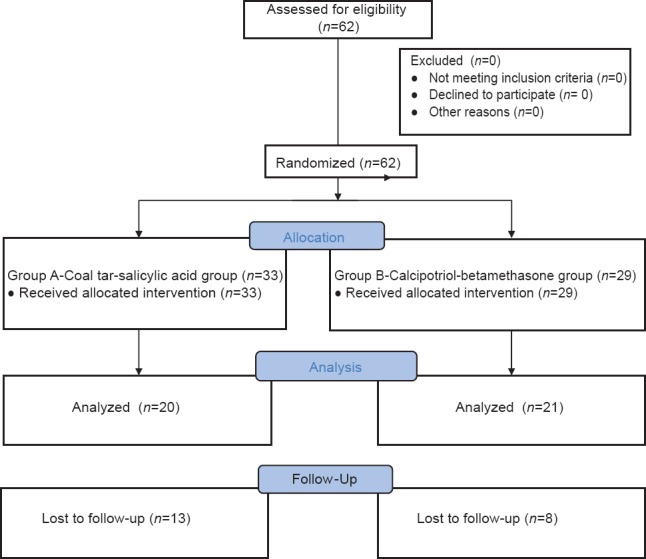
A total of 62 patients of limited chronic plaque psoriasis (body surface area <10%) were randomized into two treatment groups: Group A received topical application of 6% coal tar with 3% salicylic acid ointment and Group B received calcipotriol/betamethasone dipropionate, once at night for 12 weeks. Results were assessed based on psoriasis area severity index (PASI) scores and patient global assessment (PGA) at each visit.
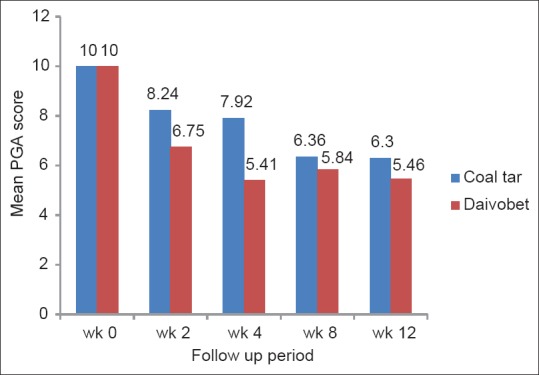
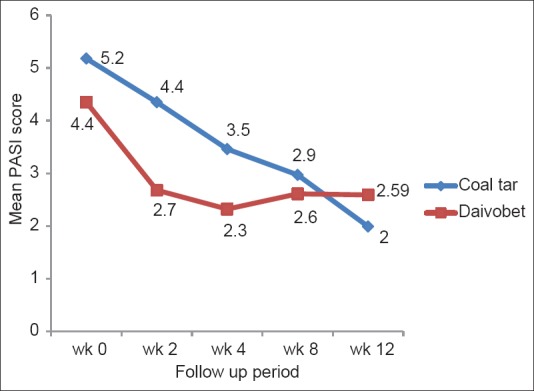
Mean PASI was significantly lower at week 2 (P = 0.01) and week 4 follow-up (P = 0.05) and the mean reduction in PASI was significantly higher at week 2 (P = 0.02) with calcipotriol/betamethasone than coal tar-salicylic acid, but this difference was not sustained at subsequent follow-up visits. Similarly, PGA scores at weeks 2 and 4 were significantly lower with calcipotriol/betamethasone dipropionate ointment (P = 0.003 and P = 0.007 respectively). There was no significant difference in any parameter during subsequent follow-up visits or at the end of the treatment phase (12 weeks).
Topical nightly application of calcipotriol/betamethasone dipropionate ointment leads to an initial, more rapid reduction in disease severity, but the overall outcome parameters are comparable in the two treatment groups.
慢性斑块状银屑病是一种常见的丘疹鳞屑性皮肤病,目前使用多种外用药物进行治疗,包括煤焦油、外用糖皮质激素以及最近的外用卡泊三醇/倍他米松二丙酸酯。尚无研究比较纯化煤焦油制剂与卡泊三醇/倍他米松二丙酸酯软膏治疗局限性慢性斑块状银屑病的疗效。
进行一项前瞻性随机开放标签对照试验,比较每晚外用一次煤焦油 - 水杨酸软膏与卡泊三醇/倍他米松二丙酸酯软膏治疗局限性慢性斑块状银屑病12周的疗效和安全性。
总共62例局限性慢性斑块状银屑病患者(体表面积<10%)被随机分为两个治疗组:A组每晚外用6%煤焦油与3%水杨酸软膏,B组每晚外用一次卡泊三醇/倍他米松二丙酸酯,共12周。每次随访时根据银屑病面积和严重程度指数(PASI)评分及患者整体评估(PGA)评估结果。
在第2周(P = 0.01)和第4周随访时(P = 0.05),卡泊三醇/倍他米松组的平均PASI显著更低,且在第2周时卡泊三醇/倍他米松组的PASI平均降低幅度显著高于煤焦油 - 水杨酸组(P = 0.02),但在随后的随访中这种差异未持续存在。同样,在第2周和第4周时卡泊三醇/倍他米松二丙酸酯软膏组的PGA评分显著更低(分别为P = 0.003和P = 0.007)。在随后的随访期间以及治疗阶段结束时(12周),任何参数均无显著差异。
每晚外用卡泊三醇/倍他米松二丙酸酯软膏可使疾病严重程度最初更快降低,但两个治疗组的总体结局参数相当。