Makvandi Manoochehr, Neisi Niloofar, Khalafkhany Davod, Makvandi Kamyar, Hajiani Eskandar, Shayesteh Ali Akbar, Masjedi Zadeh Abdolrahim, Sina Amir Hosein, Hamidifard Mojtaba, Rasti Mojtaba, Aryan Ehsan, Ahmadi Kambiz, Yad Yad Mohammad Jafar
Infectious and Tropical Disease Research Center, Ahvaz Jundishapur University of Medical Sciences, Ahvaz, IR Iran ; Research Institute for Infectious Diseases of Digestive System, Ahvaz Jundishapur University of Medical Sciences, Ahvaz, IR Iran ; Virology Department, Ahvaz Jundishapur University of Medical Sciences, Ahvaz, IR Iran.
Virology Department, Ahvaz Jundishapur University of Medical Sciences, Ahvaz, IR Iran.
Jundishapur J Microbiol. 2014 Aug;7(8):e11648. doi: 10.5812/jjm.11648. Epub 2014 Jul 13.
The occult hepatitis B infection (OBI) is defined as the presence of hepatitis B virus (HBV) DNA in the sera or in the liver biopsy and the absence of hepatitis B surface antigen (HBsAg) by serological test.
The current study aimed to evaluate the occult HBV infection by polymerase chain reaction (PCR) and determine HBV genotyping among the patients with abnormal alanine transaminase (ALT) in Ahvaz city, Iran.
The sera of 120 patients, 54 (45%) females and 66 (55%) males, with abnormal ALT 40-152 IU were collected. All the patients were negative for HBsAg for more than one year. The patients` sera were tested by PCR using primers specified for the S region of HBV. Then the positive PCR products were sequenced to determine HBV genotyping and phylogenic tree.
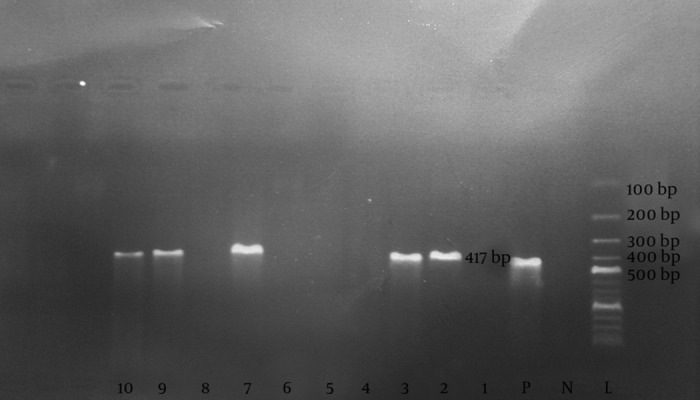
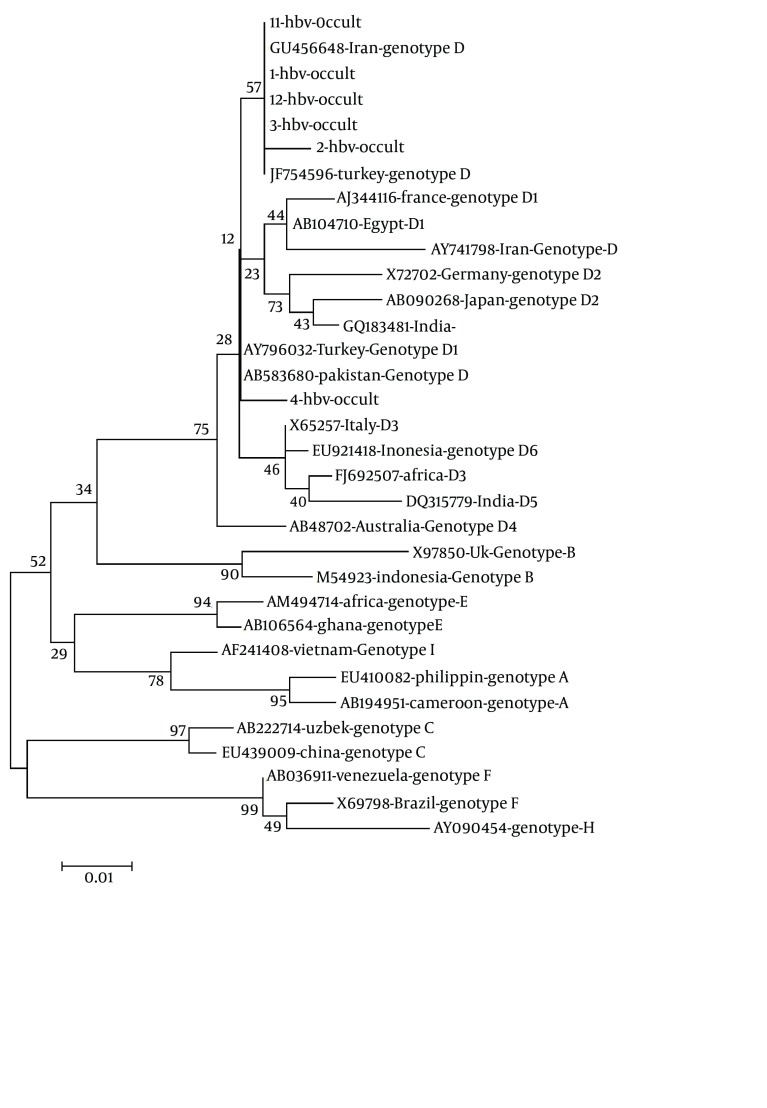
Of these 120 subjects, 12 (10%) patients including 6 (5%) males and 6 (5%) females were found positive for HBV DNA by PCR, which indicated the presence of occult HBV infection among these patients. The sequencing results revealed that genotype D was predominant with sub-genotyping D1 among OBI patients.
Occult hepatitis B infection is remarkably prevalent in Ahvaz, Iran, and should be considered as a potential risk factor for the transmission of Hepatitis B Virus throughout the community by the carriers.
隐匿性乙型肝炎感染(OBI)的定义为血清或肝活检中存在乙型肝炎病毒(HBV)DNA,且血清学检测乙型肝炎表面抗原(HBsAg)阴性。
本研究旨在通过聚合酶链反应(PCR)评估伊朗阿瓦士市丙氨酸转氨酶(ALT)异常患者中的隐匿性HBV感染情况,并确定HBV基因分型。
收集了120例ALT异常(40 - 152 IU)患者的血清,其中女性54例(45%),男性66例(55%)。所有患者HBsAg阴性超过一年。使用针对HBV S区域的引物通过PCR检测患者血清。然后对阳性PCR产物进行测序以确定HBV基因分型和系统发育树。
在这120名受试者中,12例(10%)患者包括6例(5%)男性和6例(5%)女性通过PCR检测HBV DNA呈阳性,这表明这些患者中存在隐匿性HBV感染。测序结果显示,OBI患者中D基因型占主导,其中D1亚型为主。
隐匿性乙型肝炎感染在伊朗阿瓦士市非常普遍,应被视为携带者在整个社区传播乙型肝炎病毒的潜在危险因素。