Kim Jun W, Cochran Frank V, Cochran Jennifer R
Departments of †Bioengineering and ‡Chemical Engineering, Stanford University , Stanford, California 94305, United States.
J Am Chem Soc. 2015 Jan 14;137(1):6-9. doi: 10.1021/ja508416e. Epub 2014 Dec 22.
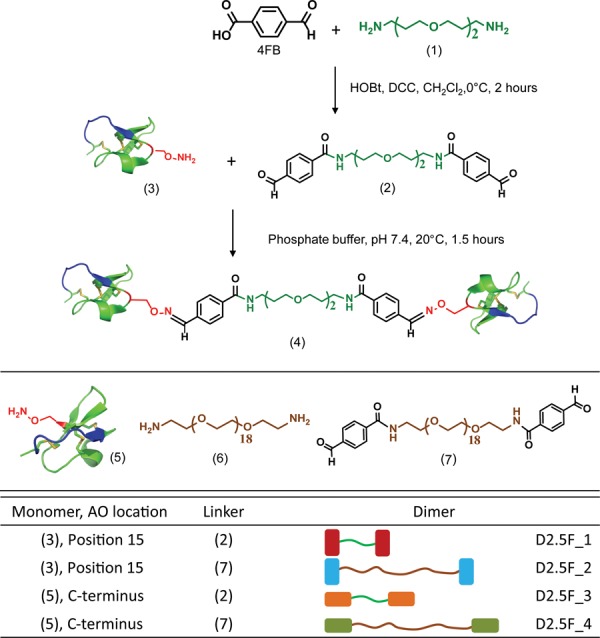
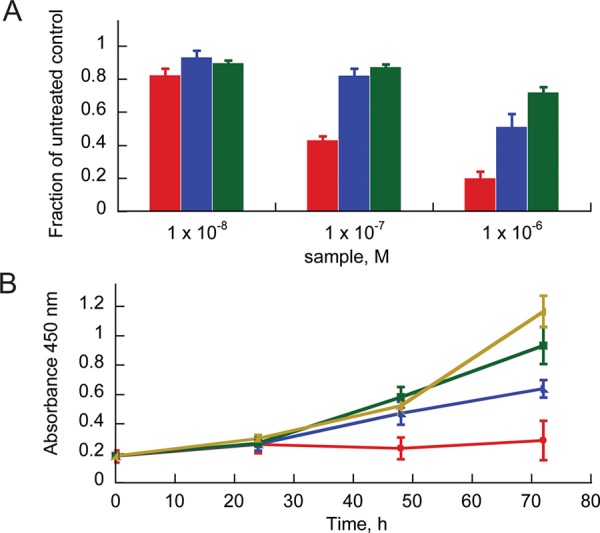
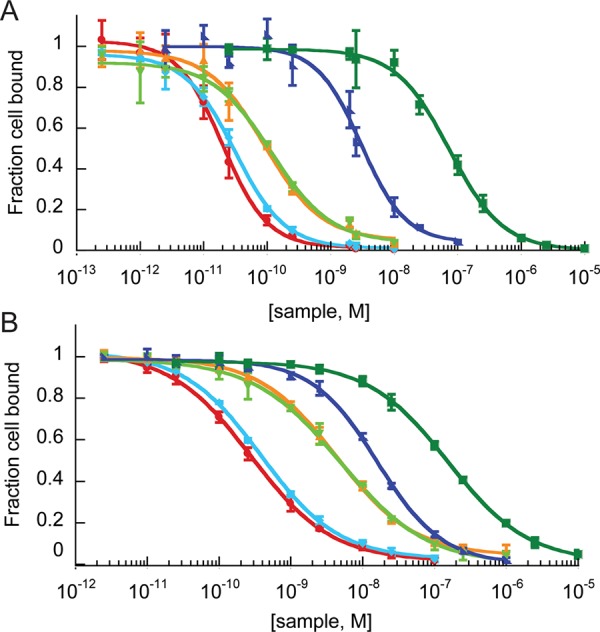
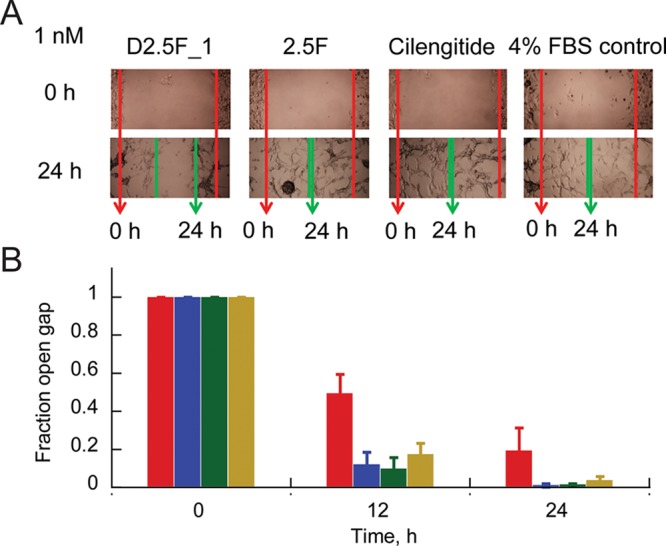
Molecules that target and inhibit αvβ3, αvβ5, and α5β1 integrins have generated great interest because of the role of these receptors in mediating angiogenesis and metastasis. Attempts to increase the binding affinity and hence the efficacy of integrin inhibitors by dimerization have been marginally effective. In the present work, we achieved this goal by using oxime-based chemical conjugation to synthesize dimers of integrin-binding cystine knot (knottin) miniproteins with low-picomolar binding affinity to tumor cells. A non-natural amino acid containing an aminooxy side chain was introduced at different locations within a knottin monomer and reacted with dialdehyde-containing cross-linkers of different lengths to create knottin dimers with varying molecular topologies. Dimers cross-linked through an aminooxy functional group located near the middle of the protein exhibited higher apparent binding affinity to integrin-expressing tumor cells compared with dimers cross-linked through an aminooxy group near the C-terminus. In contrast, the cross-linker length had no effect on the integrin binding affinity. A chemical-based dimerization strategy was critical, as knottin dimers created through genetic fusion to a bivalent antibody domain exhibited only modest improvement (less than 5-fold) in tumor cell binding relative to the knottin monomer. The best oxime-conjugated knottin dimer achieved an unprecedented 150-fold increase in apparent binding affinity over the knottin monomer. Also, this dimer bound 3650-fold stronger and inhibited tumor cell migration and proliferation compared with cilengitide, an integrin-targeting peptidomimetic that performed poorly in recent clinical trials, suggesting promise for further therapeutic development.
由于αvβ3、αvβ5和α5β1整合素在介导血管生成和转移中所起的作用,靶向并抑制这些整合素的分子引起了广泛关注。通过二聚化来提高整合素抑制剂的结合亲和力从而增强其疗效的尝试,效果并不显著。在本研究中,我们通过基于肟的化学偶联实现了这一目标,合成了对肿瘤细胞具有低皮摩尔结合亲和力的整合素结合胱氨酸结(knottin)小蛋白二聚体。在knottin单体的不同位置引入含氨氧基侧链的非天然氨基酸,并与不同长度的含二醛交联剂反应,以创建具有不同分子拓扑结构的knottin二聚体。与通过C末端附近的氨氧基交联的二聚体相比,通过位于蛋白质中部附近的氨氧基官能团交联的二聚体对表达整合素的肿瘤细胞表现出更高的表观结合亲和力。相比之下,交联剂长度对整合素结合亲和力没有影响。基于化学的二聚化策略至关重要,因为通过与二价抗体结构域基因融合产生的knottin二聚体在肿瘤细胞结合方面相对于knottin单体仅表现出适度的改善(小于5倍)。最佳的肟偶联knottin二聚体相对于knottin单体在表观结合亲和力上实现了前所未有的150倍增长。此外,与西仑吉肽相比,这种二聚体的结合力强3650倍,并抑制肿瘤细胞迁移和增殖,西仑吉肽是一种靶向整合素的拟肽,在最近的临床试验中表现不佳,这表明其在进一步治疗开发方面具有潜力。