Chao Chia-Ter, Lee Szu-Ying, Yang Wei-Shun, Yen Chung-Jen, Chiang Chih-Kang, Huang Jenq-Wen, Hung Kuan-Yu
1] Division of Nephrology, Department of Internal Medicine, National Taiwan University Hospital [2] Division of Nephrology, Department of Internal Medicine, Jin-Shan branch, New Taipei City [3] Graduate Institute of Toxicology, National Taiwan University, Taipei, Taiwan.
Division of Nephrology, Department of Internal Medicine, Yun-Lin branch, Yun-Lin County.
Sci Rep. 2014 Dec 9;4:7371. doi: 10.1038/srep07371.
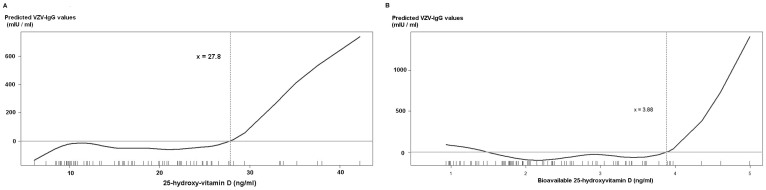
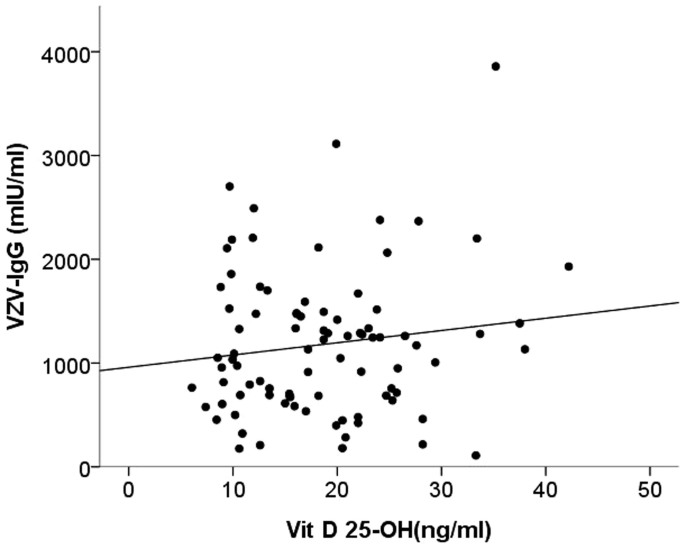
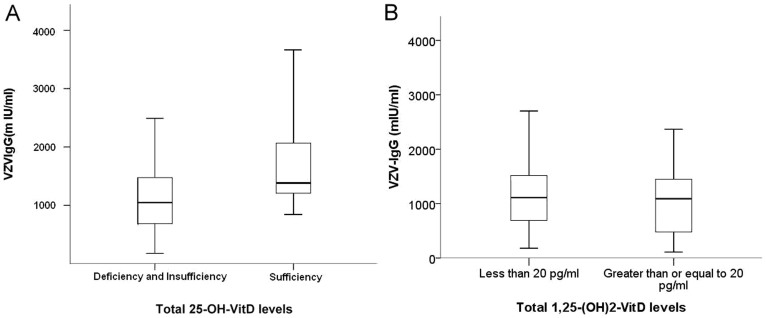
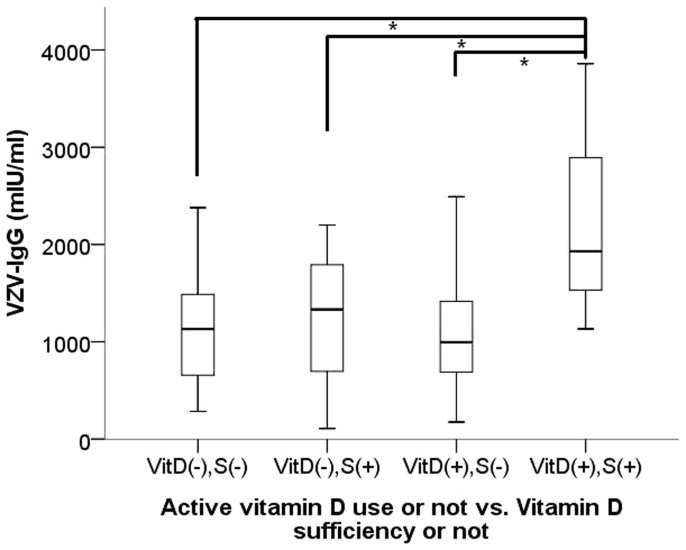
Uremia results in a relatively immunocompromised status, and patients under chronic dialysis have an elevated risk of developing herpes zoster (HZ). We sought to investigate the relationship between vitamin D status and immunity to varicella-zoster virus (VZV). A multicenter prevalent hemodialysis cohort was assembled between 2012 and 2013. We assayed the biochemical parameters, 25-hydroxy- (25-OH-D) and 1,25-dihydroxyvitamin D, vitamin D-binding protein levels in the sera. VZV immunity was quantitated using VZV-specific glycoprotein IgG and IgM titers. Eighty-eight patients were enrolled and their sera were analyzed. Chronic hemodialysis patients with 25-OH-D < 30 ng/ml (insufficiency or deficiency) had significantly lower VZV-IgG than those with sufficient 25-OH-D (p = 0.04). This discrepancy became more prominent if active vitamin D users alone were analyzed (p = 0.01). Generalized additive modeling showed that those with 25-OH-D higher than 27.8 ng/ml or bioavailable 25-OH-D higher than 3.88 ng/ml had significantly higher VZV-IgG levels than those with lower values. Linear regression suggested that both total and bioavailable 25-OH-D were significantly associated with higher VZV-IgG levels (p = 0.003 [total] and 0.01 [bioavailable]), whereas patients with cancer had lower VZV-IgG. Vitamin D may therefore be a potentially useful choice for raising VZV immunity in chronic dialysis patients.
尿毒症会导致相对免疫功能低下的状态,接受慢性透析的患者发生带状疱疹(HZ)的风险升高。我们试图研究维生素D状态与水痘-带状疱疹病毒(VZV)免疫力之间的关系。在2012年至2013年期间组建了一个多中心血液透析现患队列。我们检测了血清中的生化参数、25-羟基维生素D(25-OH-D)和1,25-二羟基维生素D、维生素D结合蛋白水平。使用VZV特异性糖蛋白IgG和IgM滴度对VZV免疫力进行定量。纳入了88例患者并对他们的血清进行了分析。25-OH-D<30 ng/ml(不足或缺乏)的慢性血液透析患者的VZV-IgG显著低于25-OH-D充足的患者(p=0.04)。如果仅分析活性维生素D使用者,这种差异会更加明显(p=0.01)。广义相加模型显示,25-OH-D高于27.8 ng/ml或生物可利用的25-OH-D高于3.88 ng/ml的患者的VZV-IgG水平显著高于值较低的患者。线性回归表明,总25-OH-D和生物可利用的25-OH-D均与较高的VZV-IgG水平显著相关(p=0.003[总]和0.01[生物可利用]),而癌症患者的VZV-IgG较低。因此,维生素D可能是提高慢性透析患者VZV免疫力的一个潜在有用选择。