Taher Chato, Frisk Gabriella, Fuentes Stina, Religa Piotr, Costa Helena, Assinger Alice, Vetvik Katja Kannisto, Bukholm Ida R K, Yaiw Koon-Chu, Smedby Karin Ekström, Bäcklund Magnus, Söderberg-Naucler Cecilia, Rahbar Afsar
Unit of Experimental Medicine (L8:03), Center for Molecular Medicine, Department of Medicine, Solna, Karolinska Institute, Stockholm, Sweden.
Clinical Epidemiology Unit, Karolinska University Hospital, Stockholm, Sweden; Department of Oncology, Karolinska University Hospital, Stockholm, Sweden.
Transl Oncol. 2014 Dec;7(6):732-40. doi: 10.1016/j.tranon.2014.09.008.
Brain metastases (BMs) develop by largely unknown mechanisms and cause major morbidity and mortality in patients with solid tumors. Human cytomegalovirus (HCMV) is frequently detected in tumor tissue from patients with different cancers. Here, we aimed to determine the prevalence and potential prognostic role of HCMV in BMs.
We obtained archived samples of BMs from 41 patients with breast cancer and 37 with colorectal cancer and paired primary tumor tissues from 13 and 12 patients in each respective group. In addition, primary breast cancer tissues from 15 patients were included. HCMV proteins were detected with an immunohistochemical technique and Western blot. HCMV nucleic acids were detected with TaqMan polymerase chain reaction (PCR) assay.
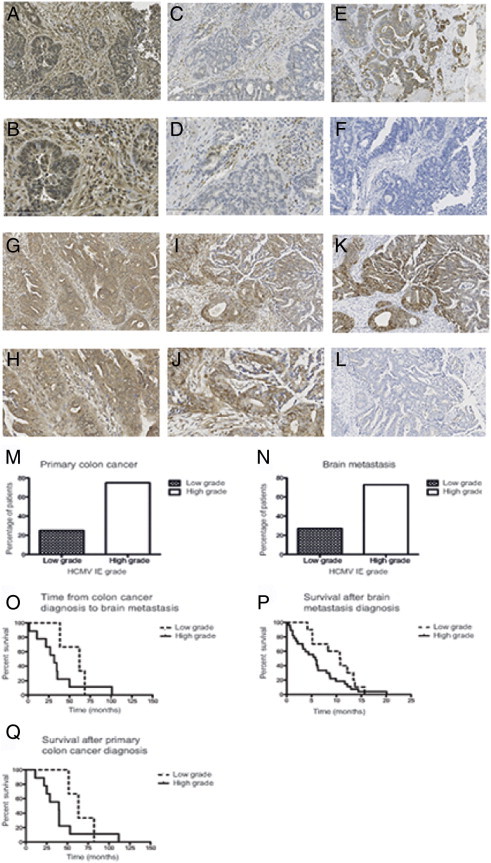
HCMV proteins were abundantly expressed in 99% of BM specimens, and in 12 of 13 (92%) paired primary breast cancer specimens. All 12 paired colon cancer samples were positive for HCMV proteins. Protein staining was mainly confined to neoplastic cells. Western blot analysis detected an HCMV-IE reactive protein in 53% of breast cancer specimens, and PCR detected the presence of HCMV DNA and transcripts in 92% and 80% of samples, respectively. Patients with high-level expression of HCMV-IE proteins in their tumors had a shorter time to tumor progression and shorter overall survival.
The prevalence of HCMV proteins and nucleic acids is very high in primary and metastatic tumors and may drive the development of metastatic brain tumors; therefore, this virus may represent a potential therapeutic target in metastatic cancer.
脑转移瘤(BMs)的发生机制大多不明,且在实体瘤患者中会导致严重的发病和死亡。人巨细胞病毒(HCMV)在不同癌症患者的肿瘤组织中经常被检测到。在此,我们旨在确定HCMV在脑转移瘤中的患病率及其潜在的预后作用。
我们获取了41例乳腺癌患者和37例结直肠癌患者的脑转移瘤存档样本,以及每组中分别13例和12例患者的配对原发性肿瘤组织。此外,还纳入了15例患者的原发性乳腺癌组织。采用免疫组织化学技术和蛋白质印迹法检测HCMV蛋白。用TaqMan聚合酶链反应(PCR)检测HCMV核酸。
HCMV蛋白在99%的脑转移瘤标本中大量表达,在13例配对原发性乳腺癌标本中的12例(92%)中也大量表达。所有12对结肠癌样本的HCMV蛋白均呈阳性。蛋白染色主要局限于肿瘤细胞。蛋白质印迹分析在53%的乳腺癌标本中检测到一种HCMV-IE反应性蛋白,PCR分别在92%和80%的样本中检测到HCMV DNA和转录本的存在。肿瘤中HCMV-IE蛋白高表达的患者肿瘤进展时间较短,总生存期也较短。
HCMV蛋白和核酸在原发性和转移性肿瘤中的患病率非常高,可能推动转移性脑肿瘤的发展;因此,这种病毒可能是转移性癌症的一个潜在治疗靶点。