Pierce Janene, Murphy Andrew J, Panzer Alexis, de Caestecker Christian, Ayers Gregory D, Neblett David, Saito-Diaz Kenyi, de Caestecker Mark, Lovvorn Harold N
Department of Pediatric Surgery, Vanderbilt University School of Medicine, Nashville, TN, USA.
Department of Biostatistics, Vanderbilt University School of Medicine, Nashville, TN, USA.
Transl Oncol. 2014 Dec;7(6):800-11. doi: 10.1016/j.tranon.2014.09.005.
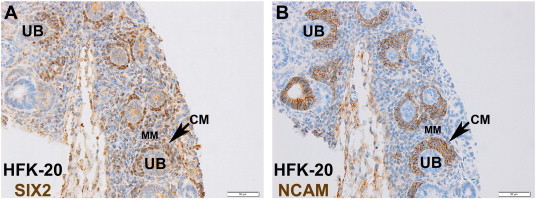
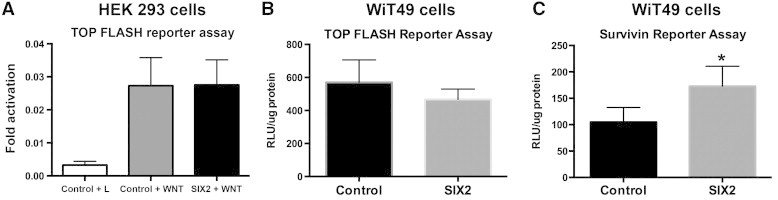
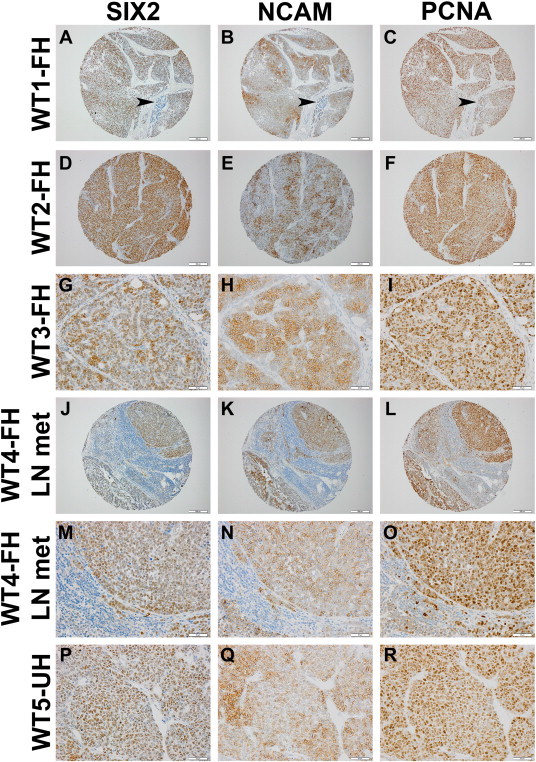
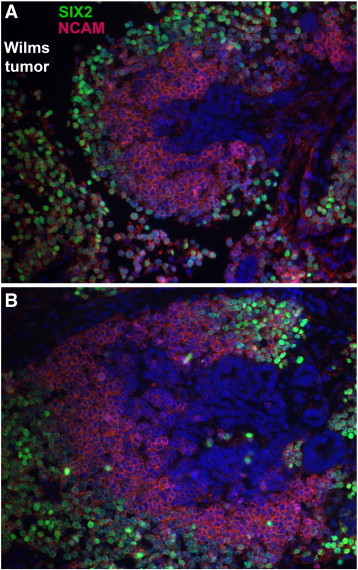
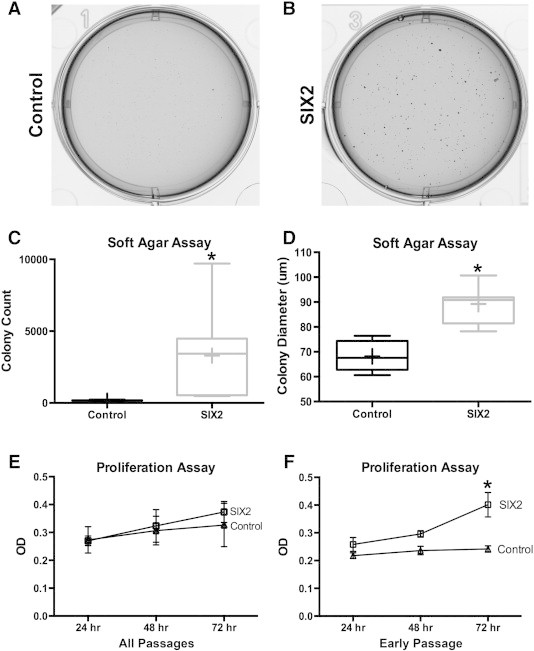
Wilms tumor (WT) blastema retains gene expression profiles characteristic of the multipotent nephron progenitor pool, or cap mesenchyme (CM), in the developing kidney. As a result, WT blastema and the CM are believed to represent contextual analogues of one another. Sine oculis homeobox 2 (SIX2) is a transcription factor expressed specifically in the CM, provides a critical mechanism for CM self-renewal, and remains persistently active in WT blastema, although its purpose in this childhood malignancy remains unclear. We hypothesized that SIX2, analogous to its function in development, confers a survival pathway to blastema, the putative WT stem cell. To test its functional significance in WT biology, wild-type SIX2 was overexpressed in the human WT cell line, WiT49. After validating this model, SIX2 effects on anchorage-independent growth, proliferation, invasiveness, canonical WNT pathway signaling, and gene expression of specific WNT pathway participants were evaluated. Relative to controls, WiT49 cells overexpressing SIX2 showed significantly enhanced anchorage-independent growth and early-passage proliferation representing surrogates of cell survival. Interestingly, overexpression of SIX2 generally repressed TCF/LEF-dependent canonical WNT signaling, which activates and coordinates both differentiation and stem pathways, but significantly heightened canonical WNT signaling through the survivin promoter, a mechanism that exclusively maintains the stem state. In summary, when overexpressed in a human WT cell line, SIX2 enhances cell survival and appears to shift the balance in WNT/β-catenin signaling away from a differentiation path and toward a stem cell survival path.
肾母细胞瘤(WT)胚基保留了发育中的肾脏中多能肾单位祖细胞池或帽状间充质(CM)的基因表达谱特征。因此,WT胚基和CM被认为是彼此的背景类似物。无眼同源框2(SIX2)是一种在CM中特异性表达的转录因子,为CM的自我更新提供关键机制,并且在WT胚基中持续活跃,尽管其在这种儿童恶性肿瘤中的作用尚不清楚。我们假设,SIX2与其在发育中的功能类似,赋予了胚基(假定的WT干细胞)一条生存途径。为了测试其在WT生物学中的功能意义,野生型SIX2在人WT细胞系WiT49中过表达。在验证该模型后,评估了SIX2对不依赖贴壁生长、增殖、侵袭性、经典WNT通路信号传导以及特定WNT通路参与者基因表达的影响。相对于对照组,过表达SIX2的WiT49细胞显示出显著增强的不依赖贴壁生长和早期传代增殖,这代表了细胞存活的替代指标。有趣的是,SIX2的过表达通常抑制TCF/LEF依赖的经典WNT信号传导(该信号传导激活并协调分化和干细胞途径),但通过生存素启动子显著增强了经典WNT信号传导(这是一种专门维持干细胞状态的机制)。总之,当在人WT细胞系中过表达时SIX2可增强细胞存活,并似乎使WNT/β-连环蛋白信号传导平衡从分化途径转向干细胞存活途径。