Liu Jianing, Ju Pan, Zhou Yuru, Zhao Ya, Xie Yajun, Long Yaoshui, Gu Yuping, Ni Dongsheng, Lyv Zhongshi, Mao Zhaomin, Hao Jin, Li Yiman, Wan Qianya, Kanyomse Quist, Liu Yamin, Xiang Yue, Wang Ruoli, Chen Xiangling, Zhang Junman, Liu Xihan, Zhao Hui, Zhou Qin, Li Ge
Division of Molecular Nephrology and the Creative Training Center for Undergraduates, the Ministry of Education Key Laboratory of Clinical Diagnostics, School of Laboratory Medicine, Chongqing Medical University, Chongqing 400016, China.
The fifth Clinical College of Medicine, Chongqing Medical University, Chongqing 400016, China.
Int J Mol Sci. 2016 Sep 8;17(9):1504. doi: 10.3390/ijms17091504.
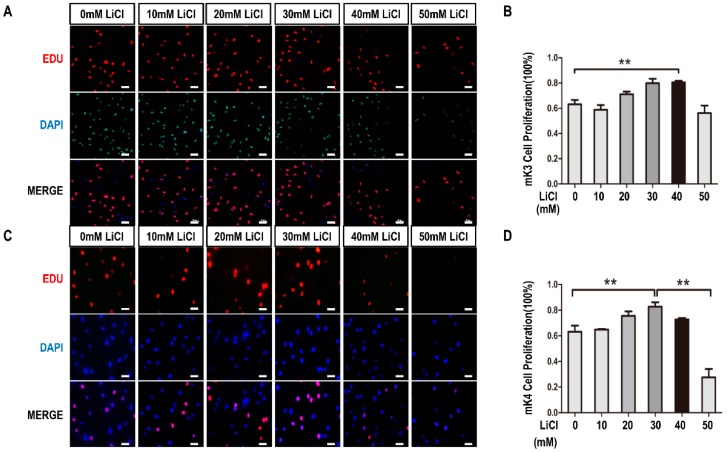
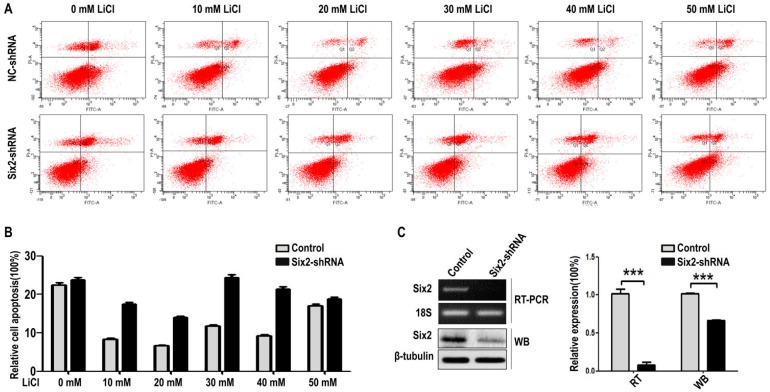
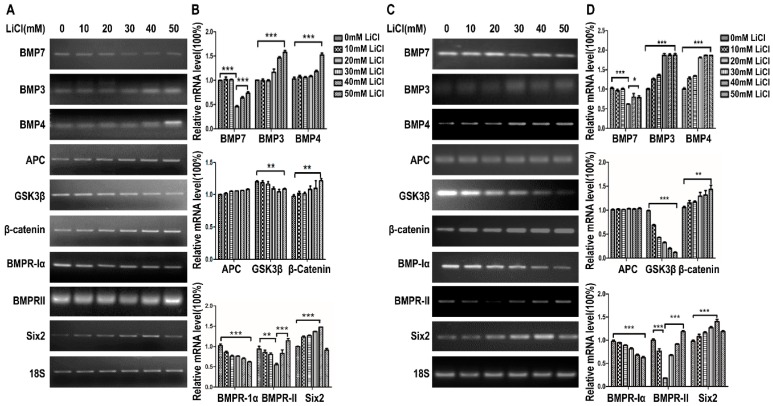
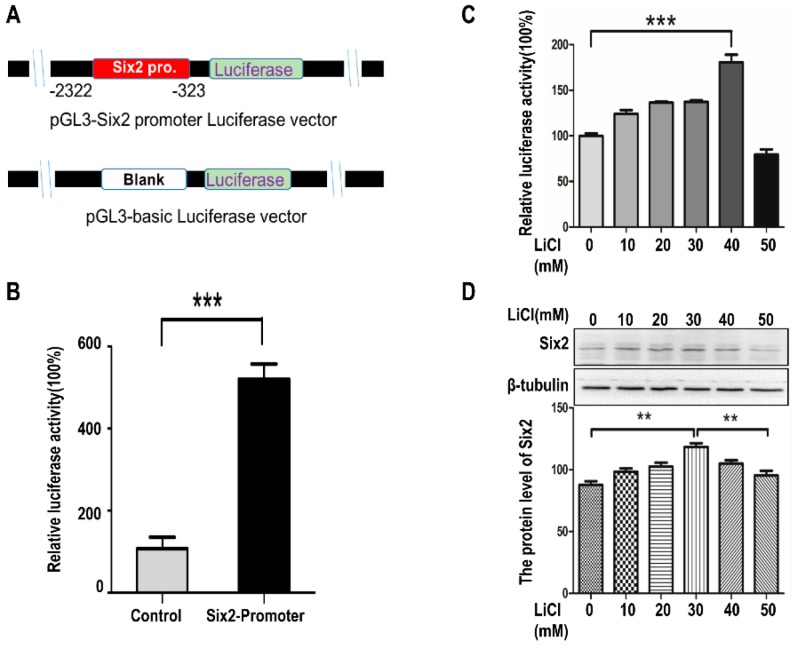
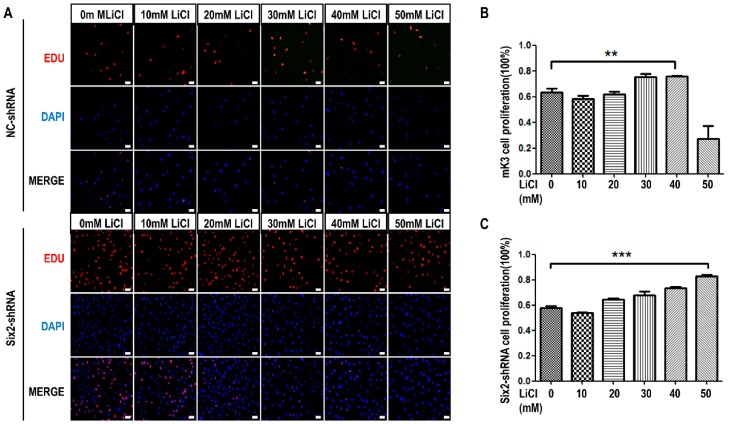
The metanephric mesenchyme (MM) cells are a subset of kidney progenitor cells and play an essential role in mesenchymal-epithelial transition (MET), the key step of nephron generation. Six2, a biological marker related to Wnt signaling pathway, promotes the proliferation, inhibits the apoptosis and maintains the un-differentiation of MM cells. Besides, LiCl is an activator of Wnt signaling pathway. However, the role of LiCl in cellular regulation of MM cells remains unclear, and the relationship between LiCl and Six2 in this process is also little known. Here, we performed EdU assay and flow cytometry assay to, respectively, detect the proliferation and apoptosis of MM cells treated with LiCl of increasing dosages. In addition, reverse transcription-PCR (RT-PCR) and Western-blot were conducted to measure the expression of Six2 and some maker genes of Wnt and bone-morphogenetic-protein (BMP) signaling pathway. Furthermore, luciferase assay was also carried out to detect the transcriptional regulation of Six2. Then we found LiCl promoted MM cell proliferation at low-concentration (10, 20, 30, and 40 mM). The expression of Six2 was dose-dependently increased in low-concentration (10, 20, 30, and 40 mM) at both mRNA and protein level. In addition, both of cell proliferation and Six2 expression in MM cells declined when dosage reached high-concentration (50 mM). However, Six2 knock-down converted the proliferation reduction at 50 mM. Furthermore, Six2 deficiency increased the apoptosis of MM cells, compared with negative control cells at relative LiCl concentration. However, the abnormal rise of apoptosis at 30 mM of LiCl concentration implies that it might be the reduction of GSK3β that increased cell apoptosis. Together, these demonstrate that LiCl can induce the proliferation and apoptosis of MM cells coordinating with Six2.
后肾间充质(MM)细胞是肾祖细胞的一个亚群,在间充质-上皮转化(MET)中起关键作用,而MET是肾单位生成的关键步骤。Six2是一种与Wnt信号通路相关的生物标志物,可促进MM细胞增殖、抑制其凋亡并维持MM细胞的未分化状态。此外,氯化锂(LiCl)是Wnt信号通路的激活剂。然而,LiCl在MM细胞的细胞调节中的作用仍不清楚,在此过程中LiCl与Six2之间的关系也鲜为人知。在这里,我们进行了EdU检测和流式细胞术检测,分别检测不同剂量LiCl处理的MM细胞的增殖和凋亡情况。此外,进行了逆转录PCR(RT-PCR)和蛋白质免疫印迹法来检测Six2以及Wnt和骨形态发生蛋白(BMP)信号通路的一些标志物基因的表达。此外,还进行了荧光素酶检测以检测Six2的转录调控。然后我们发现低浓度(10、20、30和40 mM)的LiCl可促进MM细胞增殖。Six2的表达在低浓度(10、20、30和40 mM)时在mRNA和蛋白质水平均呈剂量依赖性增加。此外,当剂量达到高浓度(50 mM)时,MM细胞的增殖和Six2表达均下降。然而,Six2基因敲低逆转了50 mM时的增殖减少。此外,与相对LiCl浓度下的阴性对照细胞相比,Six2缺乏增加了MM细胞的凋亡。然而,在30 mM LiCl浓度下凋亡的异常增加表明可能是GSK3β的减少增加了细胞凋亡。总之,这些结果表明LiCl可与Six2协同诱导MM细胞的增殖和凋亡。