Landrein Benoit, Refahi Yassin, Besnard Fabrice, Hervieux Nathan, Mirabet Vincent, Boudaoud Arezki, Vernoux Teva, Hamant Olivier
Laboratoire de Reproduction de développement des plantes, INRA, CNRS, ENS Lyon, UCB Lyon 1, Université de Lyon, 46 Allée d'Italie, 69364 Lyon, Cedex 07, France Laboratoire Joliot-Curie, Laboratoire de Physique, CNRS, ENS Lyon, UCB Lyon 1, Université de Lyon, 46 Allée d'Italie, 69364 Lyon, Cedex 07, France.
Laboratoire de Reproduction de développement des plantes, INRA, CNRS, ENS Lyon, UCB Lyon 1, Université de Lyon, 46 Allée d'Italie, 69364 Lyon, Cedex 07, France Sainsbury Laboratory, University of Cambridge, Cambridge CB2 1NN, UK.
J Exp Bot. 2015 Mar;66(5):1317-24. doi: 10.1093/jxb/eru482. Epub 2014 Dec 11.
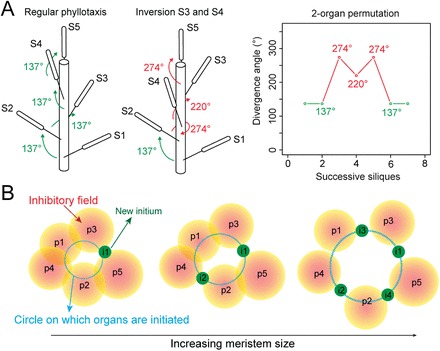
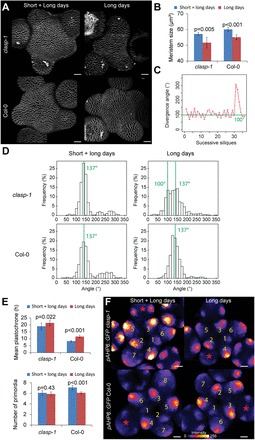
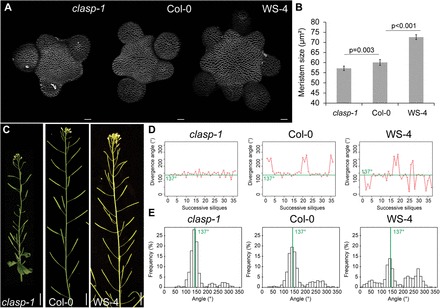
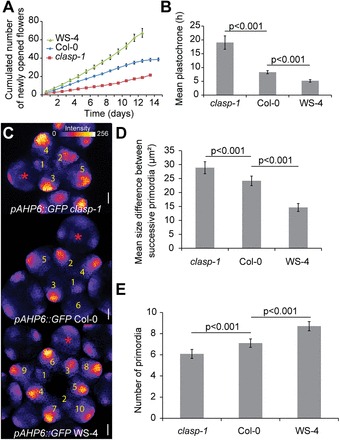
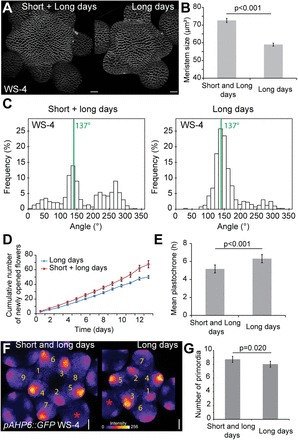
Using the plant model Arabidopsis, the relationship between day length, the size of the shoot apical meristem, and the robustness of phyllotactic patterns were analysed. First, it was found that reducing day length leads to an increased meristem size and an increased number of alterations in the final positions of organs along the stem. Most of the phyllotactic defects could be related to an altered tempo of organ emergence, while not affecting the spatial positions of organ initiations at the meristem. A correlation was also found between meristem size and the robustness of phyllotaxis in two accessions (Col-0 and WS-4) and a mutant (clasp-1), independent of growth conditions. A reduced meristem size in clasp-1 was even associated with an increased robustness of the phyllotactic pattern, beyond what is observed in the wild type. Interestingly it was also possible to modulate the robustness of phyllotaxis in these different genotypes by changing day length. To conclude, it is shown first that robustness of the phyllotactic pattern is not maximal in the wild type, suggesting that, beyond its apparent stereotypical order, the robustness of phyllotaxis is regulated. Secondly, a role for day length in the robustness of the phyllotaxis was also identified, thus providing a new example of a link between patterning and environment in plants. Thirdly, the experimental results validate previous model predictions suggesting a contribution of meristem size in the robustness of phyllotaxis via the coupling between the temporal sequence and spatial pattern of organ initiations.
利用植物模式生物拟南芥,分析了日长、茎尖分生组织大小与叶序模式稳健性之间的关系。首先,发现缩短日长会导致分生组织大小增加,以及茎上器官最终位置的改变数量增加。大多数叶序缺陷可能与器官出现的节奏改变有关,而不影响分生组织处器官起始的空间位置。在两个生态型(Col-0和WS-4)和一个突变体(clasp-1)中,还发现分生组织大小与叶序稳健性之间存在相关性,且与生长条件无关。在clasp-1中,分生组织大小的减小甚至与叶序模式稳健性的增加有关,超过了野生型中观察到的情况。有趣的是,通过改变日长,也有可能调节这些不同基因型中叶序的稳健性。总之,首先表明叶序模式的稳健性在野生型中并非最大,这表明,除了其明显的刻板顺序外,叶序的稳健性是受到调控的。其次,还确定了日长在叶序稳健性中的作用,从而提供了植物模式形成与环境之间联系的一个新例子。第三,实验结果验证了先前的模型预测,表明分生组织大小通过器官起始的时间序列和空间模式之间的耦合,对叶序的稳健性有贡献。