Zhang Bingxu, Gu Xiaoyan, Li Yafei, Li Xiaohong, Gu Mengxiao, Zhang Nan, Shen Xiangguang, Ding Huanzhong
National Reference Laboratory of Veterinary Drug Residues (SCAU), College of Veterinary Medicine, South China Agricultural University, Guangzhou, 510642, China.
BMC Vet Res. 2014 Dec 16;10:297. doi: 10.1186/s12917-014-0297-1.
The resistance of cephalosporins is significantly serious in veterinary clinic. In order to inhibit the bacterial resistance production, the mutant selection window (MSW) hypothesis with Escherichia coli (E. coli) ATCC 25922 exposed to cefquinome in an animal tissue-cage model was investigated.
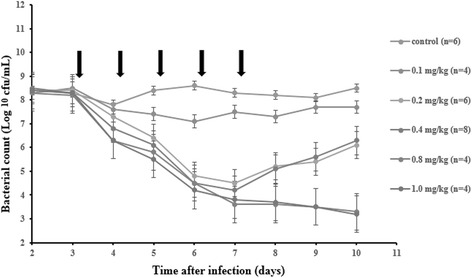
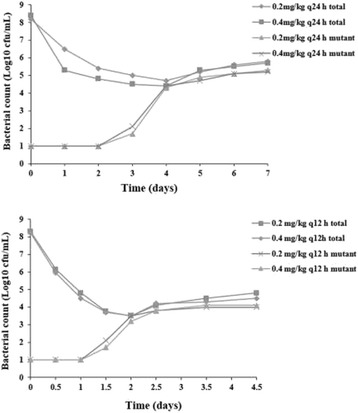
Localized infection with E. coli was established in piglets, and the infected animals were administrated intramuscularly with various doses and intervals of cefquinome to provide antibiotic concentrations below the MIC99, between the MIC99 and the mutant prevention concentration (MPC), and above the MPC. E. coli lost susceptibility when drug concentrations fluctuated between the lower and upper boundaries of the window, which defined in vitro as the MIC99 (0.06 μg/mL) and the MPC (0.16 μg/mL) respectively. For PK/PD parameters, there were no mutant selection enrichment when T>MIC99 was ≤ 25% or T>MPC was ≥ 50% of administration interval. When T>MIC99 was > 25% and T>MPC was <50% of administration interval, resistance selection was observed. When AUC24 h/MIC99 and AUC24 h/MPC were considered, the mutant selection window extended from 32.84 h to 125.64 h and from 12.83 h to 49.09 h, respectively.
These findings demonstrate that the MSW exists in vivo for time-dependent antimicrobial agents, and its boundaries fit well with those determined in vitro. Maintenance of antimicrobial concentrations above the MPC for > 50% of administration interval is a straightforward way to restrict the acquisition of resistance in this tissue cage model. This situation was achieved with daily intramuscular doses of 1 mg cefquinome/kg body weight.
头孢菌素类药物在兽医临床中的耐药性问题十分严重。为了抑制细菌耐药性的产生,我们在动物组织笼模型中,以大肠杆菌(E. coli)ATCC 25922为研究对象,探讨了头孢喹肟的突变选择窗(MSW)假说。
在仔猪中建立了大肠杆菌局部感染模型,对感染动物肌肉注射不同剂量和给药间隔的头孢喹肟,使抗生素浓度分别低于MIC99、介于MIC99与突变预防浓度(MPC)之间以及高于MPC。当药物浓度在体外定义的窗口下限和上限之间波动时,大肠杆菌失去敏感性,该窗口下限和上限分别为MIC99(0.06μg/mL)和MPC(0.16μg/mL)。对于药代动力学/药效学(PK/PD)参数,当给药间隔中T>MIC99≤25%或T>MPC≥50%时,未观察到突变选择富集。当给药间隔中T>MIC99>25%且T>MPC<50%时,观察到耐药性选择。当考虑AUC24 h/MIC99和AUC24 h/MPC时,突变选择窗分别从32.84小时扩展到125.64小时和从12.83小时扩展到49.09小时。
这些研究结果表明,对于时间依赖性抗菌药物,体内存在突变选择窗,其边界与体外测定的边界吻合良好。在给药间隔的>50%时间内维持抗菌药物浓度高于MPC是在该组织笼模型中限制耐药性产生的一种直接方法。每日肌肉注射1mg/kg体重的头孢喹肟可实现这种情况。