Gawande Nilesh Dinkar, Subashini Swaminathan, Murugan Marimuthu, Subbarayalu Mohankumar
Department of Plant Molecular Biology and Bioinformatics, Centre for Plant Molecular Biology and Biotechnology, Tamil Nadu Agricultural University, Coimbatore - 641003, Tami Nadu, INDIA.
Department of Plant Biotechnology, Centre for Plant Molecular Biology and Biotechnology, Tamil Nadu Agricultural University, Coimbatore - 641003, Tami Nadu, India.
Bioinformation. 2014 Nov 27;10(11):679-83. doi: 10.6026/97320630010679. eCollection 2014.
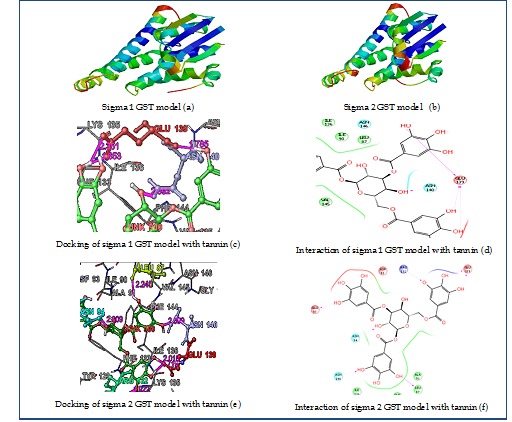
Glutathione S-transferases (GSTs) are one of the major families of detoxifying enzymes that detoxifies different chemical compounds including insecticides in different insect species. Among the GST subclasses, sigma GSTs are found to be the most abundant and conserved among different insect orders. These GSTs are found to play an important role in lipid peroxidation as well as detoxification. Cotton aphid, Aphis gossypii is the most damaging sucking pest with a wide range of hosts and vector of more than 50 plant viruses. Resistance to insecticides in A. gossypii is reported in India and in other countries. Glutathione S transferases (GSTs), an oxidative enzyme is understood to have a role in insecticide resistance and plant resistance breakdown. In relation to this, we have focused on the sigma 1 (GenBank Accession No: JN989964.1) and sigma 2 (GenBank Accession No: JN989965.1) GSTs of A. gossypii and their interaction with plant natural compounds and insecticides. Molecular screening of different insecticides (Chlorphinamidine, Mevinphos, Nitenpyrum, Piperonyl butoxide, Tetrachlorovinphos, Pyrethrins, Resmetrin, Pirimicarb and Dinotefuran) and known plant derived natural compounds (Catechin, Gossypol, Myrcene, Kaempferol, P-coumaric acid, Quercetin, Tannins, α-mangostin, Capsaicin, Cinnamic acid, Citronellal, Curcumin, Dicumarol, Ellagic acid, Eugenol, Geriniol, Isoeugenol, Juglone, Menadione, Methyl jasmonate, Morin, Myricetin, Myristicin, Piperine, Plumbagin, Tangitinin C, Thymol, Vanillin, Alpha pipene, α-terpineol Apigenin and β-Caryophyllene) with sigma 1 and sigma 2 GST protein models was completed using Maestro 9.3 (Schrodinger, USA). This exercise showed the binding of piperonyl butoxide with sigma 1 GST and tannin with sigma 2 GST for further consideration.
谷胱甘肽S-转移酶(GSTs)是主要的解毒酶家族之一,可对包括不同昆虫种类中的杀虫剂在内的多种化合物进行解毒。在GST亚类中,发现σ-GSTs在不同昆虫目中最为丰富且保守。这些GSTs在脂质过氧化以及解毒过程中发挥着重要作用。棉蚜,棉蚜是最具破坏性的刺吸式害虫,寄主范围广泛,是50多种植物病毒的传播媒介。在印度和其他国家均报道了棉蚜对杀虫剂产生抗性。谷胱甘肽S-转移酶(GSTs),一种氧化酶,被认为在杀虫剂抗性和植物抗性破坏中起作用。与此相关,我们重点研究了棉蚜的σ1(GenBank登录号:JN989964.1)和σ2(GenBank登录号:JN989965.1)GSTs,以及它们与植物天然化合物和杀虫剂的相互作用。使用Maestro 9.3(美国薛定谔公司)完成了不同杀虫剂(杀虫脒、速灭磷、仲丁威、胡椒基丁醚、四氯乙烯磷、除虫菊酯、炔咪菊酯、抗蚜威和呋虫胺)和已知植物源天然化合物(儿茶素、棉酚、月桂烯、山奈酚、对香豆酸、槲皮素、单宁、α-山竹黄酮、辣椒素、肉桂酸、香茅醛、姜黄素、双香豆素、鞣花酸、丁香酚、香叶醇、异丁香酚、胡桃醌、甲萘醌、茉莉酸甲酯、桑色素、杨梅素、肉豆蔻醚、胡椒碱、白花丹素、Tangitinin C、百里香酚、香草醛、α-蒎烯、α-松油醇、芹菜素和β-石竹烯)与σ1和σ2 GST蛋白模型的分子筛选。该实验表明胡椒基丁醚与σ1 GST结合,单宁与σ2 GST结合,值得进一步研究。