Kahle Juliette J, Neas Lucas M, Devlin Robert B, Case Martin W, Schmitt Michael T, Madden Michael C, Diaz-Sanchez David
Environmental Public Health Division, National Health and Environmental Effects Research Laboratory, U.S. Environmental Protection Agency, Research Triangle Park, North Carolina, USA.
Environ Health Perspect. 2015 Apr;123(4):310-6. doi: 10.1289/ehp.1307986. Epub 2014 Dec 16.
Trends in climate suggest that extreme weather events such as heat waves will become more common. High levels of the gaseous pollutant ozone are associated with elevated temperatures. Ozone has been associated with respiratory diseases as well as cardiovascular morbidity and mortality and can reduce lung function and alter systemic markers of fibrinolysis. The interaction between ozone and temperature is unclear.
Sixteen healthy volunteers were exposed in a randomized crossover study to 0.3 ppm ozone and clean air for 2 hr at moderate (22°C) temperature and again at an elevated temperature (32.5°C). In each case lung function was performed and blood taken before and immediately after exposure and the next morning.
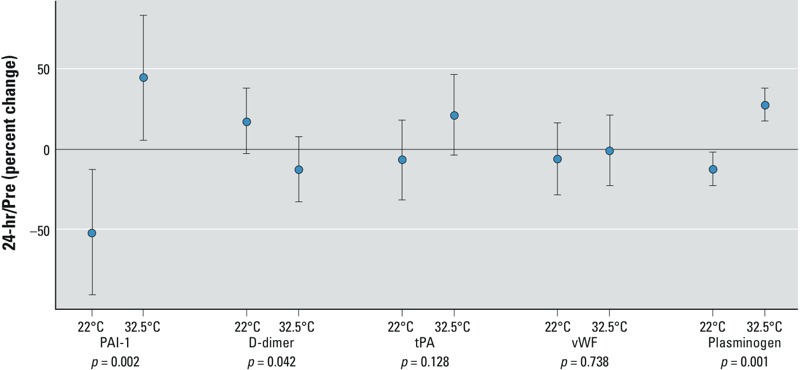
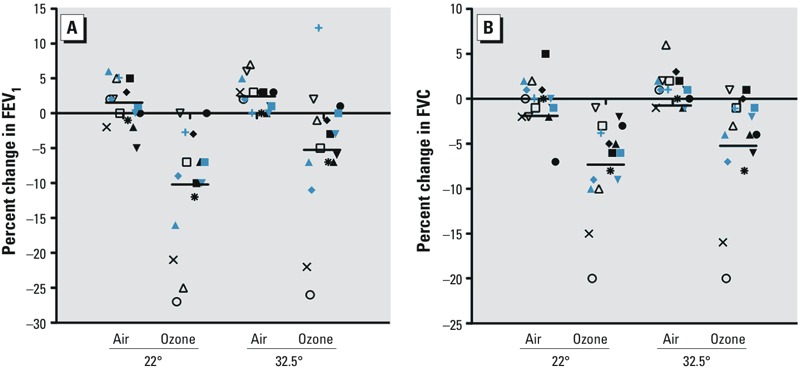
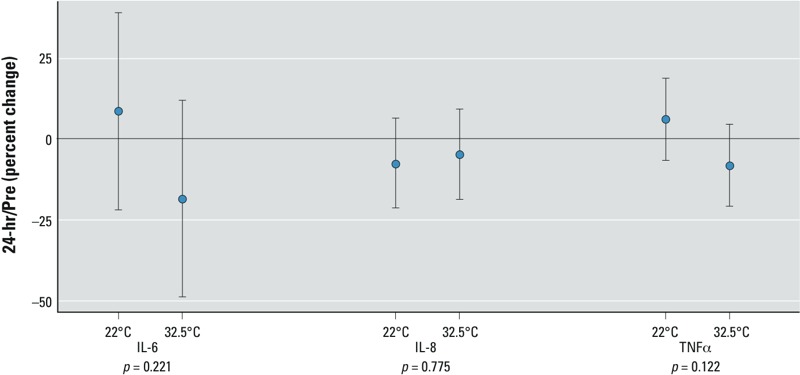
Ozone exposure at 22°C resulted in a decrease in markers of fibrinolysis the next day. There was a 51.8% net decrease in PAI-1 (plasminogen activator inhibitor-1), a 12.1% net decrease in plasminogen, and a 17.8% net increase in D-dimer. These significantly differed from the response at 32.5°C, where there was a 44.9% (p = 0.002) and a 27.9% (p = 0.001) increase in PAI-1 and plasminogen, respectively, and a 12.5% (p = 0.042) decrease in D-dimer. In contrast, decrements in lung function following ozone exposure were comparable at both moderate and elevated temperatures (forced expiratory volume in 1 sec, -12.4% vs. -7.5%, p > 0.05). No changes in systemic markers of inflammation were observed for either temperature.
Ozone-induced systemic but not respiratory effects varied according to temperature. Our study suggests that at moderate temperature ozone may activate the fibrinolytic pathway, while at elevated temperature ozone may impair it. These findings provide a biological basis for the interaction between temperature and ozone on mortality observed in some epidemiologic studies.
气候趋势表明,诸如热浪等极端天气事件将变得更加常见。气态污染物臭氧含量高与气温升高有关。臭氧与呼吸系统疾病以及心血管疾病的发病率和死亡率相关,并且会降低肺功能并改变纤维蛋白溶解的全身标志物。臭氧与温度之间的相互作用尚不清楚。
在一项随机交叉研究中,16名健康志愿者在中等温度(22°C)和高温(32.5°C)下分别暴露于0.3 ppm臭氧和清洁空气中2小时。在每种情况下,在暴露前、暴露后立即以及第二天早晨进行肺功能测试并采集血液。
在22°C下暴露于臭氧会导致第二天纤维蛋白溶解标志物减少。纤溶酶原激活物抑制剂-1(PAI-1)净减少51.8%,纤溶酶原净减少12.1%,D-二聚体净增加17.8%。这些与在32.5°C时的反应有显著差异,在32.5°C时,PAI-1和纤溶酶原分别增加44.9%(p = 0.002)和27.9%(p = 0.001),D-二聚体减少12.5%(p = 0.042)。相比之下,在中等温度和高温下,臭氧暴露后肺功能的下降程度相当(第1秒用力呼气量,-12.4%对-7.5%,p > 0.05)。两种温度下均未观察到全身炎症标志物的变化。
臭氧引起的全身效应而非呼吸效应随温度而变化。我们的研究表明,在中等温度下,臭氧可能激活纤维蛋白溶解途径,而在高温下,臭氧可能损害该途径。这些发现为一些流行病学研究中观察到的温度与臭氧对死亡率的相互作用提供了生物学基础。