Thompson Corinne N, Anders Katherine L, Nhi Le Thi Quynh, Tuyen Ha Thanh, Van Minh Pham, Tu Le Thi Phuong, Nhu Tran Do Hoang, Nhan Nguyen Thi Thanh, Ly Tran Thi Thao, Duong Vu Thuy, Vi Lu Lan, Van Thuy Nguyen Thi, Hieu Nguyen Trong, Van Chau Nguyen Vinh, Campbell James I, Thwaites Guy, Simmons Cameron, Baker Stephen
Oxford University Clinical Research Unit, Wellcome Trust Major Overseas Programme, Ho Chi Minh City, Vietnam.
BMC Public Health. 2014 Dec 17;14:1289. doi: 10.1186/1471-2458-14-1289.
Shigella spp. are one of the most common causes of paediatric dysentery globally, responsible for a substantial proportion of diarrhoeal disease morbidity and mortality, particularly in industrialising regions. Alarming levels of antimicrobial resistance are now reported in S. flexneri and S. sonnei, hampering treatment options. Little is known, however, about the burden of infection and disease due to Shigella spp. in the community.
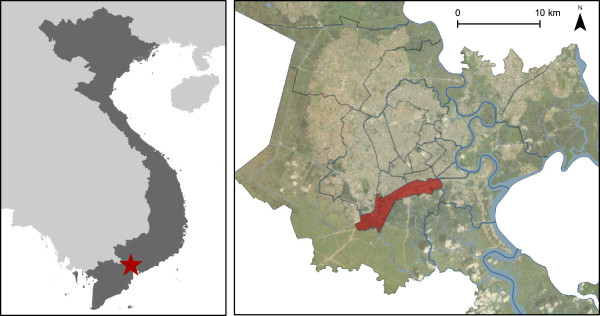
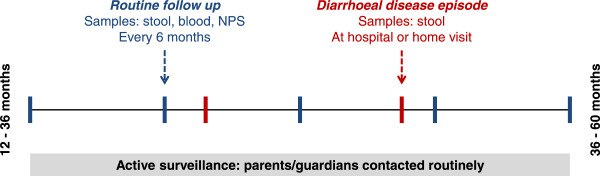
METHODS/DESIGN: In order to estimate the incidence of this bacterial infection in the community in Ho Chi Minh City, Vietnam we have designed a longitudinal cohort to follow up approximately 700 children aged 12-60 months for two years with active and passive surveillance for diarrhoeal disease. Children will be seen at 6 month intervals for health checks where blood and stool samples will be collected. Families will also be contacted every two weeks for information on presence of diarrhoea in the child. Upon report of a diarrhoeal disease episode, study nurses will either travel to the family home to perform an evaluation or the family will attend a study hospital at a reduced cost, where a stool sample will also be collected. Case report forms collected at this time will detail information regarding disease history, risk factors and presence of disease in the household.Outcomes will include (i) age-specific incidence of Shigella spp. and other agents of diarrhoeal disease in the community, (ii) risk factors for identified aetiologies, (iii) rates of seroconversion to a host of gastrointestinal pathogens in the first few years of life. Further work regarding the longitudinal immune response to a variety of Shigella antigens, host genetics and candidate vaccine/diagnostic proteins will also be conducted.
This is the largest longitudinal cohort with active surveillance designed specifically to investigate Shigella infection and disease. The study is strengthened by the active surveillance component, which will likely capture a substantial proportion of episodes not normally identified through passive or hospital-based surveillance. It is hoped that information from this study will aid in the design and implementation of Shigella vaccine trials in the future.
志贺氏菌属是全球小儿痢疾最常见的病因之一,在腹泻病的发病率和死亡率中占很大比例,尤其是在工业化地区。目前据报道,福氏志贺菌和宋内志贺菌的耐药水平令人担忧,这限制了治疗选择。然而,关于社区中志贺氏菌属引起的感染和疾病负担,人们了解甚少。
方法/设计:为了估计越南胡志明市社区中这种细菌感染的发病率,我们设计了一个纵向队列,对约700名12至60个月大的儿童进行为期两年的随访,采用主动和被动监测腹泻病。每6个月对儿童进行一次健康检查,采集血液和粪便样本。每两周还会联系家庭,了解儿童腹泻情况。一旦报告腹泻病发作,研究护士将前往家庭进行评估,或者家庭以降低的费用前往研究医院,在那里也会采集粪便样本。此时收集的病例报告表将详细记录疾病史、危险因素和家庭中疾病的存在情况。结果将包括:(i)社区中志贺氏菌属和其他腹泻病病原体的年龄特异性发病率;(ii)已确定病因的危险因素;(iii)生命最初几年中针对多种胃肠道病原体的血清转化率。还将开展关于对多种志贺氏菌抗原的纵向免疫反应、宿主遗传学以及候选疫苗/诊断蛋白的进一步研究。
这是专门为调查志贺氏菌感染和疾病而设计的最大规模的主动监测纵向队列。主动监测部分加强了该研究,这可能会捕捉到很大一部分通常通过被动或基于医院的监测无法识别的发作病例。希望这项研究的信息将有助于未来志贺氏菌疫苗试验的设计和实施。