Ogutu Bernhards, Juma Elizabeth, Obonyo Charles, Jullien Vincent, Carn Gwenaelle, Vaillant Michel, Taylor Walter Robert John, Kiechel Jean-René
Drugs for Neglected Diseases initiative, Geneva, Switzerland.
Malar J. 2014 Dec 16;13:498. doi: 10.1186/1475-2875-13-498.
Pharmacokinetic (PK) and pharmacodynamic (PD) data are limited for artesunate (AS) and amodiaquine (AQ) in uncomplicated Plasmodium falciparum.
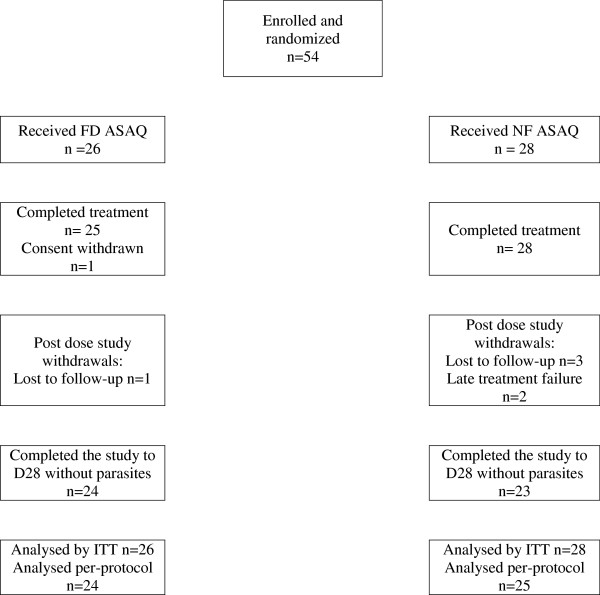
From 2007-8, 54 P. falciparum-infected, Kenyan adults were assigned randomly fixed dose (FD) ASAQ (n = 26) or non-fixed (NF) ASAQ (n = 28). Total doses were 600 mg AS (both arms) + 1,620 mg (FD) or 1,836 mg (NF)AQ. Follow-up extended over 28 days. PK data were collected for AS, dihydroartemisinin (DHA), AS + DHA combined as DHA equivalents (DHAeq), AQ, desethylamodiaquine (DAQ),and their relationships assessed against the PD collected data consisting of parasitological efficacy, adverse events (AEs), and the Bazett's corrected QTinterval (QTcB).
Mean AUC 0-72 of dihydroartemisinin equivalents (DHAeq) when administered as a fixed dose (FD) compared to NF dose were similar: 24.2 ±4.6 vs 26.4±6.9 µmolh/L (p = 0.68) Parasite clearance rates were also similar after 24 hrs: 17/25 (68%) vs 18/28(64.3%) (p = 0.86),as well as at 48 hrs: 25/8 (100%)vs 26 (92.9%)/28 (p = 0.49). Mean FD vs NF DAQ AUC0-28 were 27.6±3.19 vs 32.7±5.53 mgh/L (p = 0.0005). Two PCR-proven new infections occurred on Day (D) 28 for estimated, in vivo, DAQ minimum inhibitory concentrations of 15.2 and 27.5 ng/mL. Combining the FD and NF arms, the mean QTcB at D2+4 hrs increased significantly (p = 0.0059) vs baseline: 420 vs410 ms (∆ = 9.02 (95% confidence interval 2.72-15.31 ms), explained by falling heart rates, increasing DAQ concentrations and female sex in a general linear mixed effects model. Ten of 108 (9.26%) AEs (5/arm) reported by 37/54 (68.5%) patients were possibly or probably drug related. Severe, asymptomatic neutropaenia developed in 2/47 (4.25%) patients on D28: 574/µL (vsD0: 5,075/µL), and 777/µL (vsD0: 3,778/µL).
Tolerability of both formulations was good. For QTcB, a parameter for ECG modifications, increases were modest and due to rising DAQ concentrations and falling heart rates as malaria resolved. Rapid parasite clearance rates and no resistant infections suggest effective pharmacokinetics of both formulations.
对于青蒿琥酯(AS)和阿莫地喹(AQ)治疗非复杂性恶性疟原虫感染的药代动力学(PK)和药效学(PD)数据有限。
2007年至2008年,54名感染恶性疟原虫的肯尼亚成年人被随机分配接受固定剂量(FD)ASAQ(n = 26)或非固定(NF)ASAQ(n = 28)治疗。总剂量为600 mg AS(两组均如此)+ 1620 mg(FD)或1836 mg(NF)AQ。随访期延长至28天。收集AS、双氢青蒿素(DHA)、AS + DHA合并为双氢青蒿素等效物(DHAeq)、AQ、去乙基阿莫地喹(DAQ)的PK数据,并评估它们与收集的PD数据之间的关系,PD数据包括寄生虫学疗效、不良事件(AE)和Bazett校正QT间期(QTcB)。
与非固定剂量相比,固定剂量(FD)给药时双氢青蒿素等效物(DHAeq)的平均AUC0 - 72相似:24.2±4.6 vs 26.4±6.9 µmolh/L(p = 0.68)。24小时后寄生虫清除率也相似:17/25(68%)vs 18/28(64.3%)(p = 0.86),48小时时也是如此:25/25(100%)vs 26/28(92.9%)(p = 0.49)。固定剂量与非固定剂量的DAQ的平均AUC0 - 28分别为27.6±3.19 vs 32.7±5.53 mgh/L(p = 0.0005)。在第28天发生了2例经PCR证实的新感染,估计体内DAQ最低抑菌浓度分别为15.2和27.5 ng/mL。将固定剂量组和非固定剂量组合并后,第2 + 4小时的平均QTcB较基线显著增加(p = 0.0059):420 vs 410 ms(∆ = 9.02(95%置信区间2.72 - 15.31 ms)),在一般线性混合效应模型中,这可由心率下降、DAQ浓度增加和女性性别来解释。37/54(68.5%)名患者报告的108例AE中有10例(每组5例)可能或很可能与药物有关。2/47(4.25%)名患者在第28天出现严重无症状中性粒细胞减少:574/µL(vs第0天:5075/µL),以及777/µL(vs第0天:3778/µL)。
两种制剂的耐受性良好。对于QTcB这一心电图改变参数,其升高幅度较小,是由于随着疟疾病情缓解DAQ浓度升高和心率下降所致。快速的寄生虫清除率和无耐药感染表明两种制剂的药代动力学有效。