Assi Serge-Brice, Aba Yapo Thomas, Yavo Jean Claude, Nguessan Abouo Franklin, Tchiekoi N'cho Bertin, San Koffi Moïse, Bissagnéné Emmanuel, Duparc Stephan, Lameyre Valérie, Tanoh Mea Antoine
Institut Pierre Richet (IPR)/Institut National de Santé Publique (INSP), Bouaké, Ivory Coast.
National Malaria Control Programme, Abidjan, Ivory Coast.
Malar J. 2017 Jan 3;16(1):8. doi: 10.1186/s12936-016-1655-1.
In many malaria-endemic, sub-Saharan African countries, existing pharmacovigilance systems are not sufficiently operational to document reliably the safety profile of anti-malarial drugs. This study describes the implantation of a community-based pharmacovigilance system in Côte d'Ivoire and its use to document the safety of ASAQ Winthrop (artesunate-amodiaquine).
This prospective, longitudinal, descriptive, non-comparative, non-interventional study on the use of artesunate-amodiaquine in real-life conditions of use was conducted in seven Community Health Centres of the Agboville district in Côte d'Ivoire. Twenty trained Health Centre employees and 70 trained community health workers were involved in data collection in the field. All patients with suspected uncomplicated falciparum malaria, seeking treatment at one of the participating Health Centres, and treated with artesunate-amodiaquine could be enrolled. Two visits were planned, one for inclusion at the Health Centre and a second at home, performed by a community health worker 3-10 days after the inclusion visit. Administration of artesunate-amodiaquine was unsupervised. Adverse events (AEs) were documented at the home visit or during any unexpected visit to the Health Centre or to the hospital and coded and adjudicated by a local pharmacovigilance committee. Symptoms suggestive of hepatic failure, severe neutropaenia, extrapyramidal disorders and retinopathy were considered a priori as AEs of special interest.
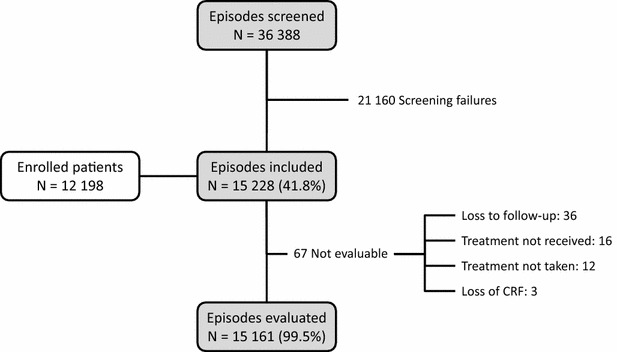
Some 15,228 malaria episodes in 12,198 patients were evaluated; 2545 AEs were documented during 1978 malaria episodes (13.0%). The most frequently observed events were asthenia (682 cases), vomiting (482 cases) and somnolence (174 cases). Most reported AEs were of mild or moderate intensity and resolved without corrective treatment. One-hundred and five (105) AEs reported during 100 episodes (0.7%) were considered as serious. Three serious cases of transient extrapyramidal disorders, identified as AEs of special interest were reported in three patients.
The fixed dose artesunate-amodiaquine combination ASAQ Winthrop for the unsupervised treatment of uncomplicated falciparum malaria under real-life conditions of care in Côte d'Ivoire is well tolerated. The study emphasizes the interest of involving properly trained community health workers to collect pharmacovigilance data in the field in order to document rare AEs.
在撒哈拉以南非洲许多疟疾流行的国家,现有的药物警戒系统运作不够充分,无法可靠地记录抗疟药物的安全性概况。本研究描述了在科特迪瓦实施的基于社区的药物警戒系统及其用于记录温斯洛普公司的蒿甲醚-阿莫地喹(ASAQ)安全性的情况。
本项关于蒿甲醚-阿莫地喹在实际使用条件下应用的前瞻性、纵向、描述性、非对比性、非干预性研究在科特迪瓦阿比让区的7个社区卫生中心开展。20名经过培训的卫生中心工作人员和70名经过培训的社区卫生工作者参与了实地数据收集。所有在参与研究的卫生中心之一寻求治疗且接受蒿甲醚-阿莫地喹治疗的疑似非复杂性恶性疟患者均可纳入。计划进行两次访视,一次在卫生中心纳入时进行,另一次由社区卫生工作者在纳入访视后3至10天进行家访。蒿甲醚-阿莫地喹的给药无人监督。在家访期间或在任何意外前往卫生中心或医院就诊时记录不良事件(AE),并由当地药物警戒委员会进行编码和判定。提示肝衰竭、严重中性粒细胞减少、锥体外系疾病和视网膜病变的症状被预先视为特别关注的不良事件。
评估了12,198例患者的约15,228次疟疾发作;在1978次疟疾发作期间记录了2545例不良事件(13.0%)。最常观察到的事件是乏力(682例)、呕吐(482例)和嗜睡(174例)。大多数报告的不良事件为轻度或中度,无需纠正治疗即可缓解。在100次发作(0.7%)期间报告的105例不良事件被视为严重不良事件。在3名患者中报告了3例被确定为特别关注不良事件的严重短暂性锥体外系疾病病例。
在科特迪瓦实际医疗条件下,固定剂量的蒿甲醚-阿莫地喹复方制剂温斯洛普公司的ASAQ用于非复杂性恶性疟无监督治疗时耐受性良好。该研究强调了让经过适当培训的社区卫生工作者参与实地收集药物警戒数据以记录罕见不良事件的意义。