Tain You-Lin, Lee Chien-Te, Huang Li-Tung
Department of Pediatrics, Kaohsiung Chang Gung Memorial Hospital and Chang Gung University College of Medicine, Kaohsiung 833, Taiwan.
Division of Nephrology, Departments of Medicine, Kaohsiung Chang Gung Memorial Hospital and Chang Gung University College of Medicine, Kaohsiung 833, Taiwan.
Int J Mol Sci. 2014 Dec 15;15(12):23255-68. doi: 10.3390/ijms151223255.
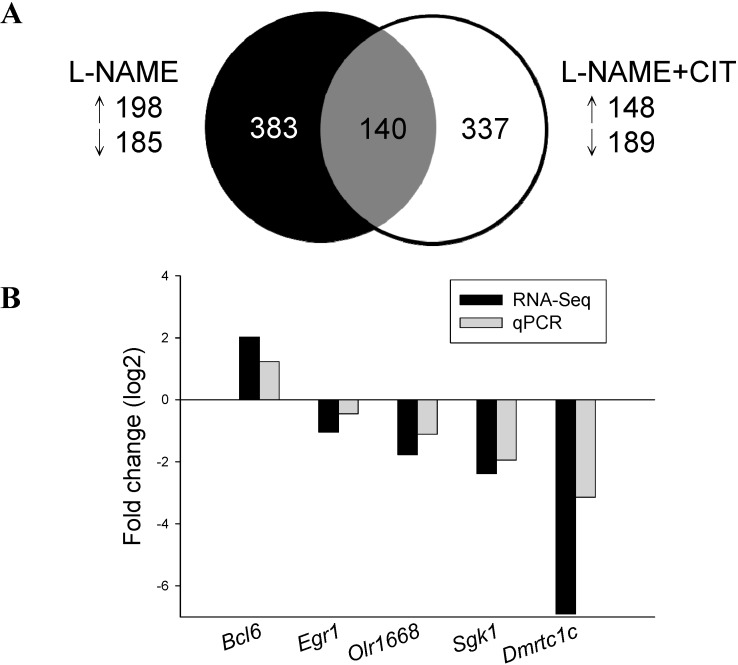
Maternal malnutrition can elicit gene expression leading to fetal programming. L-citrulline (CIT) can be converted to L-arginine to generate nitric oxide (NO). We examined whether maternal CIT supplementation can prevent N(G)-nitro-L-arginine-methyl ester (L-NAME, NO synthase inhibitor)-induced programmed hypertension and examined their effects on the renal transcriptome in male offspring using next generation RNA sequencing (RNA-Seq) technology. Pregnant Sprague-Dawley rats received L-NAME administration at 60mg/kg/day subcutaneously via osmotic minipump during pregnancy alone or with additional 0.25% L-citrulline solution in drinking water during the whole period of pregnancy and lactation. Male offspring were assigned to three groups: control, L-NAME, and L-NAME + CIT. L-NAME exposure induced hypertension in the 12-week-old offspring, which CIT therapy prevented. Identified differentially expressed genes in L-NAME and CIT-treated offspring kidneys, including Guca2b, Hmox1, Hba2, Hba-a2, Dusp1, and Serpine1 are related to regulation of blood pressure (BP) and oxidative stress. In conclusion, our data suggests that the beneficial effects of CIT supplementation are attributed to alterations in expression levels of genes related to BP control and oxidative stress. Our results suggest that early nutritional intervention by CIT has long-term impact on the renal transcriptome to prevent NO depletion-related programmed hypertension. However, our RNA-Seq results might be a secondary phenomenon. The implications of epigenetic regulation at an early stage of programming deserve further clarification.
母体营养不良可引发基因表达,导致胎儿编程。L-瓜氨酸(CIT)可转化为L-精氨酸以生成一氧化氮(NO)。我们研究了母体补充CIT是否可以预防N(G)-硝基-L-精氨酸甲酯(L-NAME,一氧化氮合酶抑制剂)诱导的程序性高血压,并使用下一代RNA测序(RNA-Seq)技术研究了它们对雄性后代肾脏转录组的影响。怀孕的Sprague-Dawley大鼠在孕期单独通过渗透微型泵皮下注射60mg/kg/天的L-NAME,或在整个怀孕和哺乳期在饮用水中额外添加0.25%的L-瓜氨酸溶液。雄性后代被分为三组:对照组、L-NAME组和L-NAME + CIT组。L-NAME暴露导致12周龄后代出现高血压,而CIT治疗可预防。在L-NAME和CIT处理的后代肾脏中鉴定出的差异表达基因,包括Guca2b、Hmox1、Hba2、Hba-a2、Dusp1和Serpine1,与血压(BP)调节和氧化应激有关。总之,我们的数据表明,补充CIT的有益作用归因于与血压控制和氧化应激相关基因表达水平的改变。我们的结果表明,CIT的早期营养干预对肾脏转录组有长期影响,以预防与NO耗竭相关的程序性高血压。然而,我们的RNA-Seq结果可能是一种次要现象。编程早期表观遗传调控的影响值得进一步阐明。