Wang Jiawei, Yao Zhanshi, Lei Ting, Poon Andrew W
Photonic Device Laboratory, Department of Electronic and Computer Engineering, The Hong Kong University of Science and Technology, Clear Water Bay, Kowloon, Hong Kong.
Sci Rep. 2014 Dec 18;4:7528. doi: 10.1038/srep07528.
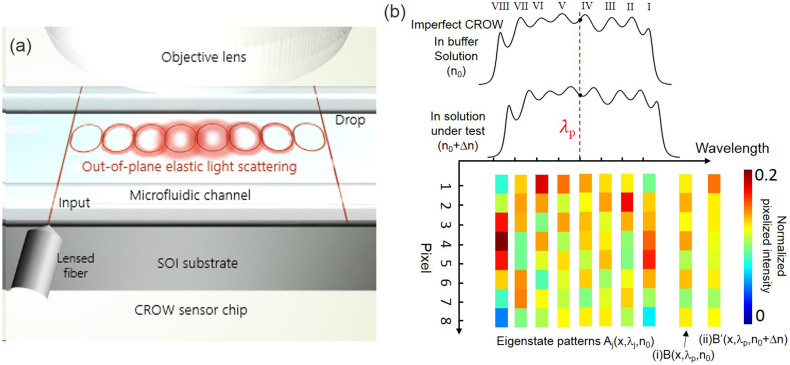
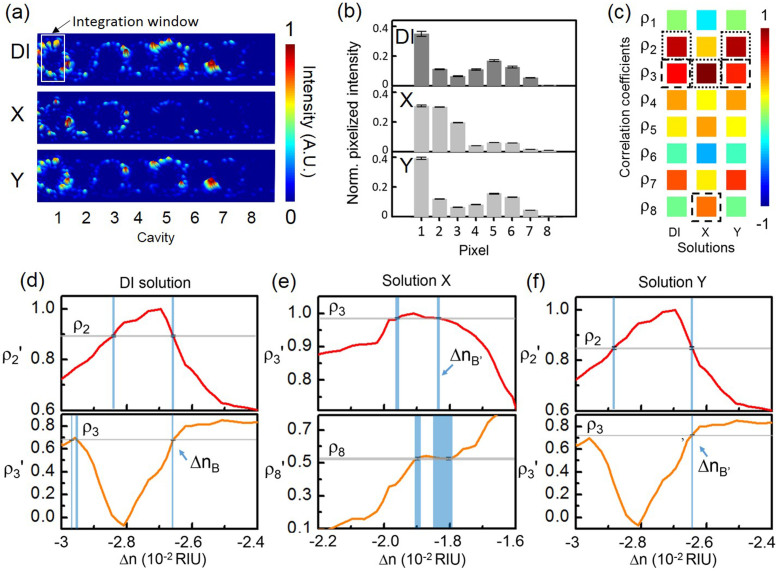
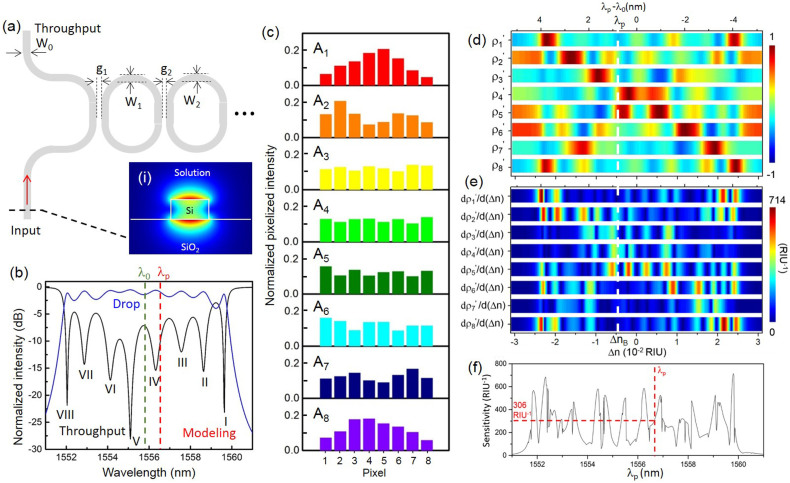
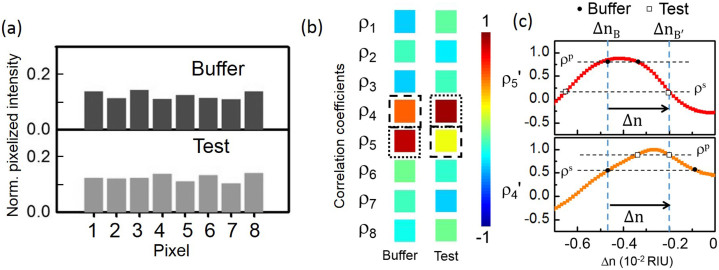
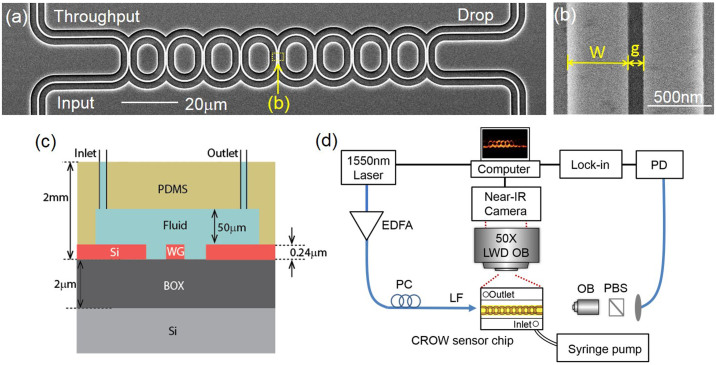
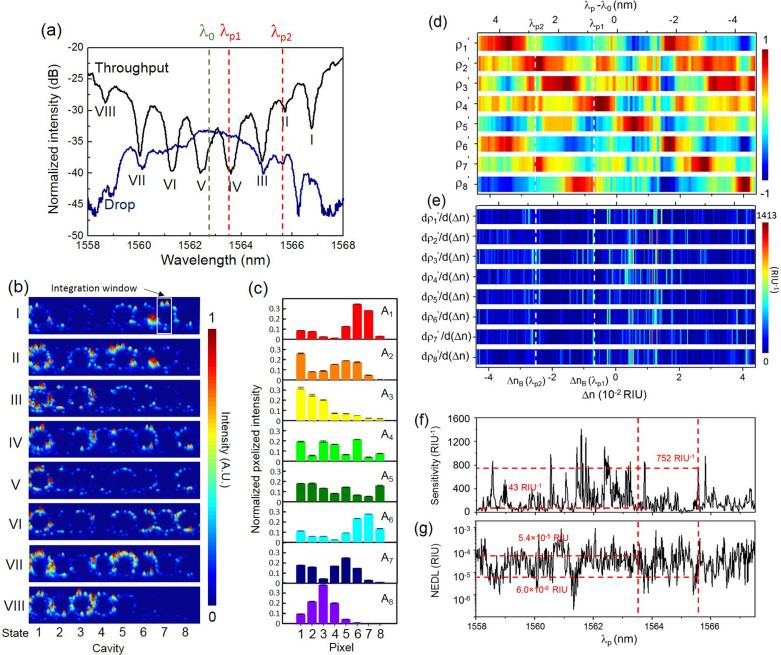
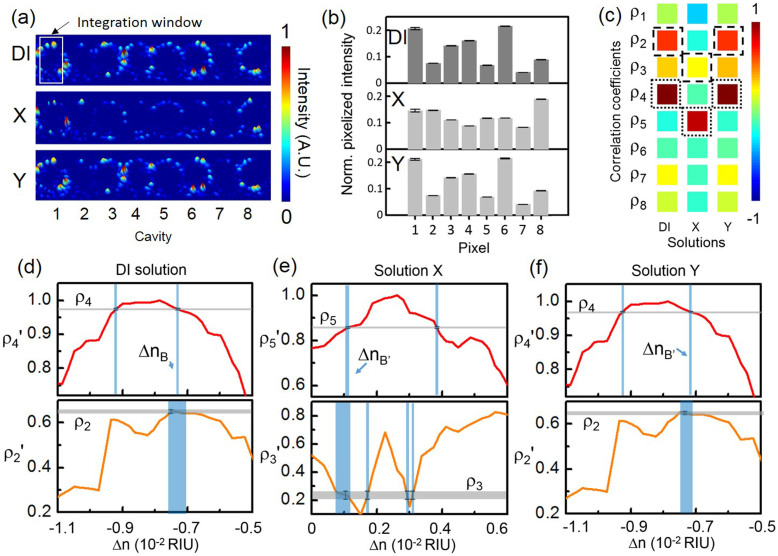
Chip-scale, optical microcavity-based biosensors typically employ an ultra-high-quality microcavity and require a precision wavelength-tunable laser for exciting the cavity resonance. For point-of-care applications, however, such a system based on measurements in the spectral domain is prone to equipment noise and not portable. An alternative microcavity-based biosensor that enables a high sensitivity in an equipment-noise-tolerant and potentially portable system is desirable. Here, we demonstrate the proof-of-concept of such a biosensor using a coupled-resonator optical-waveguide (CROW) on a silicon-on-insulator chip. The sensing scheme is based on measurements in the spatial domain, and only requires exciting the CROW at a fixed wavelength and imaging the out-of-plane elastic light-scattering intensity patterns of the CROW. Based on correlating the light-scattering intensity pattern at a probe wavelength with the light-scattering intensity patterns at the CROW eigenstates, we devise a pattern-recognition algorithm that enables the extraction of a refractive index change, Δn, applied upon the CROW upper-cladding from a calibrated set of correlation coefficients. Our experiments using an 8-microring CROW covered by NaCl solutions of different concentrations reveal a Δn of ~1.5 × 10(-4) refractive index unit (RIU) and a sensitivity of ~752 RIU(-1), with a noise-equivalent detection limit of ~6 × 10(-6) RIU.
基于芯片级光学微腔的生物传感器通常采用超高品质微腔,并且需要精密的波长可调激光器来激发腔共振。然而,对于即时检测应用,这种基于光谱域测量的系统容易受到设备噪声影响且不便于携带。因此,需要一种基于微腔的生物传感器,在容忍设备噪声且可能便于携带的系统中实现高灵敏度。在此,我们展示了一种在绝缘体上硅芯片上使用耦合谐振器光波导(CROW)的此类生物传感器的概念验证。该传感方案基于空间域测量,仅需在固定波长下激发CROW并对CROW的面外弹性光散射强度图案进行成像。基于将探测波长处的光散射强度图案与CROW本征态处的光散射强度图案相关联,我们设计了一种模式识别算法,该算法能够从一组校准的相关系数中提取施加在CROW上包层的折射率变化Δn。我们使用被不同浓度NaCl溶液覆盖的8微环CROW进行的实验显示,折射率变化Δn约为1.5×10⁻⁴折射率单位(RIU),灵敏度约为752 RIU⁻¹,噪声等效检测限约为6×10⁻⁶ RIU。