Lichtner Valentina, Dowding Dawn, Esterhuizen Philip, Closs S José, Long Andrew F, Corbett Anne, Briggs Michelle
School of Healthcare, University of Leeds, Leeds, UK.
BMC Geriatr. 2014 Dec 17;14:138. doi: 10.1186/1471-2318-14-138.
There is evidence of under-detection and poor management of pain in patients with dementia, in both long-term and acute care. Accurate assessment of pain in people with dementia is challenging and pain assessment tools have received considerable attention over the years, with an increasing number of tools made available. Systematic reviews on the evidence of their validity and utility mostly compare different sets of tools. This review of systematic reviews analyses and summarises evidence concerning the psychometric properties and clinical utility of pain assessment tools in adults with dementia or cognitive impairment.
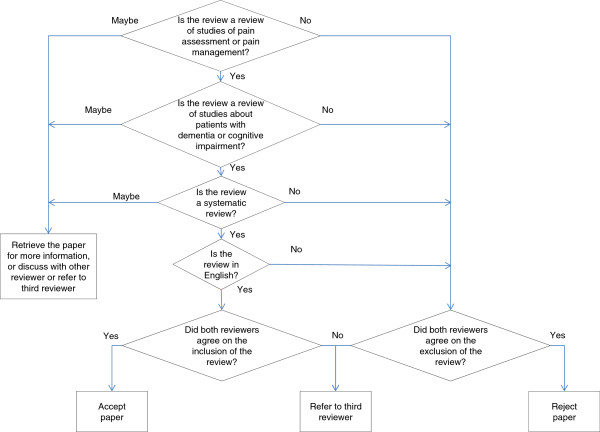
We searched for systematic reviews of pain assessment tools providing evidence of reliability, validity and clinical utility. Two reviewers independently assessed each review and extracted data from them, with a third reviewer mediating when consensus was not reached. Analysis of the data was carried out collaboratively. The reviews were synthesised using a narrative synthesis approach.
We retrieved 441 potentially eligible reviews, 23 met the criteria for inclusion and 8 provided data for extraction. Each review evaluated between 8 and 13 tools, in aggregate providing evidence on a total of 28 tools. The quality of the reviews varied and the reporting often lacked sufficient methodological detail for quality assessment. The 28 tools appear to have been studied in a variety of settings and with varied types of patients. The reviews identified several methodological limitations across the original studies. The lack of a 'gold standard' significantly hinders the evaluation of tools' validity. Most importantly, the samples were small providing limited evidence for use of any of the tools across settings or populations.
There are a considerable number of pain assessment tools available for use with the elderly cognitive impaired population. However there is limited evidence about their reliability, validity and clinical utility. On the basis of this review no one tool can be recommended given the existing evidence.
有证据表明,在长期护理和急性护理中,痴呆症患者的疼痛检测不足且管理不善。准确评估痴呆症患者的疼痛具有挑战性,多年来疼痛评估工具受到了广泛关注,可用工具的数量也在不断增加。关于其有效性和实用性证据的系统评价大多比较不同组别的工具。本系统评价的综述分析并总结了有关痴呆症或认知障碍成人疼痛评估工具的心理测量特性和临床实用性的证据。
我们搜索了提供可靠性、有效性和临床实用性证据的疼痛评估工具的系统评价。两名评审员独立评估每篇综述并从中提取数据,当未达成共识时由第三名评审员进行调解。数据的分析是合作进行的。使用叙述性综合方法对综述进行综合。
我们检索到441篇可能符合条件的综述,23篇符合纳入标准,8篇提供了可供提取的数据。每篇综述评估了8至13种工具,总共提供了28种工具的证据。综述的质量各不相同,报告往往缺乏足够的方法学细节以供质量评估。这28种工具似乎在各种环境和不同类型的患者中都有研究。综述确定了原始研究中的几个方法学局限性。缺乏“金标准”严重阻碍了对工具有效性的评估。最重要的是,样本量小,为任何工具在不同环境或人群中的使用提供的证据有限。
有相当数量的疼痛评估工具可用于老年认知障碍人群。然而,关于它们的可靠性、有效性和临床实用性的证据有限。根据本综述,鉴于现有证据,无法推荐任何一种工具。