Tuntland Hanne, Espehaug Birgitte, Forland Oddvar, Hole Astri Drange, Kjerstad Egil, Kjeken Ingvild
Centre for Care Research Western Norway, and Department of Occupational Therapy, Physiotherapy and Radiography, Bergen University College, P,O, Box 7030, 5020 Bergen, Norway.
BMC Geriatr. 2014 Dec 18;14:139. doi: 10.1186/1471-2318-14-139.
As a result of the ageing population, there is an urgent need for innovation in community health-care in order to achieve sustainability. Reablement is implemented in primary care in some Western countries to help meet these challenges. However, evidence to support the use of such home-based rehabilitation is limited. Reablement focuses on early, time-intensive, multidisciplinary, multi-component and individualised home-based rehabilitation for older adults with functional decline. The aim of this study is to investigate the effectiveness of reablement in home-dwelling adults compared with standard treatment in relation to daily activities, physical functioning, health-related quality of life, use of health-care services, and costs.
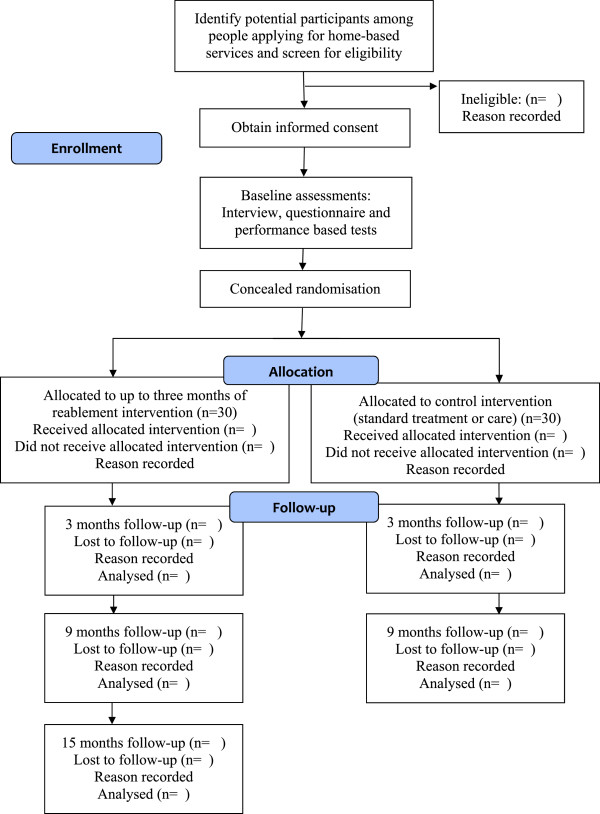
METHODS/DESIGN: The study will be a 1:1 parallel-group randomised controlled superiority trial conducted in a rural municipality in Norway. The experimental group will be offered reablement and the control group offered standard treatment. A computer-generated permuted block randomisation sequence, with randomly selected block sizes, will be used for allocation. Neither participants nor health-care providers will be blinded, however all research assistants and researchers will be blinded. The sample size will consist of 60 participants. People will be eligible if they are home-dwelling, over 18 years of age, understand Norwegian and have functional decline. The exclusion criteria will be people in need of institution-based rehabilitation or nursing home placement, and people who are terminally ill or cognitively reduced. The primary outcome will be self-perceived performance, and satisfaction with performance of daily activities, assessed with the Canadian Occupational Performance Measure. In addition, physical capacity, health-related quality of life, use of health-care services, and cost data will be collected at baseline, and after 3 and 9 months in both groups, and again after 15 months in the intervention group. Data will be analysed on an intention-to-treat basis using a linear mixed model for repeated measures.
The findings will make an important contribution to evaluating cost-effective and evidence-based rehabilitation approaches for community-dwelling adults.
The trial was registered in ClinicalTrials.gov November 20, 2012, identifier: NCT02043262.
由于人口老龄化,迫切需要创新社区医疗保健以实现可持续性。一些西方国家在初级保健中实施康复护理以帮助应对这些挑战。然而,支持这种居家康复使用的证据有限。康复护理专注于为功能下降的老年人提供早期、高强度、多学科、多组分且个性化的居家康复。本研究的目的是调查与标准治疗相比,康复护理对居家成年人在日常活动、身体功能、健康相关生活质量、医疗保健服务使用及成本方面的有效性。
方法/设计:本研究将在挪威一个农村自治市进行1:1平行组随机对照优势试验。实验组将接受康复护理,对照组接受标准治疗。将使用计算机生成的置换区组随机化序列,随机选择区组大小进行分配。参与者和医疗保健提供者均不设盲,但所有研究助理和研究人员将设盲。样本量将包括60名参与者。如果他们居家居住、年龄超过18岁、懂挪威语且有功能下降,则符合入选条件。排除标准将是需要机构康复或养老院安置的人,以及绝症患者或认知能力下降者。主要结局将是自我感知表现以及对日常活动表现的满意度,使用加拿大职业表现测量法进行评估。此外,将在基线时、两组3个月和9个月后以及干预组15个月后收集身体能力、健康相关生活质量、医疗保健服务使用及成本数据。将使用重复测量的线性混合模型在意向性分析基础上对数据进行分析。
研究结果将为评估社区居住成年人具有成本效益且基于证据的康复方法做出重要贡献。
该试验于2012年11月20日在ClinicalTrials.gov注册,标识符:NCT02043262。