Suppr超能文献

口吃学龄前儿童的表达性语言测验内离散度

Expressive Language Intratest Scatter of Preschool-Age Children Who Stutter.

作者信息

Millager Ryan A, Conture Edward G, Walden Tedra A, Kelly Ellen M

机构信息

Vanderbilt University.

出版信息

Contemp Issues Commun Sci Disord. 2014 Spring;41:110-119.

Abstract

PURPOSE

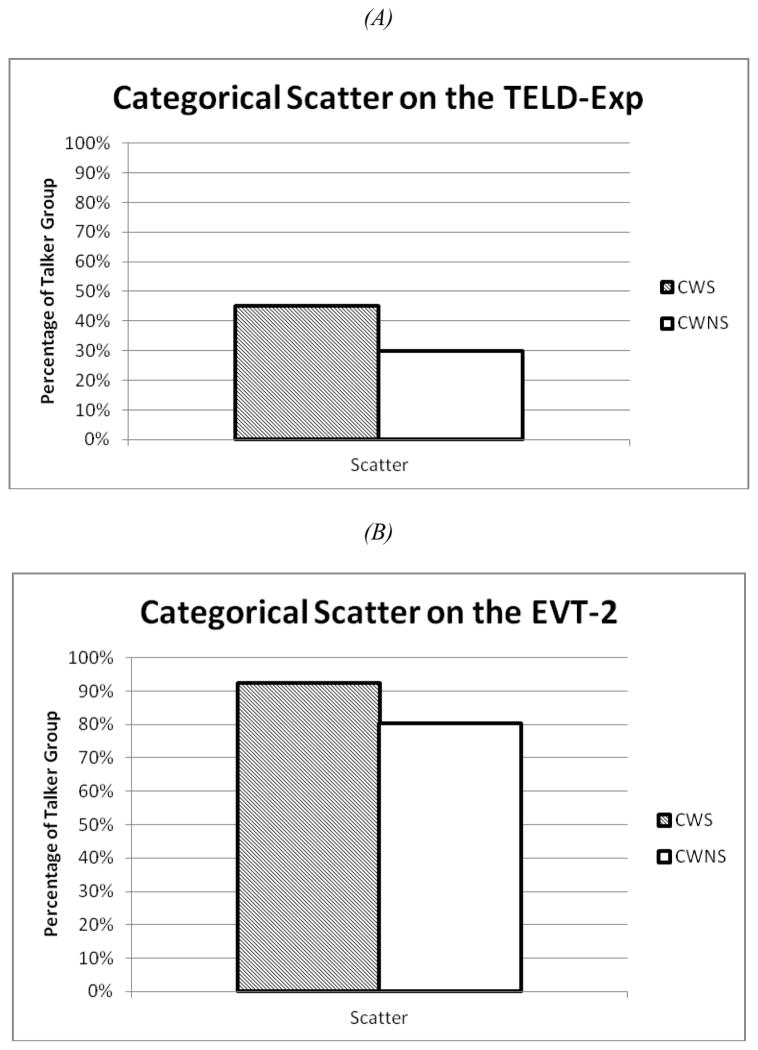
The purpose of this study was to assess intratest scatter (variability) on standardized tests of expressive language by preschool-age children who do (CWS) and do not stutter (CWNS).

METHOD

Participants were 40 preschool-age CWS and 46 CWNS. Between-group comparisons of intratest scatter were made based on participant responses to the Expressive subtest of the (TELD-Exp; Hresko, Reid, & Hamill, 1999) and the (EVT-2; Williams, 2007). Within-group correlational analyses between intratest scatter and stuttering frequency and severity were also conducted for CWS.

RESULTS

Findings indicated that, for CWS, categorical scatter on the EVT-2 was positively correlated with their stuttering frequency. No significant between-group differences in intratest scatter were found on the TELD-Exp or the EVT-2.

CONCLUSIONS

Consistent with earlier findings, variability in speech-language performance appears to be related to CWS' stuttering, a finding taken to suggest an underlying cognitive-linguistic variable (e.g., cognitive load) may be common to both variables.

摘要

目的

本研究旨在评估患有口吃(CWS)和未患口吃(CWNS)的学龄前儿童在表达性语言标准化测试中的测试内散点(变异性)。

方法

参与者包括40名学龄前CWS儿童和46名CWNS儿童。基于参与者对《皮博迪图片词汇测验-表达性》(TELD-Exp;赫雷斯科、里德和哈米尔,1999年)以及《表达性词汇测验第二版》(EVT-2;威廉姆斯,2007年)表达性子测验的回答,进行了组间测试内散点比较。还对CWS儿童进行了测试内散点与口吃频率和严重程度之间的组内相关性分析。

结果

研究结果表明,对于CWS儿童,EVT-2上的类别散点与他们的口吃频率呈正相关。在TELD-Exp或EVT-2上未发现组间测试内散点的显著差异。

结论

与早期研究结果一致,言语语言表现的变异性似乎与CWS儿童的口吃有关,这一发现表明潜在的认知语言变量(如认知负荷)可能是这两个变量共有的。
相似文献

5
Lexical diversity and lexical skills in children who stutter.口吃儿童的词汇多样性和词汇技能。
J Fluency Disord. 2020 Mar;63:105747. doi: 10.1016/j.jfludis.2020.105747. Epub 2020 Jan 22.
6
7
Speech sound articulation abilities of preschool-age children who stutter.口吃学龄前儿童的言语发音能力。
J Fluency Disord. 2013 Dec;38(4):325-41. doi: 10.1016/j.jfludis.2013.09.004. Epub 2013 Oct 9.
10

本文引用的文献

1
Speech sound articulation abilities of preschool-age children who stutter.口吃学龄前儿童的言语发音能力。
J Fluency Disord. 2013 Dec;38(4):325-41. doi: 10.1016/j.jfludis.2013.09.004. Epub 2013 Oct 9.
2
Emotional reactivity and regulation in preschool-age children who stutter.口吃学龄前儿童的情绪反应和调节。
J Fluency Disord. 2013 Sep;38(3):260-74. doi: 10.1016/j.jfludis.2013.06.002. Epub 2013 Jun 28.
3
Behavioral inhibition and childhood stuttering.行为抑制与儿童口吃。
J Fluency Disord. 2013 Jun;38(2):171-83. doi: 10.1016/j.jfludis.2013.03.001. Epub 2013 Mar 16.
5
Stuttering and language ability in children: questioning the connection.儿童口吃和语言能力:质疑两者的联系。
Am J Speech Lang Pathol. 2012 Aug;21(3):183-96. doi: 10.1044/1058-0360(2012/11-0078). Epub 2012 Mar 21.
6
The efficiency of attentional networks in children who stutter.口吃儿童注意网络的效率。
J Speech Lang Hear Res. 2012 Jun;55(3):946-59. doi: 10.1044/1092-4388(2011/10-0208). Epub 2012 Jan 9.
8
Language abilities of children who stutter: a meta-analytical review.口吃儿童的语言能力:一项元分析综述。
Am J Speech Lang Pathol. 2011 Aug;20(3):163-79. doi: 10.1044/1058-0360(2011/09-0102). Epub 2011 Apr 8.
10
Temperament dimensions in stuttering and typically developing children.口吃儿童与正常发育儿童的气质维度。
J Fluency Disord. 2010 Dec;35(4):355-72. doi: 10.1016/j.jfludis.2010.10.004. Epub 2010 Nov 4.

文献AI研究员

20分钟写一篇综述,助力文献阅读效率提升50倍。

立即体验

用中文搜PubMed

大模型驱动的PubMed中文搜索引擎

马上搜索

文档翻译

学术文献翻译模型,支持多种主流文档格式。

立即体验