Ye Meiling, Tang Ling, Luo Mengjun, Zhou Jing, Guo Bin, Liu Yangyuan, Chen Bo
Key Laboratory of Phytochemical R&D of Hunan Province and Key Laboratory of Chemical Biology and Traditional Chinese Medicine Research (Ministry of Education of China), Hunan Normal University, Changsha, 410081, China.
Yiyang Medical College, Yiyang 413000, China.
Nanoscale Res Lett. 2014 Nov 28;9(1):642. doi: 10.1186/1556-276X-9-642. eCollection 2014.
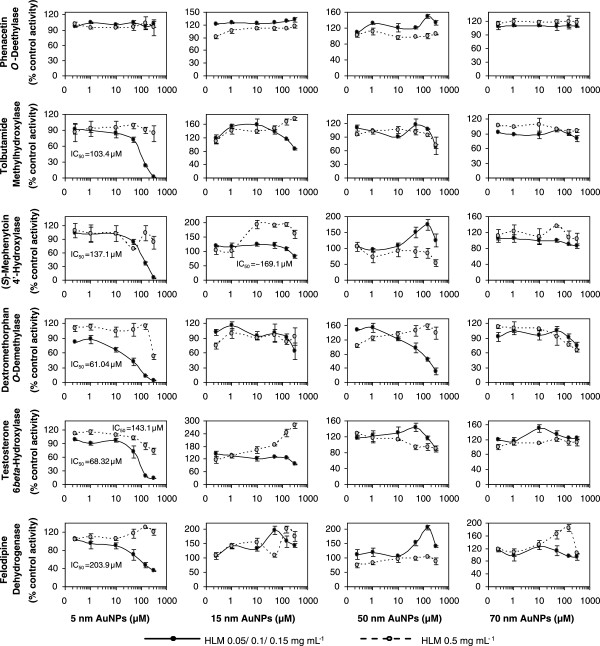
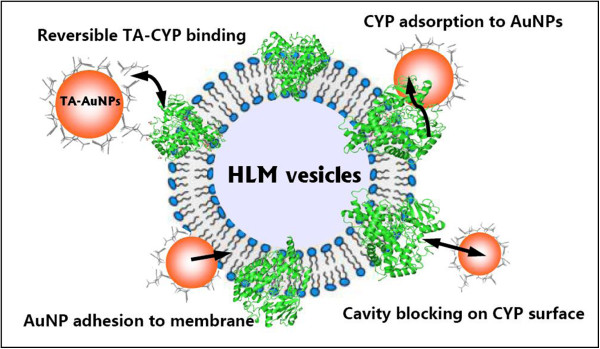
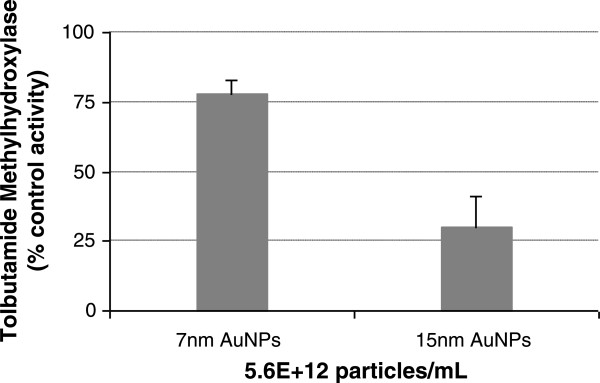
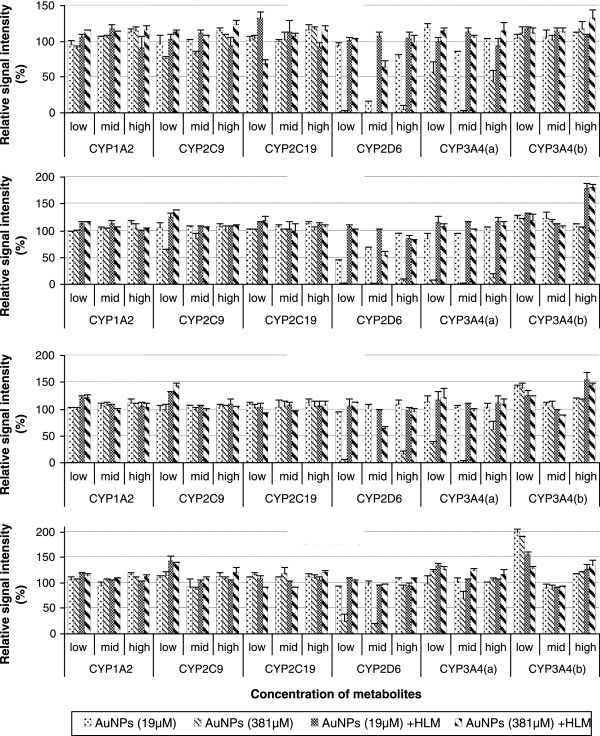
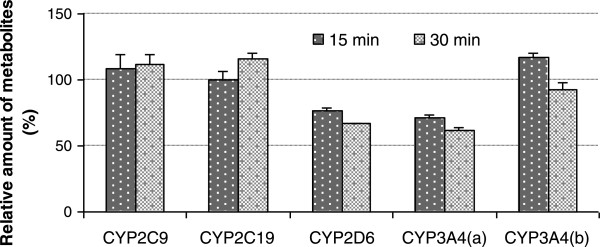
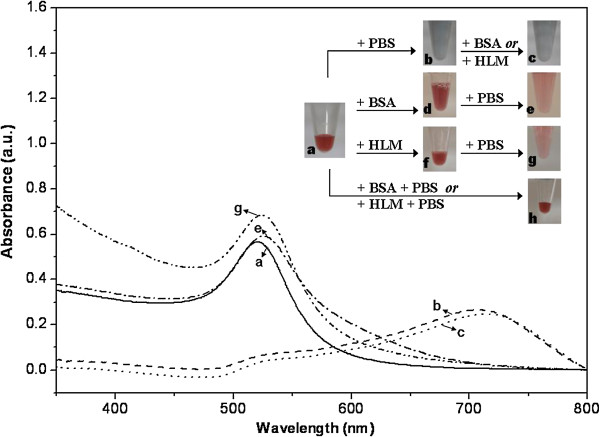
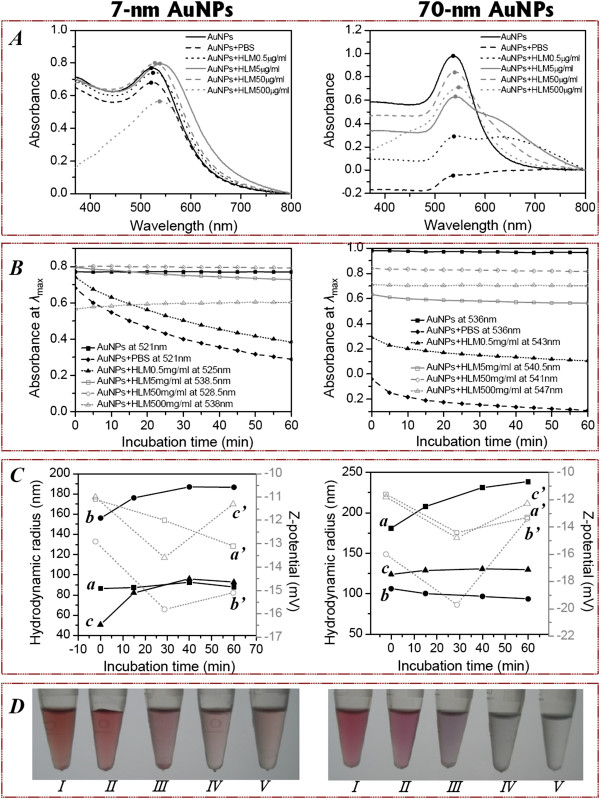
Nano-sized particles are known to interfere with drug-metabolizing cytochrome P450 (CYP) enzymes, which can be anticipated to be a potential source of unintended adverse reactions, but the mechanisms underlying the inhibition are still not well understood. Herein we report a systematic investigation of the impacts of gold nanoparticles (AuNPs) on five major CYP isozymes under in vitro incubations of human liver microsomes (HLMs) with tannic acid (TA)-stabilized AuNPs in the size range of 5 to 100 nm. It is found that smaller AuNPs show more pronounced inhibitory effects on CYP2C9, CYP2C19, CYP2D6, and CYP3A4 in a dose-dependent manner, while 1A2 is the least susceptible to the AuNP inhibition. The size- and dose-dependent CYP-specific inhibition and the nonspecific drug-nanogold binding in the coincubation media can be significantly reduced by increasing the concentration ratio of microsomal proteins to AuNPs, probably via a noncompetitive mode. Remarkably, AuNPs are also found to exhibit a slow time-dependent inactivation of 2D6 and 3A4 in a β-nicotinamide adenine dinucleotide 2'-phosphate reduced tetrasodium salt hydrate (NADPH)-independent manner. During microsomal incubations, UV-vis spectroscopy, dynamic light scattering, and zeta-potential measurements were used to monitor the changes in particle properties under the miscellaneous AuNP/HLM/CYP dispersion system. An improved stability of AuNPs by mixing HLM with the gold nanocolloid reveals that the stabilization via AuNP-HLM interactions may occur on a faster time scale than the salt-induced nanoaggregation by incubation in phosphate buffer. The results suggest that the AuNP induced CYP inhibition can be partially attributed to its adhesion onto the enzymes to alter their structural conformations or onto the HLM membrane therefore impairing the integral membrane proteins. Additionally, AuNPs likely block the substrate pocket on the CYP surface, depending on both the particle characteristics and the structural diversity of the isozymes. These findings may represent additional mechanisms for the differential inhibitory effects arising from the coincubated AuNPs on the metabolic activities of the hepatic CYP isozymes.
已知纳米级颗粒会干扰药物代谢细胞色素P450(CYP)酶,这可能是意外不良反应的潜在来源,但抑制作用的潜在机制仍未得到充分理解。在此,我们报告了一项系统研究,研究了在人肝微粒体(HLM)与单宁酸(TA)稳定的5至100nm范围内的金纳米颗粒(AuNP)体外孵育条件下,金纳米颗粒对五种主要CYP同工酶的影响。研究发现,较小的AuNP对CYP2C9、CYP2C19、CYP2D6和CYP3A4表现出更明显的剂量依赖性抑制作用,而1A2对AuNP抑制最不敏感。通过增加微粒体蛋白与AuNP的浓度比,共孵育介质中尺寸和剂量依赖性的CYP特异性抑制以及非特异性药物 - 纳米金结合可以显著降低,可能是通过非竞争性模式。值得注意的是,还发现AuNP以β - 烟酰胺腺嘌呤二核苷酸2'-磷酸还原四钠盐(NADPH)非依赖性方式对2D6和3A4表现出缓慢的时间依赖性失活。在微粒体孵育过程中,利用紫外 - 可见光谱、动态光散射和zeta电位测量来监测各种AuNP/HLM/CYP分散体系下颗粒性质的变化。通过将HLM与金纳米胶体混合提高AuNP的稳定性表明,通过AuNP - HLM相互作用的稳定作用可能比在磷酸盐缓冲液中孵育引起的盐诱导纳米聚集发生得更快。结果表明,AuNP诱导的CYP抑制可能部分归因于其粘附在酶上以改变其结构构象或粘附在HLM膜上,从而损害整合膜蛋白。此外,AuNP可能会根据颗粒特性和同工酶的结构多样性阻断CYP表面的底物口袋。这些发现可能代表了共孵育的AuNP对肝CYP同工酶代谢活性产生差异抑制作用的其他机制。