Schadt Eric E, Buchanan Sean, Brennand Kristen J, Merchant Kalpana M
Icahn Institute for Genomics and Multiscale Biology, Icahn School of Medicine at Mount Sinai New York, NY, USA ; Department of Genetics and Genomic Sciences, Icahn School of Medicine at Mount Sinai New York, NY, USA.
Lilly Research Laboratories, Eli Lilly and Company Indianapolis, IN, USA.
Front Pharmacol. 2014 Dec 2;5:252. doi: 10.3389/fphar.2014.00252. eCollection 2014.
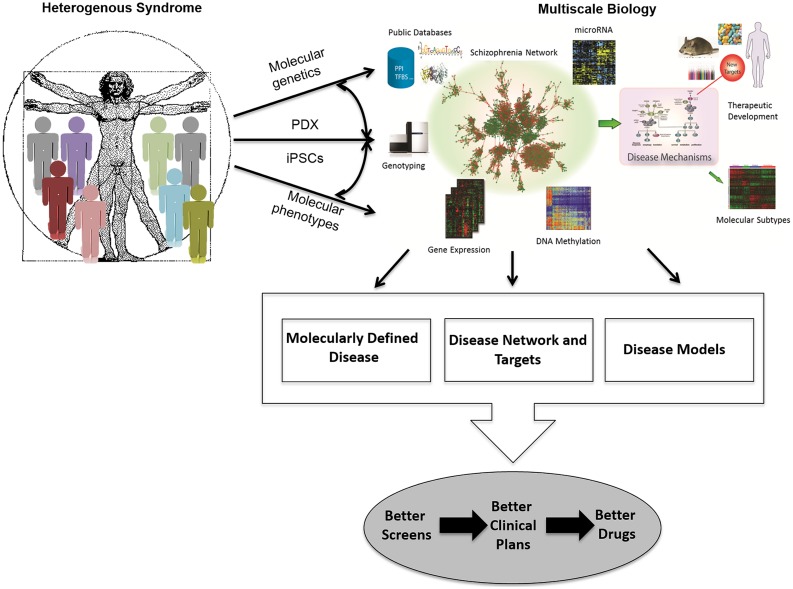
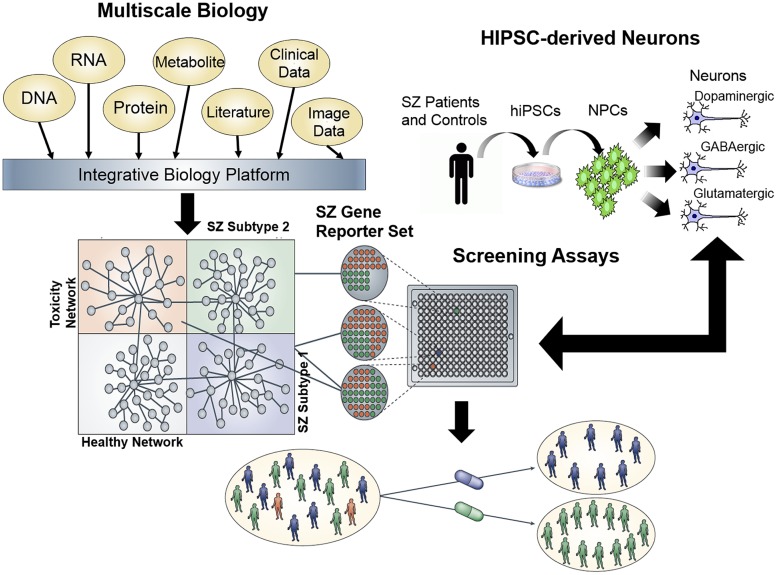
A disruptive approach to therapeutic discovery and development is required in order to significantly improve the success rate of drug discovery for central nervous system (CNS) disorders. In this review, we first assess the key factors contributing to the frequent clinical failures for novel drugs. Second, we discuss cancer translational research paradigms that addressed key issues in drug discovery and development and have resulted in delivering drugs with significantly improved outcomes for patients. Finally, we discuss two emerging technologies that could improve the success rate of CNS therapies: human induced pluripotent stem cell (hiPSC)-based studies and multiscale biology models. Coincident with advances in cellular technologies that enable the generation of hiPSCs directly from patient blood or skin cells, together with methods to differentiate these hiPSC lines into specific neural cell types relevant to neurological disease, it is also now possible to combine data from large-scale forward genetics and post-mortem global epigenetic and expression studies in order to generate novel predictive models. The application of systems biology approaches to account for the multiscale nature of different data types, from genetic to molecular and cellular to clinical, can lead to new insights into human diseases that are emergent properties of biological networks, not the result of changes to single genes. Such studies have demonstrated the heterogeneity in etiological pathways and the need for studies on model systems that are patient-derived and thereby recapitulate neurological disease pathways with higher fidelity. In the context of two common and presumably representative neurological diseases, the neurodegenerative disease Alzheimer's Disease, and the psychiatric disorder schizophrenia, we propose the need for, and exemplify the impact of, a multiscale biology approach that can integrate panomic, clinical, imaging, and literature data in order to construct predictive disease network models that can (i) elucidate subtypes of syndromic diseases, (ii) provide insights into disease networks and targets and (iii) facilitate a novel drug screening strategy using patient-derived hiPSCs to discover novel therapeutics for CNS disorders.
为了显著提高中枢神经系统(CNS)疾病药物研发的成功率,需要一种颠覆性的治疗发现和开发方法。在本综述中,我们首先评估导致新型药物频繁临床失败的关键因素。其次,我们讨论癌症转化研究范式,这些范式解决了药物研发中的关键问题,并为患者带来了疗效显著改善的药物。最后,我们讨论两种可以提高CNS治疗成功率的新兴技术:基于人类诱导多能干细胞(hiPSC)的研究和多尺度生物学模型。随着细胞技术的进步,能够直接从患者血液或皮肤细胞中生成hiPSC,以及将这些hiPSC系分化为与神经疾病相关的特定神经细胞类型的方法,现在还可以结合大规模正向遗传学以及死后全基因组表观遗传学和表达研究的数据,以生成新的预测模型。应用系统生物学方法来解释从基因到分子、细胞再到临床等不同数据类型的多尺度性质,可以为人类疾病带来新的见解,这些疾病是生物网络的涌现特性,而非单个基因变化的结果。此类研究已经证明了病因途径的异质性,以及对源自患者的模型系统进行研究的必要性,从而能够更高保真地重现神经疾病途径。在两种常见且可能具有代表性的神经疾病——神经退行性疾病阿尔茨海默病和精神疾病精神分裂症的背景下,我们提出需要一种多尺度生物学方法,并举例说明其影响,该方法可以整合全景、临床、成像和文献数据,以构建预测性疾病网络模型,该模型能够(i)阐明综合征疾病的亚型,(ii)深入了解疾病网络和靶点,以及(iii)促进使用源自患者hiPSC的新型药物筛选策略,以发现用于CNS疾病的新型疗法。