Gonzalez David M, Gregory Jill, Brennand Kristen J
Medical Scientist Training Program, Icahn School of Medicine at Mount Sinai, New York, NY, United States.
Department of Developmental and Stem Cell Biology, Icahn School of Medicine at Mount Sinai, New York, NY, United States.
Front Cell Dev Biol. 2017 Dec 19;5:117. doi: 10.3389/fcell.2017.00117. eCollection 2017.
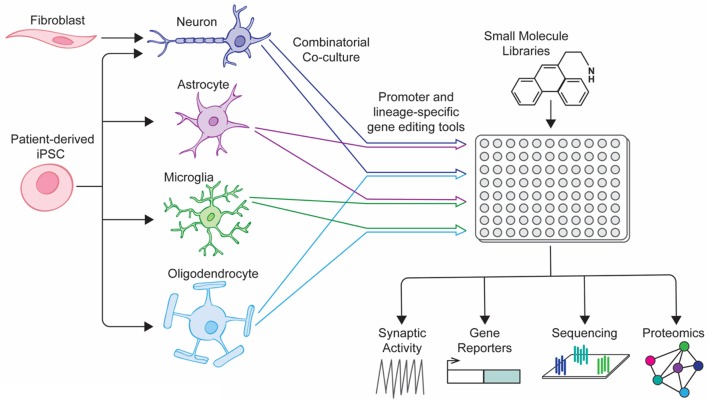
Current applications of human induced pluripotent stem cell (hiPSC) technologies in patient-specific models of neurodegenerative and neuropsychiatric disorders tend to focus on neuronal phenotypes. Here, we review recent efforts toward advancing hiPSCs toward non-neuronal cell types of the central nervous system (CNS) and highlight their potential use for the development of more complex models of neurodevelopment and disease. We present evidence from previous works in both rodents and humans of the importance of these cell types (oligodendrocytes, microglia, astrocytes) in neurological disease and highlight new hiPSC-based models that have sought to explore these relationships . Lastly, we summarize efforts toward conducting high-throughput screening experiments with hiPSCs and propose methods by which new screening platforms could be designed to better capture complex relationships between neural cell populations in health and disease.
人类诱导多能干细胞(hiPSC)技术目前在神经退行性疾病和神经精神疾病的患者特异性模型中的应用往往集中在神经元表型上。在此,我们综述了将hiPSC推进到中枢神经系统(CNS)非神经元细胞类型方面的最新研究成果,并强调了它们在开发更复杂的神经发育和疾病模型中的潜在用途。我们展示了先前在啮齿动物和人类研究中关于这些细胞类型(少突胶质细胞、小胶质细胞、星形胶质细胞)在神经疾病中的重要性的证据,并突出了旨在探索这些关系的基于hiPSC的新模型。最后,我们总结了使用hiPSC进行高通量筛选实验的研究成果,并提出了设计新筛选平台的方法,以便更好地捕捉健康和疾病状态下神经细胞群体之间的复杂关系。