Chang Audrey N, Greenfield Norma J, Singh Abhishek, Potter James D, Pinto Jose R
Department of Molecular and Cellular Pharmacology, Leonard Miller School of Medicine, University of Miami Miami, FL, USA.
Department of Neuroscience and Cell Biology, Robert Wood Johnson Medical School, Rutgers University New Jersey, NJ, USA.
Front Physiol. 2014 Dec 2;5:460. doi: 10.3389/fphys.2014.00460. eCollection 2014.
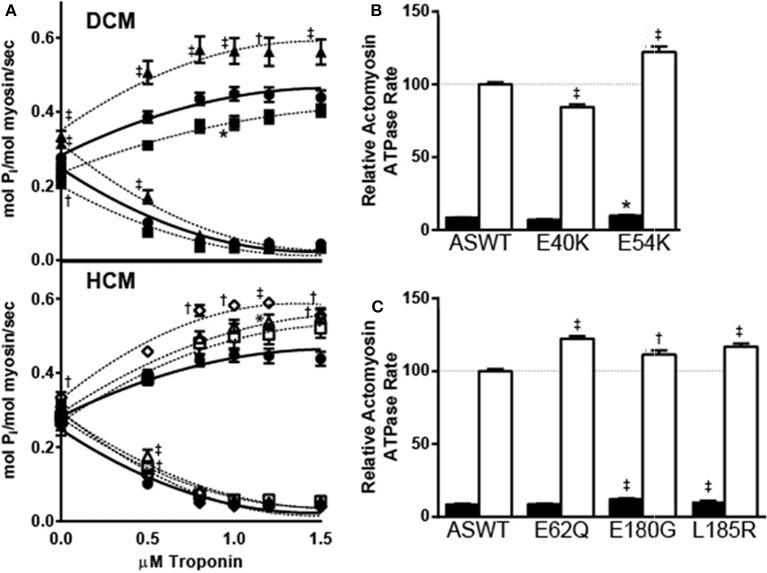
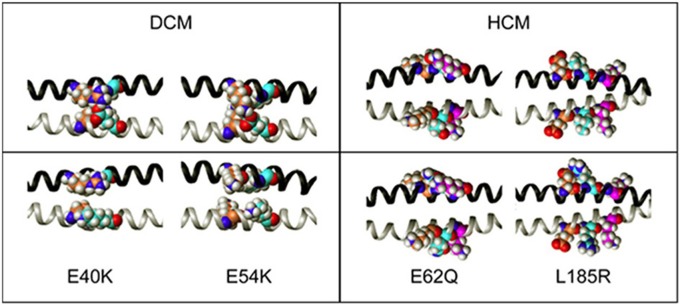
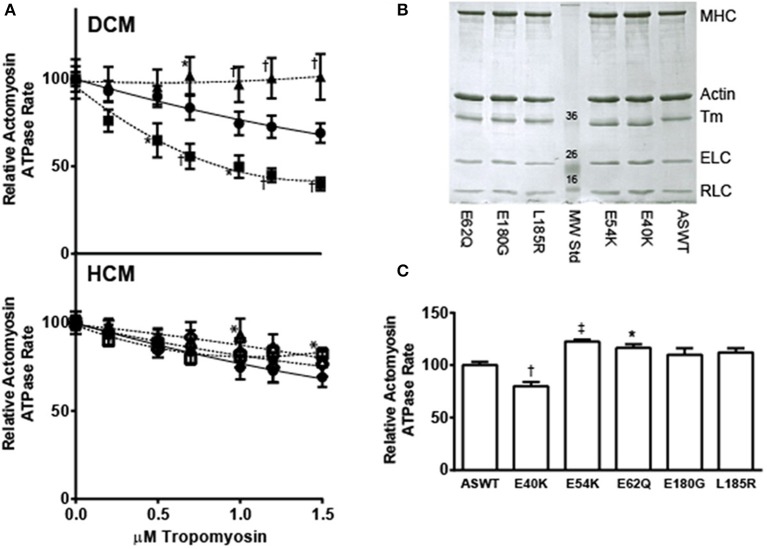
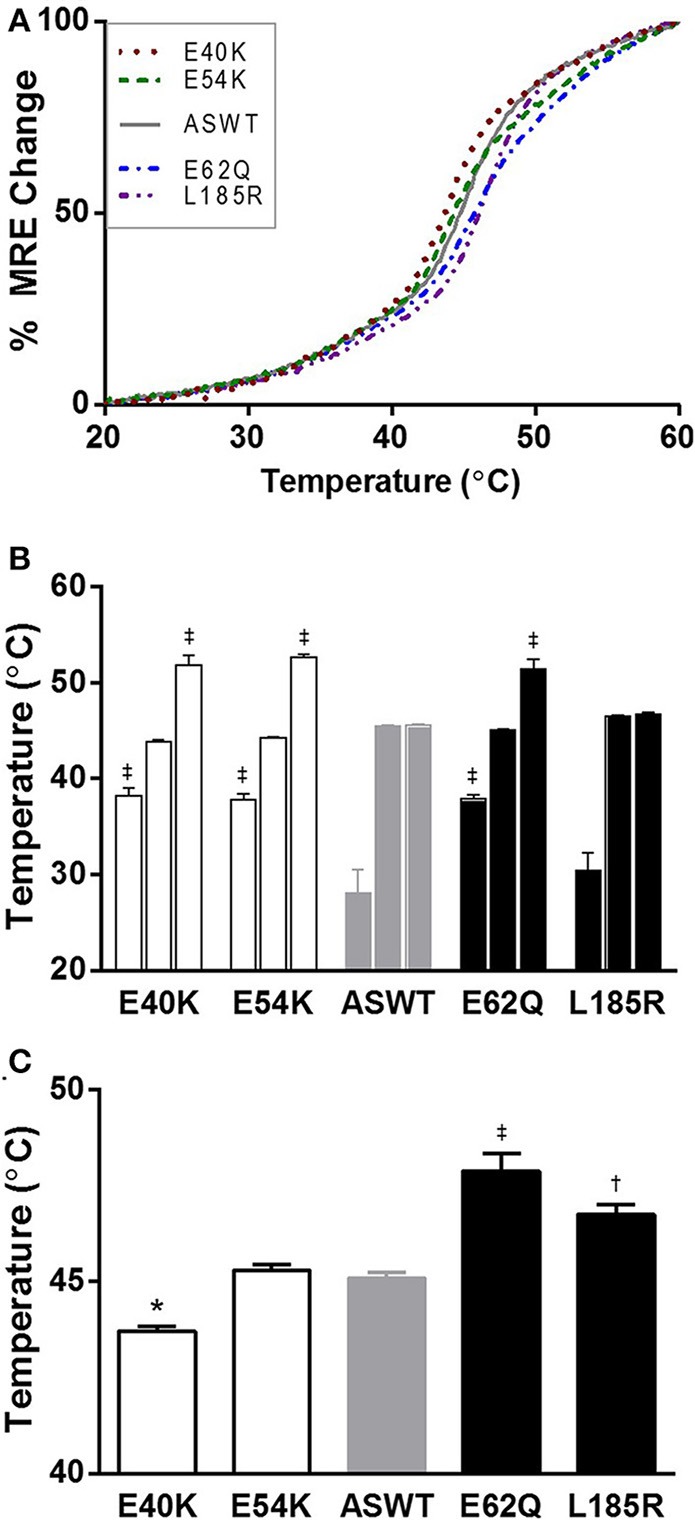
The potential alterations to structure and associations with thin filament proteins caused by the dilated cardiomyopathy (DCM) associated tropomyosin (Tm) mutants E40K and E54K, and the hypertrophic cardiomyopathy (HCM) associated Tm mutants E62Q and L185R, were investigated. In order to ascertain what the cause of the known functional effects may be, structural and protein-protein interaction studies were conducted utilizing actomyosin ATPase activity measurements and spectroscopy. In actomyosin ATPase measurements, both HCM mutants and the DCM mutant E54K caused increases in Ca(2+)-induced maximal ATPase activities, while E40K caused a decrease. Investigation of Tm's ability to inhibit actomyosin ATPase in the absence of troponin showed that HCM-associated mutant Tms did not inhibit as well as wildtype, whereas the DCM associated mutant E40K inhibited better. E54K did not inhibit the actomyosin ATPase activity at any concentration of Tm tested. Thermal denaturation studies by circular dichroism and molecular modeling of the mutations in Tm showed that in general, the DCM mutants caused localized destabilization of the Tm dimers, while the HCM mutants resulted in increased stability. These findings demonstrate that the structural alterations in Tm observed here may affect the regulatory function of Tm on actin, thereby directly altering the ATPase rates of myosin.
研究了由扩张型心肌病(DCM)相关的原肌球蛋白(Tm)突变体E40K和E54K,以及肥厚型心肌病(HCM)相关的Tm突变体E62Q和L185R引起的结构改变及其与细肌丝蛋白的关联。为了确定已知功能效应的原因,利用肌动球蛋白ATP酶活性测量和光谱学进行了结构和蛋白质-蛋白质相互作用研究。在肌动球蛋白ATP酶测量中,HCM突变体和DCM突变体E54K均导致Ca(2+)诱导的最大ATP酶活性增加,而E40K则导致活性降低。在没有肌钙蛋白的情况下对Tm抑制肌动球蛋白ATP酶能力的研究表明,与HCM相关的突变体Tm的抑制作用不如野生型,而与DCM相关的突变体E40K的抑制作用更好。在任何测试的Tm浓度下,E54K均未抑制肌动球蛋白ATP酶活性。通过圆二色性进行的热变性研究以及Tm突变的分子建模表明,总体而言,DCM突变体导致Tm二聚体局部不稳定,而HCM突变体则导致稳定性增加。这些发现表明,此处观察到的Tm结构改变可能会影响Tm对肌动蛋白的调节功能,从而直接改变肌球蛋白的ATP酶速率。