Brito Natalie H, Grenell Amanda, Barr Rachel
Robert Wood Johnson Foundation Health and Society Scholars, Columbia University in the City of New York New York, NY, USA.
Department of Psychology, Georgetown University Washington, DC, USA.
Front Psychol. 2014 Dec 2;5:1369. doi: 10.3389/fpsyg.2014.01369. eCollection 2014.
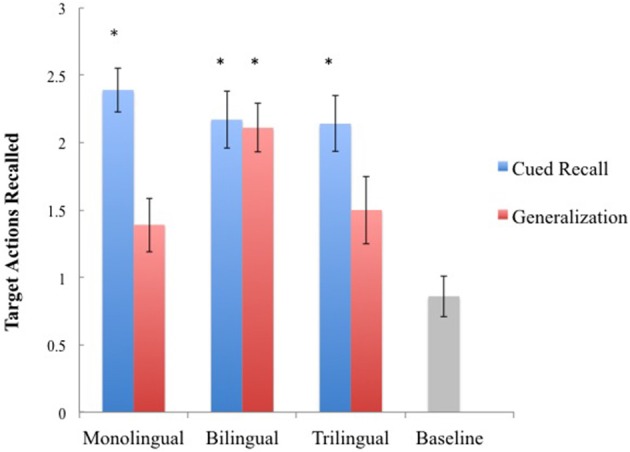
The specificity of the bilingual advantage in memory was examined by testing groups of monolingual, bilingual, and trilingual 24-month-olds on tasks tapping cued recall, memory generalization and working memory. For the cued recall and memory generalization conditions, there was a 24-h delay between time of encoding and time of retrieval. In addition to the memory tasks, parent-toddler dyads completed a picture-book reading task, in order to observe emotional responsiveness, and a parental report of productive vocabulary. Results indicated no difference between language groups on cued recall, working memory, emotional responsiveness, or productive vocabulary, but a significant difference was found in the memory generalization condition with only the bilingual group outperforming the baseline control group. These results replicate and extend results from past studies (Brito and Barr, 2012, 2014; Brito et al., 2014) and suggest a bilingual advantage specific to memory generalization.
通过对单语、双语和三语的24个月大婴儿组进行线索回忆、记忆泛化和工作记忆任务测试,研究了双语记忆优势的特异性。在线索回忆和记忆泛化条件下,编码时间和检索时间之间有24小时的延迟。除了记忆任务外,亲子二元组还完成了绘本阅读任务,以观察情绪反应,并进行了生产性词汇的家长报告。结果表明,在线索回忆、工作记忆、情绪反应或生产性词汇方面,语言组之间没有差异,但在记忆泛化条件下发现了显著差异,只有双语组的表现优于基线对照组。这些结果重复并扩展了过去研究(Brito和Barr,2012年、2014年;Brito等人,2014年)的结果,并表明了双语在记忆泛化方面的特异性优势。