Department of Biological Sciences, University of Alberta, Edmonton, Alberta T6G 2E9 Canada.
Department of Biological Sciences, University of Alberta, Edmonton, Alberta T6G 2E9 Canada ; Department of Biometry and Environmental System Analysis, University of Freiburg, Freiburg, 79106 Germany.
Mov Ecol. 2014 Feb 7;2(1):4. doi: 10.1186/2051-3933-2-4. eCollection 2014.
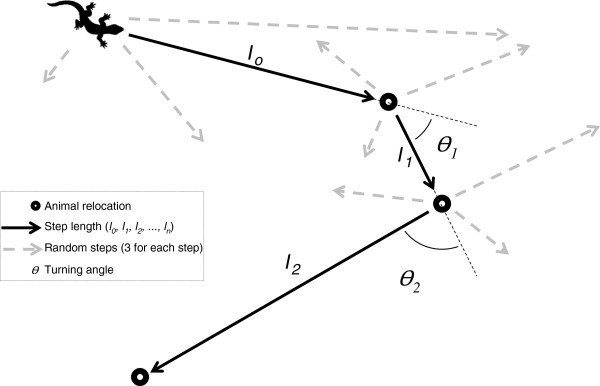
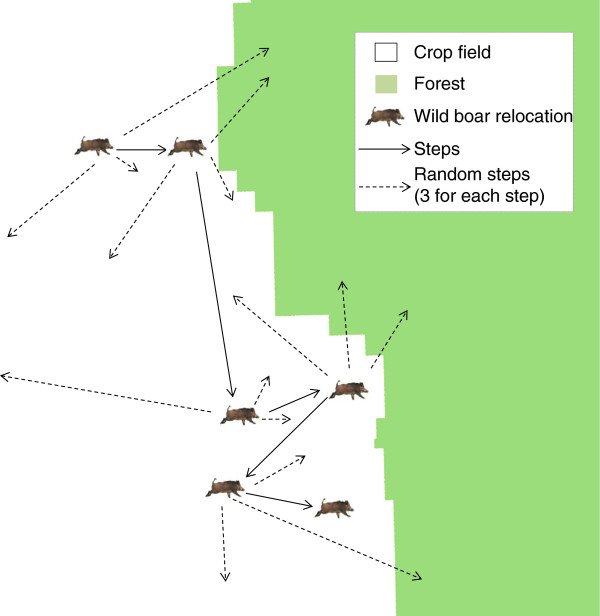
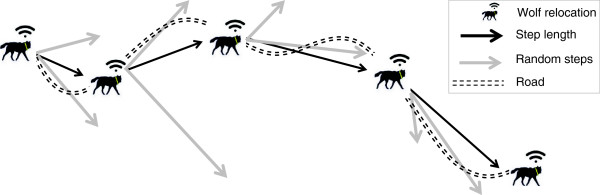
Recent progress in positioning technology facilitates the collection of massive amounts of sequential spatial data on animals. This has led to new opportunities and challenges when investigating animal movement behaviour and habitat selection. Tools like Step Selection Functions (SSFs) are relatively new powerful models for studying resource selection by animals moving through the landscape. SSFs compare environmental attributes of observed steps (the linear segment between two consecutive observations of position) with alternative random steps taken from the same starting point. SSFs have been used to study habitat selection, human-wildlife interactions, movement corridors, and dispersal behaviours in animals. SSFs also have the potential to depict resource selection at multiple spatial and temporal scales. There are several aspects of SSFs where consensus has not yet been reached such as how to analyse the data, when to consider habitat covariates along linear paths between observations rather than at their endpoints, how many random steps should be considered to measure availability, and how to account for individual variation. In this review we aim to address all these issues, as well as to highlight weak features of this modelling approach that should be developed by further research. Finally, we suggest that SSFs could be integrated with state-space models to classify behavioural states when estimating SSFs.
最近定位技术的进展使得人们能够大规模地收集动物的连续空间数据。这为研究动物的运动行为和栖息地选择带来了新的机遇和挑战。步长选择函数(SSFs)等工具是研究通过景观移动的动物对资源选择的相对较新的强大模型。SSFs 将观察到的步长(两个连续位置观测之间的线性段)的环境属性与从同一起点随机采取的替代步长相比较。SSFs 已被用于研究栖息地选择、人与野生动物的相互作用、运动走廊和动物的扩散行为。SSFs 还有可能在多个时空尺度上描述资源选择。SSFs 还有一些方面尚未达成共识,例如如何分析数据,何时应在线性观测之间而不是在观测端点考虑沿线性路径的栖息地协变量,应考虑多少随机步长来衡量可用性,以及如何考虑个体变异。在本次综述中,我们旨在解决所有这些问题,并强调这种建模方法的薄弱环节,这些环节应通过进一步的研究加以发展。最后,我们建议将 SSFs 与状态空间模型集成,以便在估计 SSFs 时对行为状态进行分类。