Whelan J, Poon D, Weil P A, Stein R
Department of Molecular Physiology and Biophysics, Vanderbilt University School of Medicine, Nashville, Tennessee 37232-0615.
Mol Cell Biol. 1989 Aug;9(8):3253-9. doi: 10.1128/mcb.9.8.3253-3259.1989.
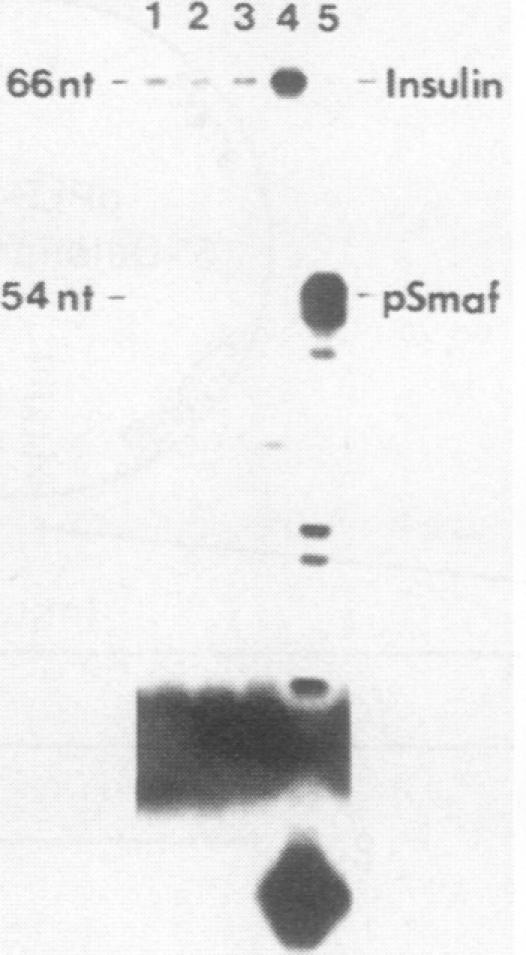
The insulin gene is expressed almost exclusively in pancreatic beta-cells. The DNA sequences that control cell-specific expression are located upstream of the transcription initiation site. To identify the cis-acting transcriptional control regions within the rat insulin II gene that are responsible for this tissue-specific expression pattern, we constructed a series of 5'-flanking deletion mutants and analyzed their expression in vivo in transfected insulin-producing and -nonproducing cell lines. Pancreatic beta-cell-specific expression was shown to be controlled by enhancer sequences lying between nucleotides -342 and -91 relative to the transcription start site. The rat insulin II enhancer appears to be a chimera, composed of a number of distinct cis-acting DNA elements. Both positive and negative transcriptional regulatory elements appear to be responsible for this cell-type-specific expression. We have shown that expression from one element within the enhancer, which is found between nucleotides -100 and -91, is regulated by both positive- and negative-acting cellular transcription factors. Expression from chimeras containing only the enhancer element sequences from -100 to -91 were active only in insulin-producing cells, indicating that the positive-acting factor(s) required for this activity may be active only in beta-cells. In contrast to the enhancer region, the rat insulin II gene promoter did not appear to require cell-specific transcription factors. Promoter mutants with 5'-flanking sequences extending to nucleotides -90 and -73 were constitutively active in both insulin-producing and -nonproducing cells. These results suggest that rat insulin II gene transcription in pancreatic beta-cells is imparted by a combination of both negative- and positive-acting cellular factors interacting with the gene enhancer.
胰岛素基因几乎只在胰腺β细胞中表达。控制细胞特异性表达的DNA序列位于转录起始位点的上游。为了鉴定大鼠胰岛素II基因中负责这种组织特异性表达模式的顺式作用转录控制区域,我们构建了一系列5'侧翼缺失突变体,并分析了它们在转染的胰岛素产生细胞系和非产生细胞系中的体内表达情况。胰腺β细胞特异性表达显示受相对于转录起始位点核苷酸-342至-91之间的增强子序列控制。大鼠胰岛素II增强子似乎是一种嵌合体,由许多不同的顺式作用DNA元件组成。正向和负向转录调节元件似乎都负责这种细胞类型特异性表达。我们已经表明,增强子中位于核苷酸-100至-91之间的一个元件的表达受正向和负向作用的细胞转录因子调控。仅包含-100至-91的增强子元件序列的嵌合体的表达仅在胰岛素产生细胞中具有活性,这表明这种活性所需的正向作用因子可能仅在β细胞中具有活性。与增强子区域相反,大鼠胰岛素II基因启动子似乎不需要细胞特异性转录因子。5'侧翼序列延伸至核苷酸-90和-73的启动子突变体在胰岛素产生细胞和非产生细胞中均具有组成型活性。这些结果表明,胰腺β细胞中大鼠胰岛素II基因的转录是由与基因增强子相互作用的负向和正向作用细胞因子共同作用产生的。